
The Day the Deep Sea Changed How I See Life 🌊
Like many people in Europe and North America, I grew up believing a simple truth about life on Earth:
no sunlight means no life.
Plants need light. Animals need plants. End of story.
Or so I thought—until I learned about deep-sea tube worms.
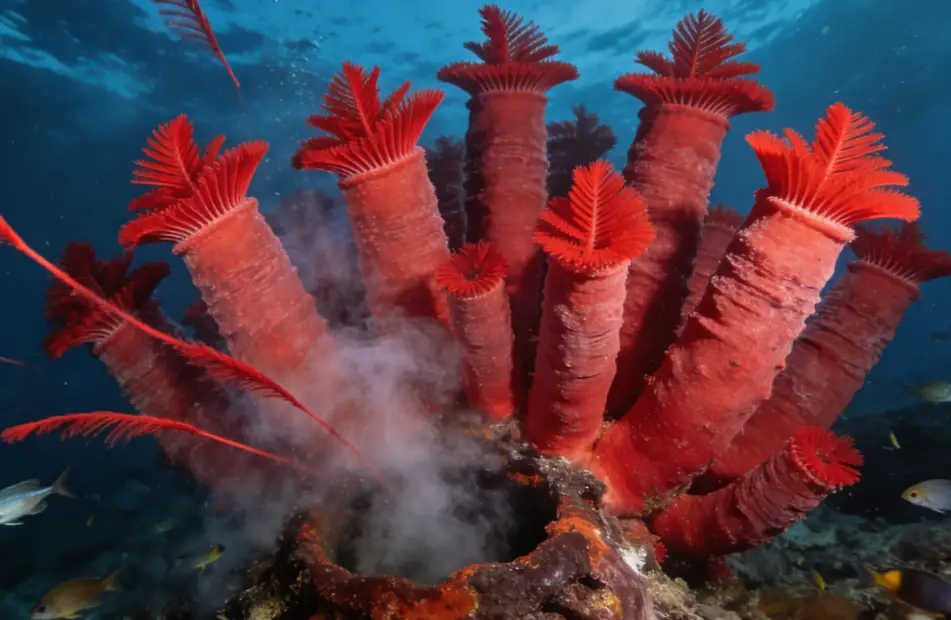
These strange, crimson-tipped creatures live nearly two kilometers below the ocean’s surface, in a world of crushing pressure, toxic chemicals, and total darkness. They have no mouth, no stomach, no eyes, and yet they thrive—forming entire ecosystems where sunlight has never existed.
The first time I encountered tube worms in a documentary about hydrothermal vents, I felt something shift inside me. They weren’t just odd animals. They were a direct challenge to everything I thought I knew about life.
This article is my attempt to share that sense of wonder—and to explain why deep-sea tube worms matter far beyond the ocean floor.
What Exactly Is a Deep-Sea Tube Worm? 🧬
When most Western readers hear “worm,” they imagine something small, slimy, and frankly unpleasant.
Deep-sea tube worms are none of those things.
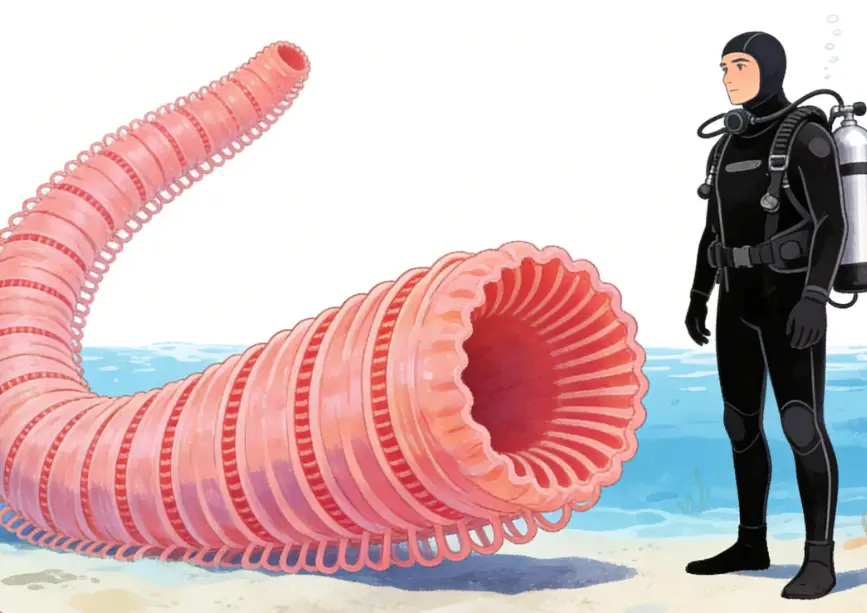
The most famous species, Riftia pachyptila, can grow over 2 meters (6 feet) long. They live inside rigid white tubes made of chitin, anchored to the seabed near hydrothermal vents—cracks in Earth’s crust that release superheated, mineral-rich fluids.
Key characteristics at a glance:
- 🪱 No mouth or digestive system
- ❤️ Bright red plume (not blood—more on that later)
- 🌡️ Lives near water exceeding 350°C (660°F)
- 🌑 Complete darkness
- 🧪 Depends on chemical energy, not sunlight
Already, they sound like science fiction.
The Extreme World of Hydrothermal Vents 🌋
To understand tube worms, we need to understand where they live.
What are hydrothermal vents?
Hydrothermal vents form where tectonic plates pull apart. Seawater seeps down, gets superheated by magma, absorbs minerals and chemicals (like hydrogen sulfide), and then erupts back into the ocean.
The environment around these vents is:
- 💥 Chemically toxic
- 🧱 Under immense pressure
- ❄️ Near freezing just meters away
- 🌑 Permanently dark
For a long time, scientists assumed nothing could survive there.
They were wrong.
A Discovery That Shook Western Science 🧠
In 1977, a U.S. research expedition using the submersible Alvin descended to the Galápagos Rift.
What they found changed biology forever.
Instead of barren rock, the scientists saw dense colonies of giant tube worms, clams, crabs, and shrimp—an entire ecosystem, completely independent of sunlight.
This discovery forced a rewrite of biology textbooks across Europe and North America.
Life, it turned out, does not require the Sun.
How Do Tube Worms Survive Without Eating? 🤯
Here’s where things get truly fascinating.
Deep-sea tube worms survive through a process called chemosynthesis—a biological alternative to photosynthesis.
The secret weapon: Symbiotic bacteria 🦠
Inside the tube worm’s body is a specialized organ called a trophosome, packed with billions of bacteria.
These bacteria:
- Use hydrogen sulfide from vent fluids
- Combine it with oxygen
- Produce organic molecules (food) for the worm
The worm, in return:
- Supplies bacteria with chemicals via its blood
- Protects them inside its body
It’s a perfect partnership—one of the most elegant examples of symbiosis we know.
Why Is the Tube Worm’s Plume Bright Red? ❤️
That iconic red plume isn’t decorative—it’s functional.
Tube worm blood contains a unique form of hemoglobin that can bind both oxygen and hydrogen sulfide at the same time—something toxic to most animals.
This adaptation allows tube worms to transport chemicals to their bacteria without poisoning themselves.
From an evolutionary standpoint, it’s astonishing.
Tube Worms and the Redefinition of Life 🌌
For Western scientists, tube worms didn’t just expand marine biology—they expanded philosophy.
They forced us to ask:
- What is life?
- Where can life exist?
- Could life exist on other planets?
If ecosystems can thrive without sunlight on Earth, then perhaps Europa, Enceladus, or Mars might host similar life forms.
NASA astrobiologists study tube worms not because they’re weird—but because they’re relevant to the search for extraterrestrial life 🚀.
Are Tube Worms Endangered? ⚠️
Surprisingly, yes.
While tube worms live far from human eyes, they are not beyond human impact.
Major threats include:
- 🛢️ Deep-sea mining
- ⛏️ Seabed resource extraction
- 🌡️ Climate-driven ocean chemistry changes
- 🧪 Pollution reaching the deep ocean
Because vent ecosystems are slow to recover, even small disturbances can cause irreversible damage.
Why Should Western Readers Care? 🌍
It’s easy to dismiss deep-sea creatures as irrelevant to daily life in Europe or North America.
But tube worms matter because they:
- Redefine biological limits
- Inspire medical and biochemical research
- Inform climate science
- Shape our understanding of Earth’s resilience
- Help guide space exploration
Most importantly, they remind us of something profoundly humbling:
👉 We do not fully understand our own planet.
What Tube Worms Taught Me Personally 💭
Learning about deep-sea tube worms changed how I see life—not just in oceans, but everywhere.
They taught me that:
- Life is more adaptable than we imagine
- “Impossible” often just means “undiscovered”
- Nature doesn’t follow our rules
In a time when Western society often focuses on control, efficiency, and certainty, tube worms offer a different lesson: adaptation, cooperation, and quiet resilience.
Life Finds a Way 🪐
Deep beneath the waves, in absolute darkness, life flourishes—not because conditions are kind, but because evolution is creative.
The next time you look up at the night sky or think about life beyond Earth, remember the tube worms.
They’re living proof that life doesn’t just survive—it innovates.
And sometimes, the most important discoveries are the ones we never expected to find.
Leave a Reply