
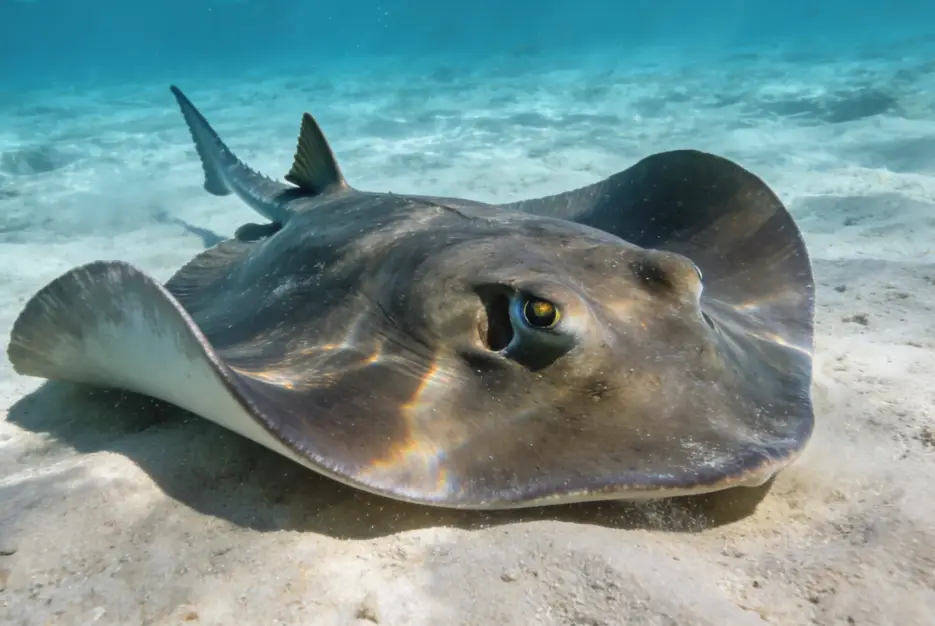
The First Time I Met an Electric Ray
The first time I encountered an electric ray, I was waist‑deep in the cold Atlantic, somewhere off the coast of southern Europe. The sea looked calm, almost boring, until the sand beneath my boots seemed to come alive. A flat, disc‑shaped animal lifted itself slightly, revealed two curious eyes, and then vanished again as if the ocean had swallowed it whole.
Later that day, a local fisherman smiled and said, “You’re lucky you didn’t touch it.” He didn’t say that because it was aggressive—electric rays are not. He said it because I had just met one of the most fascinating animals in the ocean: a fish that can produce electricity.
Electric rays, known in English as electric rays or torpedo rays, are living proof that nature often beats human technology by millions of years. In this article, I want to take you—fellow Western readers—on a deep dive into their biology, history, and cultural impact, using the lens of modern marine science and storytelling.
What Exactly Is an Electric Ray?
Electric rays belong to the order Torpediniformes, a group of cartilaginous fishes closely related to sharks and stingrays. Like their cousins, they have skeletons made of cartilage rather than bone.
What makes them special is their ability to generate powerful electric discharges, sometimes exceeding 200 volts, depending on the species. That’s enough to stun prey—and occasionally surprise careless humans.
Basic Characteristics
- Flat, round or oval body
- Soft skin (no stinging barb like stingrays)
- Large pectoral fins fused to the head
- Eyes and spiracles located on top of the body
- Mouth and gill slits on the underside
Despite their intimidating ability, electric rays are slow swimmers and generally shy. They rely on camouflage and electricity rather than speed or aggression.
How Do Electric Rays Produce Electricity? ⚡
This is where electric rays become truly mind‑blowing.
Inside their bodies, electric rays have specialized organs called electric organs, derived from modified muscle cells known as electrocytes. These cells don’t contract like muscles. Instead, they act like tiny biological batteries.
When an electric ray decides to discharge:
- The brain sends a signal
- Thousands of electrocytes activate simultaneously
- Their combined electrical potential is released in a single pulse
Think of it as a natural power grid—except it evolved long before humans even existed.
Why Electricity?
Electric rays use electricity for three main purposes:
- Hunting: Stunning or paralyzing fish and invertebrates
- Defense: Deterring predators like sharks
- Navigation & sensing: Detecting prey hidden under sand
From an evolutionary perspective, electricity is an incredibly efficient solution for a slow‑moving predator.
A Short History: Electric Rays and Human Curiosity
As a Westerner, I find it fascinating that electric rays have been part of European scientific thought for over 2,000 years.
Ancient Greece and Rome
- Aristotle described electric rays in his biological writings
- Roman physicians used them to treat headaches and gout
- Patients were instructed to stand on living electric rays to receive shocks
Yes—this was one of the earliest forms of electrotherapy.
Enlightenment and Modern Science
In the 18th century, European scientists began to study electric rays seriously. Their observations directly influenced the invention of:
- Early batteries
- Electrical circuits
- Modern neurobiology
In a very real sense, electric rays helped inspire the electrical age ⚙️.
Species Diversity: Not All Electric Rays Are the Same
There are more than 60 known species of electric rays worldwide, found in temperate and tropical oceans.
Commonly Known Species
- Atlantic torpedo (Torpedo nobiliana) – One of the most powerful
- Common torpedo (Torpedo torpedo) – Found in the Mediterranean
- Pacific electric ray (Tetronarce californica) – Common along the US West Coast
Sizes range from small dinner‑plate‑sized species to giants over 1.8 meters (6 feet) long.
Where Do Electric Rays Live?
Electric rays are bottom‑dwellers. If you’re imagining coral reefs full of color, think instead of:
- Sandy seabeds
- Muddy coastal waters
- Continental shelves
They often bury themselves under sediment, leaving only their eyes visible. This ambush lifestyle pairs perfectly with electric hunting.
As someone who has dived in both the Mediterranean and the Pacific, I can say this: you don’t see electric rays unless they want you to.
Are Electric Rays Dangerous to Humans?
This is the question I get asked most often.
The Short Answer
They are not aggressive, but they should be respected.
Electric shocks from larger species can be painful and disorienting, especially underwater. However:
- No verified human deaths
- Rare incidents
- Usually caused by accidental contact
Most shocks happen when people step on a buried ray or try to handle one.
Safety Tips (Western Diving Standards)
- Never touch marine animals
- Shuffle your feet in sandy areas
- Observe from a distance
- Educate, don’t provoke
In modern Western marine ethics, respect always comes before curiosity.
Electric Rays vs. Electric Eels: Clearing the Confusion
Despite popular belief, electric rays are not electric eels.
| Feature | Electric Rays | Electric Eels |
|---|---|---|
| Habitat | Ocean | Freshwater rivers |
| Body shape | Flat | Elongated |
| Taxonomy | Cartilaginous fish | Bony fish |
| Evolution | Rays & sharks | Knifefish |
They evolved electricity independently, which is a classic example of convergent evolution—a concept well known in Western biology education.
Reproduction and Life Cycle
Electric rays reproduce via ovoviviparity, meaning:
- Eggs develop inside the mother
- Embryos hatch internally
- Live young are born fully formed
This strategy offers better survival rates but limits the number of offspring, making populations vulnerable to overfishing.
Conservation Status: Why Electric Rays Matter 🌍
Many electric ray species are currently listed as:
- Vulnerable
- Near threatened
- Data deficient
The main threats include:
- Bottom trawling
- Habitat destruction
- Bycatch
From a Western conservation perspective, electric rays are not just “interesting”—they are indicator species. Their decline signals deeper problems in marine ecosystems.
Why Electric Rays Still Inspire Modern Science
Even today, electric rays contribute to research in:
- Neuroscience
- Bioelectric medicine
- Renewable energy concepts
- Robotics and biomimicry
When engineers talk about bio‑inspired design, electric rays are often part of the conversation.
Nature, once again, proves to be the greatest engineer of all 🧠⚡.
Respecting the Ocean’s Quiet Power
As someone raised in the Western scientific tradition, I was taught to separate emotion from observation. But standing above an electric ray, knowing it holds silent power beneath its skin, it’s impossible not to feel awe.
Electric rays remind us that:
- Intelligence isn’t always loud
- Power doesn’t need aggression
- Evolution finds solutions we haven’t imagined
The next time you think of electricity, remember—it didn’t start in a power plant. It started in the ocean.
If you enjoyed this deep dive into marine science, feel free to share, comment, or explore more ocean stories. The sea still has many secrets left to tell. 🌊
Leave a Reply