
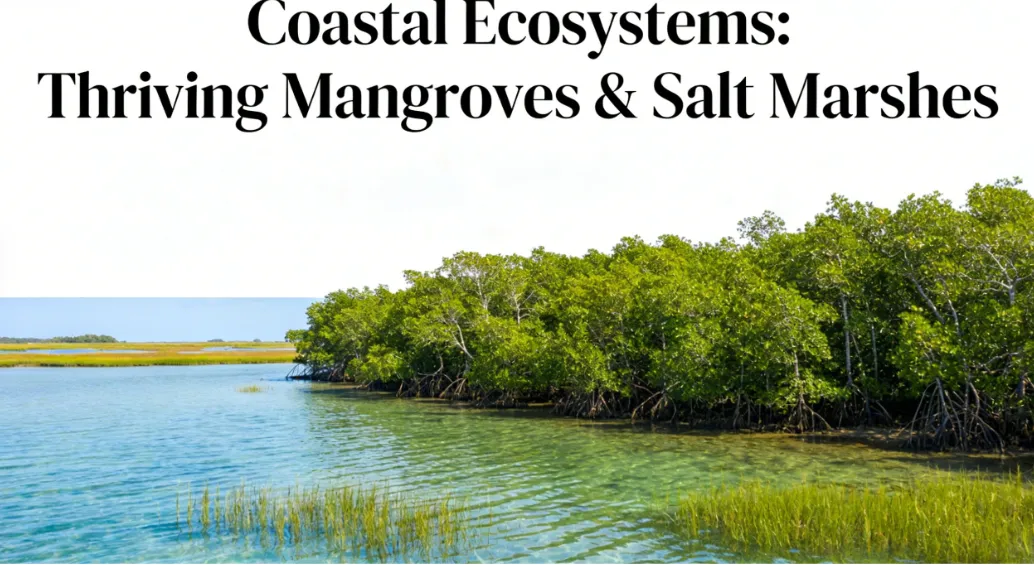
From boardrooms in New York and London to policy meetings in Brussels and climate forums across the globe, companies are racing to deliver on their net-zero promises. For years, the default playbook has centered on tropical reforestation, renewable energy investments, and industrial carbon capture. Yet a powerful, underutilized climate solution lies right at the ocean’s edge: mangroves, seagrass beds, and salt marshes — collectively known as blue carbon ecosystems.
What makes these coastal habitats truly extraordinary is their ability to sequester and store carbon at rates far exceeding even the most dense tropical rainforests. For forward-thinking businesses, funding the restoration and protection of these marine environments isn’t just an environmental gesture. It is a credible, verifiable pathway to generate high-quality carbon offsets, strengthen ESG performance, meet regulatory demands, and build lasting brand trust with Western consumers and investors.
In this article, I break down why blue carbon outperforms terrestrial forests, how companies can legally and transparently purchase carbon offsets through ocean restoration projects, and why this strategy will define corporate climate leadership in Europe and North America for decades to come.
The Science: Why Blue Carbon Beats Rainforests at Carbon Sequestration
When most people imagine Earth’s “lungs,” they picture the Amazon or the Congo Basin. But the data tells a different story. Coastal blue carbon ecosystems — mangroves, seagrasses, and salt marshes — cover less than 0.5% of the world’s ocean floor yet are responsible for more than 50% of all carbon stored in marine sediments.
Their superiority over tropical rainforests comes down to three defining advantages: sequestration speed, storage depth, and long-term stability.
1. Higher Per-Hectare Sequestration Rates
Studies consistently show that blue carbon habitats capture carbon 2 to 15 times faster than tropical rainforests on an equivalent area basis.
| Ecosystem | Annual Carbon Sequestration Rate | Long-Term Soil Carbon Storage |
|---|---|---|
| Mangroves | Up to 4x faster than tropical forests | Extremely high, often >1,000 tC/ha |
| Salt Marshes | 2–5x faster than temperate forests | Stable over millennia |
| Seagrass Beds | 2–10x faster than terrestrial grasslands | Dense, anoxic sediment storage |
| Tropical Rainforests | Moderate, mostly in above-ground biomass | Carbon released if deforested |
Unlike trees, which store most carbon in trunks, branches, and leaves — vulnerable to wildfire, logging, and disease — coastal plants pump carbon directly into waterlogged, oxygen-poor soils. This carbon does not easily decompose or escape back into the atmosphere.
2. Carbon Stored for Millennia, Not Decades
Rainforests hold carbon in living biomass. If a forest burns or is cleared, nearly all that stored carbon is immediately released. Blue carbon works differently.
Tidal flows continuously bury plant detritus, roots, and organic matter in thick, anaerobic mud. In these conditions, microbes cannot break down carbon efficiently. As a result:
- Carbon in mangrove and salt marsh soils can remain locked away for thousands of years
- Even if above-ground vegetation is damaged, the underground carbon pool remains largely intact
- Erosion and sea-level rise can actually increase carbon burial over time
This makes blue carbon one of the most permanent natural climate solutions available to businesses.
3. Co-Benefits That Resonate With Western Stakeholders
For European and North American companies, carbon reduction is no longer enough. Regulators, investors, and consumers demand holistic sustainability. Blue carbon projects deliver outsized secondary value:
- Coastal protection against storms and erosion
- Critical nurseries for commercial fish species
- Biodiversity conservation for birds, marine mammals, and invertebrates
- Improved water quality by filtering runoff
- Support for local coastal communities
In an era of CSRD (Corporate Sustainability Reporting Directive) in the EU and rising SEC climate disclosure rules in the U.S., these co-benefits turn a simple carbon offset into a high-impact ESG asset.
How Businesses Can Use Ocean Restoration to Generate Carbon Offsets
Funding blue carbon projects allows companies to generate verified carbon credits that directly offset hard-to-abate emissions from shipping, manufacturing, aviation, logistics, and data centers. Unlike unregulated “voluntary offsets” of the past, modern blue carbon credits follow strict international standards.
Below is a clear, practical framework for how Western companies can participate.
Step 1: Understand the Global Standards for Blue Carbon Offsets
Credibility is everything. The most widely accepted standards for blue carbon projects in Europe and North America are:
- Verra’s Verified Carbon Standard (VCS) — especially methodologies VM0007 for mangroves and VM0033 for tidal wetlands and seagrasses
- Climate, Community & Biodiversity (CCB) Standards — which ensure social and ecological integrity
- Gold Standard — increasingly used for high-integrity coastal restoration projects
These frameworks ensure:
- Additionality: emissions reductions would not have happened without the project
- Leakage prevention: carbon loss is not displaced elsewhere
- Permanent storage: long-term protection is legally enforced
- Third-party verification: independent auditors validate carbon calculations
Step 2: Select or Sponsor a Blue Carbon Project
Companies can engage in two main ways:
- Purchase existing verified carbon credits from already operating mangrove, seagrass, or salt marsh restoration projects
- Directly fund new restoration in exchange for a dedicated allocation of future carbon credits
Ideal projects for Western businesses include:
- Mangrove restoration in the Caribbean, West Africa, Southeast Asia, or Latin America
- Salt marsh rehabilitation along the U.S. East Coast, Gulf of Mexico, or North Sea
- Seagrass meadow recovery in the Mediterranean, Baltic, or Australian coastal zones
Projects that include local community governance and anti-deforestation agreements carry the strongest reputational value.
Step 3: Quantify, Verify, and Claim Carbon Offsets
Once a project is active, its carbon impact is calculated using:
- Soil core sampling to measure baseline and accumulated carbon
- Remote sensing and drone monitoring
- Long-term ecological surveys
Independent auditors then verify the carbon benefits. After verification, carbon credits (each equal to 1 tonne of CO₂e sequestered or protected) are issued.
For corporate accounting:
- Credits are retired to prevent double-counting
- Emissions reductions are reported in annual sustainability reports
- Offsets are applied toward scope 1, 2, and 3 net-zero targets
This process is fully recognized by the Science Based Targets initiative (SBTi), a critical point for European and U.S. corporations.
Step 4: Communicate Authentically to Western Audiences
European and North American consumers are increasingly skeptical of greenwashing. To build trust:
- Avoid vague claims like “carbon neutral”
- Specify the type of ecosystem: mangroves, salt marshes, or seagrasses
- Disclose the location, standard (Verra, CCB, etc.), and number of credits retired
- Highlight biodiversity and community benefits
Authenticity drives brand loyalty in the U.S. and EU markets far more than cheap, low-quality offsets.
Why Blue Carbon Is Becoming Essential for Western Corporate Climate Strategy
For businesses operating in North America and Europe, blue carbon is no longer a niche option — it is becoming a strategic necessity.
Regulatory Pressure Is Accelerating
- The EU’s Carbon Border Adjustment Mechanism (CBAM) penalizes high-emission imports
- CSRD mandates detailed public climate and biodiversity reporting
- U.S. states and the federal government are expanding emissions rules and incentives
- Investors increasingly exclude companies without credible net-zero plans
Blue carbon offsets provide a legitimate, auditable way to reduce reported emissions.
Reputational and Market Benefits
Consumers in the U.S., UK, EU, and Canada strongly prefer brands that invest in nature-positive solutions. Ocean restoration projects resonate emotionally: people connect with coasts, marine life, and climate resilience.
Companies that fund blue carbon projects can:
- Strengthen marketing narratives around sustainability
- Improve ESG ratings from MSCI, S&P, and Sustainalytics
- Access green financing and lower-interest loans
- Meet client and supply chain decarbonization requirements
Cost and Scalability
Compared to direct air capture (DAC) and many industrial carbon technologies, blue carbon projects are:
- More cost-effective
- Faster to implement
- Ecologically beneficial
- Scalable across global coastlines
For many mid-sized and large enterprises, this makes ocean restoration the most practical high-integrity offset available.
The Future of Blue Carbon: A Cornerstone of Corporate Net-Zero
As climate targets tighten and biodiversity loss becomes a central business risk, mangroves, seagrasses, and salt marshes will move from “hidden climate heroes” to central pillars of global climate policy.
For Western businesses, the choice is clear:
- Continue relying on traditional, sometimes controversial, forestry offsets
- Lead the market by investing in ocean restoration, with faster carbon sequestration, greater permanence, and stronger public support
Blue carbon isn’t just better for the planet. It’s better for business — especially in Europe and North America, where transparency, integrity, and ecological impact define corporate success.
By funding coastal restoration, companies aren’t just offsetting emissions. They are protecting coastlines, reviving ocean life, supporting communities, and building a defensible, future-proof net-zero strategy.
In the race to solve climate change, the ocean’s edge is where real progress begins.
Leave a Reply