
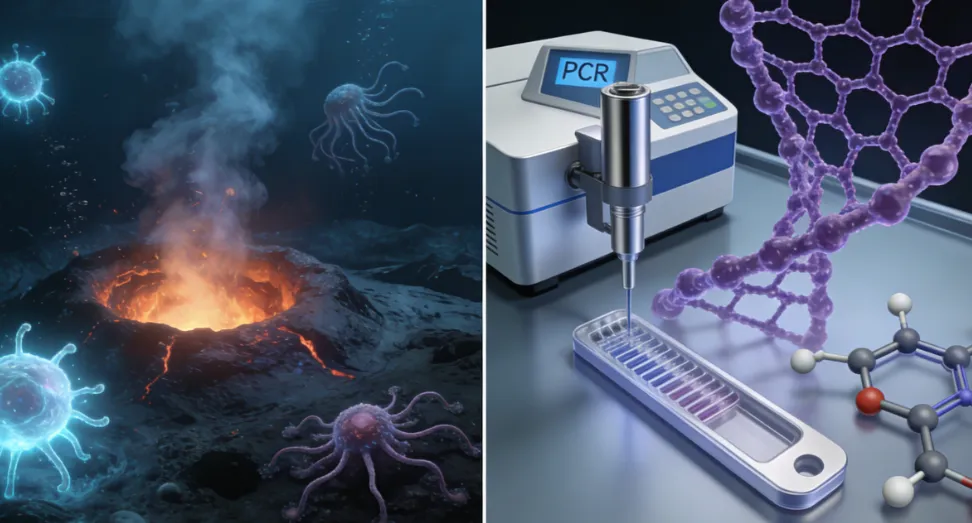
As a marine biotechnologist based in the U.S., I’ve spent over a decade exploring how organisms that thrive in the planet’s harshest environments—deep-sea hydrothermal vents, hyper-saline brines, and high-pressure dark trenches—can rewrite the rulebook for human health. What we’re learning isn’t just fascinating marine science: it’s a paradigm shift in molecular diagnostics and precision oncology.
Extremophiles, microorganisms that flourish where most life perishes, produce extremozymes—enzymes engineered by evolution to stay stable and active under extreme heat, pressure, salt, and pH. For Western researchers, clinicians, and biotech investors, these molecules represent a $100B+ opportunity to make tests faster, drugs more precise, and therapies more durable. In this deep dive, I break down the real-world science of how deep-sea extremozymes power next-generation PCR and are reshaping targeted cancer drug discovery and development.
What Are Deep-Sea Extremozymes, and Why Do They Matter?
The deep ocean isn’t a quiet desert—it’s a landscape of extreme conditions:
- Hydrothermal vents reaching 70–110°C
- Full ocean pressure up to 1,100 atmospheres
- Near-freezing cold in abyssal plains
- Hyper-saline anoxic brines and acidic vent fluids
To survive, extremophiles (mostly archaea and bacteria) evolved enzymes with unique structural traits:
- Tighter hydrophobic cores and more salt bridges to resist heat denaturation
- Flexible surface loops for pressure tolerance
- Enhanced ion coordination to function in high-salt environments
- Greater resistance to organic solvents and degradation
Unlike typical human or bacterial enzymes that break apart under stress, these biomolecules stay folded, functional, and specific—exactly what we need for demanding medical applications.
For Western biotech, this is more than academic: every major PCR test, cancer diagnostic panel, and targeted therapy pipeline now taps into extremozyme innovation. The market for extremolyte and extremozyme-based biotech is projected to surpass $12 billion by 2030, driven by diagnostics and pharma.
Part 1: How Deep-Sea Extremozymes Created Modern PCR
The story of PCR and extremozymes begins with a revolution in molecular biology. Before heat-stable polymerases, PCR required laborious manual re-dosing of enzyme after each heating cycle—slow, error-prone, and impractical for clinical use.
The Taq Revolution and Its Deep-Sea Successors
The game-changer was Taq polymerase, isolated from the thermophilic bacterium Thermus aquaticus in hot springs. While not strictly deep-sea, it proved that heat-stable extremozymes could automate PCR. Today’s next-generation polymerases come directly from deep-sea hydrothermal vent archaea:
- Pfu polymerase from hyperthermophilic archaea
- Deep-sea Pyrococcus and Methanocaldococcus species
- New-generation enzymes from Mariana Trench and East Pacific Rise vents
These deep-sea enzymes deliver transformative advantages for Western clinical labs:
Key Advantages in PCR & Real-Time Quantitative PCR (qPCR)
- Unmatched thermostabilitySurvive repeated 95°C denaturation steps without losing activity, enabling 30–40 PCR cycles in one automated run—standard for COVID-19, HPV, genetic carrier screening, and liquid biopsies.
- Higher fidelity & lower error ratesDeep-sea archaeal polymerases have built-in 3′→5′ exonuclease proofreading activity, cutting mutation rates up to 10-fold vs. Taq. Critical for cancer genotyping, NGS library prep, and forensic DNA testing.
- Resistance to inhibitorsFunction reliably in crude clinical samples (blood, saliva, tissue) where blood components, urea, or heparin would disable mesophilic enzymes. Reduces sample purification time and cost.
- High-pressure compatibilityStable under elevated pressures used in rapid microfluidic PCR devices, speeding point-of-care (POC) diagnostics in Western clinics and field testing.
Real-World Impact in the U.S. & EU
- Clinical diagnostics: Every major PCR test for infectious diseases, oncology biomarkers, and inherited disorders uses thermostable polymerases descended from extremophile discoveries.
- NGS library construction: Deep-sea polymerases enable high-throughput genome sequencing, powering personalized cancer panels across American and European hospitals.
- Point-of-care testing: Rugged extremozyme-based PCR devices deliver results in <30 minutes for urgent care and field epidemiology.
Without deep-sea extremozymes, the modern molecular diagnostics industry—worth over $114 billion globally—would not exist in its current form.
Part 2: Deep-Sea Extremozymes in Targeted Cancer Drug Development
For Western oncology researchers, the greatest promise lies in using extremozymes to discover, synthesize, and optimize targeted cancer drugs—therapies that attack cancer cells while sparing healthy tissue.
How Extremozymes Solve Critical Cancer Drug Challenges
Cancer drug development faces steep hurdles:
- Need for highly specific biocatalysts to make complex small molecules
- Harsh manufacturing conditions that degrade ordinary enzymes
- Drug resistance and off-target toxicity
- Demand for stable, long-lasting biologic therapies
Deep-sea extremozymes address all these pain points.
1. Biocatalytic Manufacturing of Targeted Cancer Drugs
Many targeted therapies (kinase inhibitors, antibody-drug conjugates/ADCs) require complex chiral synthesis. Deep-sea extremozymes act as precision green catalysts:
- Function at high temperatures to speed reactions
- Tolerate organic solvents used in pharmaceutical synthesis
- Generate ultra-pure chiral compounds with minimal side products
- Lower production costs and reduce toxic chemical waste
This aligns with U.S. and EU sustainability mandates while scaling production of high-cost personalized therapies.
2. Direct Anti-Cancer Activity & Selective Targeting
Several deep-sea extremozymes and their metabolites show inherent anti-tumor properties:
- L-glutaminases from hyper-thermophilic archaea selectively starve cancer cells by depleting glutamine, with lower liver toxicity than mesophilic versions.
- Proteases & nucleases from deep-sea halophiles induce apoptosis in tumor cells while sparing normal cells.
- Redox enzymes from pressure-tolerant microbes neutralize reactive oxygen species (ROS) that drive cancer progression and metastasis.
These molecules are being evaluated in U.S. and European preclinical pipelines for leukemia, breast, and pancreatic cancers.
3. Enabling Antibody-Drug Conjugates (ADCs) & Targeted Delivery
ADCs are one of the fastest-growing classes of cancer drugs. Extremozymes play two vital roles:
- Site-specific conjugation: Heat-stable ligases and proteases enable precise, controlled drug-linker attachment to antibodies, boosting efficacy and safety.
- Stable delivery platforms: Extremophile-derived protein scaffolds and membrane lipids protect ADCs from degradation in the bloodstream, extending half-life and improving tumor penetration.
4. Overcoming Drug Resistance
Deep-sea enzymes modify cancer-associated proteins and metabolites in ways that resensitize resistant cells to chemotherapy. They also support the development of dual-action targeted drugs that hit multiple cancer pathways simultaneously, a major focus of U.S. National Cancer Institute (NCI) research.
5. Cancer Diagnostic Biomarker Discovery
Thermostable extremozyme-based assays amplify and detect circulating tumor DNA (ctDNA) with unmatched sensitivity. This powers liquid biopsies—a cornerstone of Western precision oncology—for early detection, minimal residual disease (MRD) monitoring, and real-time treatment adjustment.
Structural Science: Why Deep-Sea Enzymes Outperform Ordinary Enzymes
From a molecular perspective, the superiority of deep-sea extremozymes lies in their evolved structure:
- Hyper-stable protein folding: Increased salt bridges, hydrogen bonds, and hydrophobic interactions prevent unfolding at high heat.
- Pressure adaptation: Flexible amino acid loops and compact cores resist compression at deep-sea pressures.
- Chaperone independence: Many function without helper proteins, simplifying recombinant production in E. coli and yeast systems used across U.S. biotech.
- Substrate specificity: Narrow active-site pockets reduce off-target reactions, critical for drug safety and diagnostic accuracy.
These structural features aren’t just laboratory curiosities—they’re the reason extremozyme-based drugs and tests are more reliable, scalable, and cost-effective.
Leading Research & Commercial Applications in the West
Major U.S. and European institutions are racing to translate deep-sea extremozyme science into products:
- NIH & NSF-funded deep-sea expeditions: Sampling hydrothermal vents to mine new polymerases and anti-cancer enzyme leads.
- Biotech startups: Developing next-gen PCR enzymes for point-of-care cancer testing.
- Pharmaceutical giants: Using extremozyme biocatalysts to streamline production of targeted kinase inhibitors and ADCs.
- Academic labs: Engineering semi-synthetic extremozymes with even greater stability and specificity via directed evolution.
Patent activity around deep-sea extremozymes has surged 300% in the last decade, reflecting their commercial and medical value.
The Future: What’s Next for Extremozymes in Medicine?
Looking ahead, deep-sea extremozymes will drive three transformative trends in Western healthcare:
- AI-powered enzyme discovery: Machine learning mining of metagenomic deep-sea data to identify novel cancer-fighting enzymes in months, not years.
- In-vivo extremozyme therapies: Engineered stable enzymes delivered directly to tumors to degrade cancer-specific proteins or activate prodrugs.
- Smart diagnostics: Integrated extremozyme-based PCR-NGS devices for single-test cancer screening and multi-biomarker monitoring.
- Sustainable pharma manufacturing: Green biocatalysis replacing harsh chemical processes, aligning with global ESG goals.
Long term, these molecules could help solve two of oncology’s biggest challenges: drug resistance and early detection.
Why This Matters for Every Reader
You don’t need a PhD in marine biology to appreciate this revolution:
- When you get a PCR-based COVID or STD test, you’re using an enzyme inspired by deep-sea life.
- If a family member undergoes cancer genotyping or receives an ADC, extremozymes likely played a role in drug development or testing.
- The next breakthrough in personalized cancer care may come from a microbe living 10,000 meters below the ocean surface.
Deep-sea extremophiles don’t just survive the abyss—they hold the keys to more accurate diagnostics, more effective cancer drugs, and a more sustainable pharmaceutical industry. For scientists, clinicians, and investors across the U.S. and Europe, this is one of the most exciting frontiers in modern medicine.
The ocean’s most extreme life isn’t just a biological wonder. It’s a treasure chest of molecules that are saving and improving lives every day.
Leave a Reply