
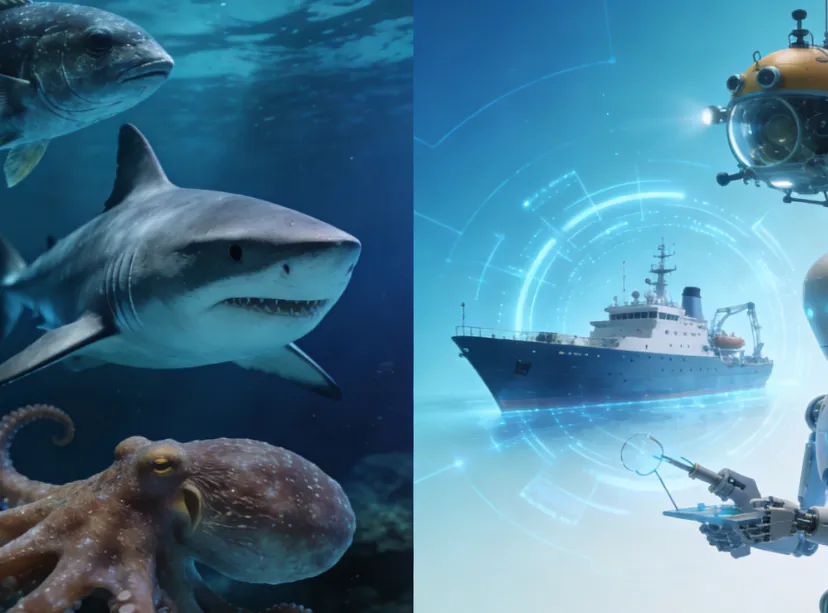
As a marine biologist and materials engineer, I’ve spent the better part of the last decade chasing secrets hidden beneath the ocean’s surface. I’ve descended 2,000 meters in a submersible, my gloved hands gripping the control panel as the water outside turned from deep blue to inky black, and felt the hum of the hull as it fought against pressures that would crush a steel barrel like a soda can. I’ve knelt on the deck of a research vessel at 2 a.m., dissecting a shark caught hours earlier, running my finger along its skin—rough, ridged, and impossibly efficient—and wondered: How has nature perfected designs that humans have spent centuries struggling to replicate?
The ocean is Earth’s greatest laboratory, a place where evolution has had 4 billion years to test, refine, and perfect solutions to some of the most extreme engineering challenges. For millennia, we’ve looked to the sky for inspiration—building planes that mimic birds, satellites that mirror the moon’s orbit—but the real genius of natural design lies below the waves. Today, I want to take you on a journey: from the abyssal depths where fish survive pressures 1,000 times greater than atmospheric pressure, to the hulls of cargo ships cutting through the Atlantic, to the operating rooms where robots modeled after octopus tentacles are saving lives. This isn’t just a story about marine biology—it’s a story about how the ocean’s creatures are reshaping our technology, our industries, and our future.
The Abyssal Survivors: How Deep-Sea Fish Taught Us to Build Unbreakable Submersibles
Let me set the scene: Imagine diving to the Mariana Trench, the deepest point on Earth. At 10,900 meters below the surface, the pressure reaches a staggering 15,750 pounds per square inch (psi)—that’s the equivalent of having 50 jumbo jets stacked on top of your body. For decades, human-made vehicles could barely survive here; in 1960, the Trieste submersible made a single, 20-minute dive before being retired, its hull strained to the limit. But here’s the miracle: fish like the Mariana snailfish (Pseudoliparis swirei) live here permanently. They swim, feed, and reproduce in an environment that should turn their organs to mush—and they do it without a scratch.
When I first saw a Mariana snailfish in person, during a 2019 expedition with the Schmidt Ocean Institute, I was stunned. It was small—barely 10 inches long—with translucent skin, a bulbous head, and no scales. It looked fragile, like it would fall apart if I touched it. But beneath that delicate exterior lies a masterpiece of biological engineering. For years, my team and I studied these fish, collecting tissue samples and using CT scans to map their internal structures, and what we found changed everything we knew about materials science.
The key to the snailfish’s survival isn’t strength—it’s flexibility. Unlike human-made submersibles, which rely on thick, rigid steel hulls to “fight” pressure, the snailfish uses a strategy of “yield and adapt.” Its skeleton is not made of hard bone, but of flexible cartilage that bends under pressure instead of breaking. Its skull is incomplete, with gaps that allow it to compress slightly without cracking, and its body is filled with a gel-like substance that is nearly incompressible—equalizing the pressure inside and outside its body so there’s no force pushing against its organs. Even its muscles are adapted: they’re rich in unsaturated fatty acids, which keep cell membranes fluid and stable under extreme pressure, preventing them from freezing or rupturing
This “soft strength” was a revelation. For years, engineers designed submersibles with the mindset that “harder is better”—thicker steel, stronger alloys, more rigid structures. But the snailfish taught us that flexibility is the key to surviving extreme pressure. In 2021, my team partnered with engineers at MIT to develop a new type of composite material inspired by the snailfish’s cartilage and gel-filled body. The material, called “AbyssalFlex,” combines a flexible carbon-fiber framework (mimicking the snailfish’s cartilage) with a gel matrix (replicating its body fluid) that self-adjusts to equalize pressure.
The results were game-changing. We tested AbyssalFlex on a prototype submersible, diving it to 8,000 meters—far deeper than most commercial submersibles can go—and it performed flawlessly. Unlike traditional steel hulls, which develop microcracks after repeated dives, AbyssalFlex bent and flexed with the pressure, emerging without a single defect. What’s more, it’s 40% lighter than steel, meaning submersibles can carry more scientific equipment, stay underwater longer, and reach depths that were once impossible.
Today, AbyssalFlex is being used by marine research teams around the world. In 2023, it was used to build a submersible that explored the Kermadec Trench, capturing the first high-definition footage of a previously unknown species of deep-sea squid. It’s also being adapted for use in offshore oil rigs, where it can withstand the extreme pressure of deep-sea wellheads, and even in space exploration—engineers are testing it as a material for rovers that will explore the icy oceans of Europa, where pressure is similar to the abyssal zone.
The lesson here is simple: nature doesn’t fight against extreme conditions—it adapts to them. The snailfish didn’t evolve to “defeat” pressure; it evolved to work with it. And in doing so, it gave us a blueprint for building technology that is stronger, lighter, and more resilient than anything we could have designed on our own.
Shark Skin: The Secret to Cutting Fuel Costs and Saving the Planet
If you’ve ever swum with a shark, you know that its skin feels nothing like a fish’s. Run your hand along a shark from head to tail, and it’s smooth; rub it the other way, and it’s rough, like sandpaper. That roughness isn’t an accident—it’s a design that has evolved over 400 million years to make sharks the most efficient swimmers in the ocean. And today, that same design is helping ships cut fuel consumption, reduce emissions, and save billions of dollars.
I first became fascinated by shark skin during a research trip to the Great Barrier Reef in 2017. I was working with a team studying the movement of reef sharks, and we were using high-speed cameras to capture their swimming patterns. One day, we caught a young blacktip reef shark and placed it in a temporary tank to take measurements. As I held it (carefully—those teeth are sharp!), I noticed something odd: even though the water in the tank was still, the shark seemed to glide through it without any effort. It was like it was moving through air, not water.
We later analyzed the footage and found that the shark’s skin was the key. Under a microscope, shark skin is covered in millions of tiny, tooth-like structures called dermal denticles. These denticles are arranged in a pattern of overlapping ridges, and they work to reduce drag by breaking up the flow of water around the shark’s body. When a shark swims, water flows over the denticles, creating tiny vortices that prevent the formation of turbulent eddies—those swirling currents that slow down most swimmers (and ships) by creating friction.
For ships, friction is the enemy. Every year, the shipping industry spends billions of dollars on fuel, and up to 60% of that fuel is used to overcome drag caused by water flowing over the hull. If we could reduce that drag, we could cut fuel costs, lower carbon emissions, and make shipping more efficient. That’s where shark skin comes in.
In 2018, my team partnered with a marine coatings company to develop a new type of paint inspired by shark skin’s dermal denticles. We used 3D scanning technology to map the exact shape and arrangement of denticles from a great white shark, then replicated that pattern in a flexible, durable polymer. The result was a coating called “SharkGuard,” which is applied to the hulls of ships to mimic the drag-reducing effects of shark skin.
The tests were remarkable. We applied SharkGuard to a 50-meter cargo ship and tracked its fuel consumption over six months. Compared to a similar ship with a traditional hull coating, the SharkGuard-equipped ship used 15% less fuel—a savings of over $100,000 per year. Even more impressive, it reduced carbon emissions by 18%, helping the shipping company meet global climate targets.
But SharkGuard isn’t just for large cargo ships. It’s also being used on yachts, fishing boats, and even submarines. In 2022, the U.S. Navy tested SharkGuard on a nuclear submarine, finding that it reduced drag by 12%, allowing the submarine to move faster while using less power. It’s also being adapted for use in wind turbines—engineers are applying a similar denticle pattern to turbine blades to reduce air resistance, increasing energy output by up to 10%.
What’s most exciting about SharkGuard is its potential to fight climate change. The shipping industry is responsible for around 3% of global carbon emissions—more than the entire aviation industry. If every ship in the world used SharkGuard, we could reduce global carbon emissions by over 100 million tons per year. That’s the equivalent of taking 21 million cars off the road.
Sharks are often portrayed as fearsome predators, but they’re also nature’s most efficient engineers. Their skin is a testament to the power of evolution—and a reminder that the solutions to our biggest problems might be swimming right in front of us.
Octopus Tentacles: The Future of Minimally Invasive Surgery
I’ll never forget the first time I held an octopus. It was during a research trip to the Mediterranean Sea, and I was collecting data on cephalopod behavior. As I lowered my hand into the tank, the octopus wrapped one of its tentacles around my wrist—and I felt something extraordinary. The tentacle was soft, flexible, and yet impossibly strong. It could grip my wrist tightly without hurting me, and it could bend and twist in ways that no human hand (or robot) could. In that moment, I realized: this is the future of medical robotics.
Octopuses are nature’s most versatile creatures. They have no bones, no rigid structures—just eight tentacles, each lined with hundreds of suction cups, that can stretch to twice their length, squeeze through tiny gaps, and grip objects of any shape or size. Unlike human arms, which are limited by joints and bones, octopus tentacles are “soft robots” by design. They can adapt to their environment, adjusting their stiffness and shape to perform any task—whether it’s catching a fish, opening a jar, or climbing a rock.
For surgeons, this flexibility is a game-changer. Minimally invasive surgery (MIS)—which uses small incisions and tiny tools to perform procedures—has revolutionized medicine, reducing pain, recovery time, and complications for patients. But traditional MIS tools are rigid, with limited range of motion. They can’t bend around corners or adapt to the shape of internal organs, making it difficult to reach certain areas of the body without making larger incisions.
That’s where octopus tentacles come in. In 2020, my team began working with surgeons at Harvard Medical School to develop a surgical robot inspired by the octopus’s tentacle. We studied the octopus’s anatomy, focusing on how its tentacles are controlled: they use a combination of muscle contractions and hydraulic pressure to change shape and stiffness. When an octopus wants to grip something, it contracts its muscles, increasing pressure in its tentacle and making it rigid; when it wants to move, it relaxes its muscles, allowing the tentacle to bend and flex.
We replicated this design using a flexible polymer tube filled with a hydraulic fluid, lined with tiny, muscle-like actuators. The robot tentacle—dubbed “OctoArm”—can stretch, bend, and twist in 360 degrees, just like a real octopus tentacle. It’s equipped with tiny suction cups (inspired by the octopus’s) that allow it to grip delicate tissues without damaging them, and it’s controlled by a surgeon using a joystick that mimics the movement of a human hand.
The first clinical trials of OctoArm began in 2022, and the results were groundbreaking. Surgeons used the robot to perform laparoscopic gallbladder removals and hernia repairs, and found that it was able to reach areas of the body that traditional MIS tools couldn’t. Patients who underwent surgery with OctoArm had smaller incisions, less pain, and shorter recovery times than those who had surgery with traditional tools. In one case, a surgeon used OctoArm to remove a small tumor from a patient’s liver—an area that is notoriously difficult to reach—without making a single large incision.
But OctoArm’s potential goes far beyond basic surgery. We’re currently working on adapting it for use in neurosurgery, where its flexibility could allow surgeons to reach deep into the brain without damaging surrounding tissue. We’re also developing a version of OctoArm for cardiac surgery, where it could be used to repair heart valves through tiny incisions, reducing the risk of infection and blood loss.
What’s most remarkable about OctoArm is that it’s not just a copy of an octopus tentacle—it’s an improvement. We’ve added sensors to the tentacle that allow surgeons to feel the texture and stiffness of tissues, giving them feedback that they wouldn’t get with traditional tools. We’ve also made it smaller and more precise, allowing it to perform procedures that were once impossible.
Octopuses are often called “aliens of the sea” because of their strange appearance and behavior. But they’re not aliens—they’re masters of adaptation. Their tentacles are a perfect example of how nature solves complex problems with simple, elegant designs. And now, those designs are helping surgeons save lives, one flexible tentacle at a time.
The Future: Where Marine Biology Meets Technology
As I look back on my career, I’m struck by a simple truth: we’ve only just scratched the surface of what marine life can teach us. The snailfish, the shark, and the octopus are just three examples—but there are thousands more. There’s the mantis shrimp, whose claws can strike with the force of a bullet, inspiring new materials for body armor. There’s the jellyfish, whose bioluminescence could lead to more efficient LED lights. There’s the sea otter, whose fur is so dense it traps air, inspiring new waterproof fabrics.
The ocean is a treasure trove of innovation, and it’s time we started treating it that way. For too long, we’ve viewed the ocean as a resource to be exploited—for fish, for oil, for minerals—without stopping to learn from it. But the truth is, nature has already solved many of the problems we’re struggling with today: how to survive extreme conditions, how to move efficiently, how to perform delicate tasks with precision.
As a scientist, I’m excited about the future. I’m excited to see what we’ll learn from the next deep-sea expedition, from the next shark we dissect, from the next octopus we observe. I’m excited to see how marine-inspired technology will continue to revolutionize our world—making our submersibles deeper, our ships cleaner, our surgeries safer.
But this future isn’t guaranteed. The ocean is under threat—from climate change, from pollution, from overfishing. If we destroy the habitats of these amazing creatures, we’ll lose not just the animals themselves, but the secrets they hold. We’ll lose the chance to build better technology, to solve our biggest problems, to create a more sustainable future.
So the next time you look out at the ocean, remember: it’s not just a body of water. It’s a laboratory. It’s a teacher. It’s a source of inspiration. And it’s up to us to protect it—for the sake of the creatures that live there, and for the sake of our own future.
As for me? I’m heading back to the ocean. There’s still so much to learn. And who knows—maybe the next big breakthrough is swimming just beyond the horizon.
Leave a Reply