
We’ve sent rovers trundling across Mars, mapped the moon’s craters with pinprick precision, and peered billions of light-years into the cosmos with cutting-edge space telescopes. Yet right here on our blue, water-covered planet, there’s a realm so vast, so mysterious, and so untouched that we know less about it than we do about the far side of the moon.
The deep sea—defined as the dark, high-pressure depths below 656 feet—covers nearly two-thirds of Earth’s surface. And here’s the staggering truth: humans have visually explored less than 0.001% of this hidden world. That’s no exaggeration. The tiny patch we’ve actually laid eyes on is roughly the size of Rhode Island, leaving endless abyssal plains, hydrothermal vents, jagged seamounts, and shadowy ocean trenches wrapped in perpetual, impenetrable darkness.
For decades, deep sea exploration was written off as a niche, wildly expensive hobby—one reserved only for a small circle of elite scientists and wealthy thrill-seekers. But that narrative is shifting fast, and for good reason.
Breakthroughs in robotics, affordable submersible tech, and a growing global urgency to fight climate change, protect marine biodiversity, and safeguard planetary health have pushed the deep ocean into the mainstream spotlight. This isn’t just a playground for daredevils anymore. It’s a scientific goldmine, a key to unlocking Earth’s oldest secrets, and a critical frontline in the fight to save our planet.
For Western audiences—raised on stories of bold exploration, grassroots innovation, and environmental stewardship—the deep sea is far more than a dry science topic. It’s the last great adventure story left on Earth.
Why the Deep Sea Has Always Been Humanity’s Most Daunting Challenge
Exploring the deep ocean is nothing like hiking a mountain or sailing the open seas. It’s a relentless battle against extreme physics—one that makes even crewed space travel look tame by comparison.
Descend just a few hundred feet below the surface, and sunlight vanishes completely. This is the aphotic zone: a world of endless night, where temperatures hover barely above freezing and water pressure climbs to mind-bending levels. At the bottom of the Mariana Trench, nearly 7 miles beneath the waves, the pressure hits 1,086 bars—the equivalent of stacking 50 jumbo jets directly on top of a single human body.
For most of human history, this hostile, unforgiving environment put the deep sea entirely out of reach. Early diving bells and rickety primitive submarines could only scrape the shallowest upper depths, and it wasn’t until 1960 that two pioneers—Jacques Piccard and Don Walsh—ventured to the Challenger Deep aboard the bathyscaphe Trieste.
Their 20-minute stay on the seafloor marked a historic milestone, yet it yielded shockingly little scientific data. The sub kicked up a thick cloud of silt that blurred visibility to less than a foot, leaving them with nothing but a fleeting, murky glimpse of the abyss.
For nearly 50 years after that groundbreaking dive, deep sea exploration moved at a glacial pace. It was held back by sky-high costs, clunky outdated technology, and the life-threatening risks of sending humans into the crushing depths.
Even as we leaped forward in aerospace, medicine, and digital technology, the deep sea remained our planet’s biggest blind spot. A 2025 study published in Science Advances laid bare the full scale of our collective ignorance.
Of the 44,000 deep-sea dives conducted since 1958, nearly all targeted the same small, easy-to-reach sites near wealthy nations like the U.S., Japan, and New Zealand. Fewer than 12,000 unique deep-sea locations have ever been explored, and most pre-1980 mission footage is grainy black-and-white tape that’s nearly useless for modern scientific research.
To put the cost in perspective: Exploring just 0.39 square miles of the deep seafloor can cost between $2 million and $20 million. For generations, that staggering price tag locked this frontier away from everyone but a tiny, privileged few.
The Weird, Wonderful Life That Defies All Logic in the Deep
If the extreme physics of the deep sea are terrifying, the life that thrives in this alien landscape is nothing short of magical. For Western readers raised on gripping nature documentaries and a lifelong love of wildlife, these creatures feel straight out of a sci-fi blockbuster—real-life oddities that rewrite every rule we thought we knew about biology.
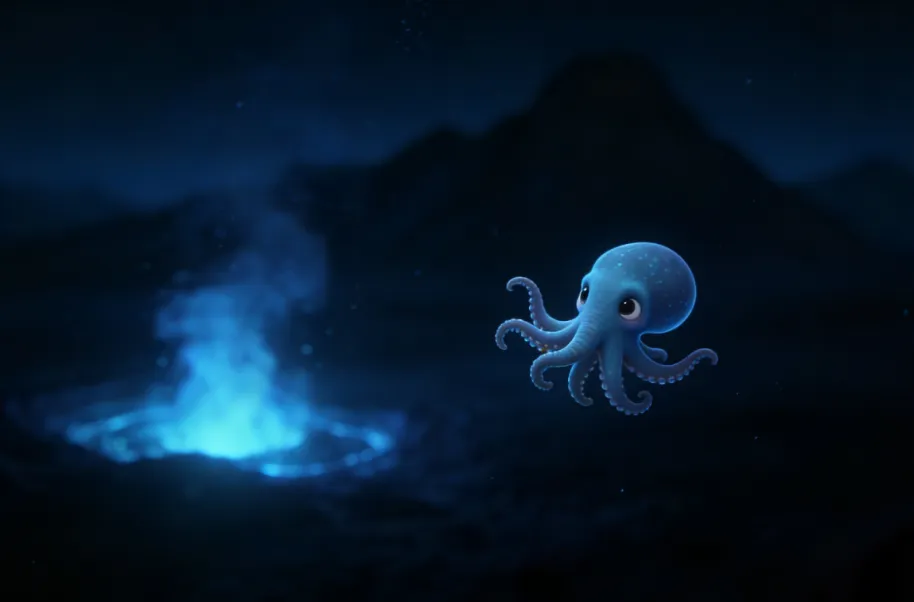
Take the beloved Dumbo octopus, a floppy, ear-finned creature that glides through the inky dark at 13,000 feet or deeper, moving like a tiny, whimsical underwater elephant. Or the Casper octopus, discovered in 2016 at 14,000 feet: pale, ghostly, and lacking both pigment and ink sacs (traits standard for shallow-water octopuses), it’s the deepest-dwelling incirrate octopod ever documented.
These aren’t just rare curiosities. They’re living proof that life can not just survive, but flourish, without sunlight. They subsist on marine snow, chemical energy, and even sunken whale carcasses that drift to the seafloor as rare, vital food sources.
Then there are hydrothermal vent ecosystems—easily one of the greatest scientific discoveries of the 20th century. Back in 1977, researchers stumbled upon these underwater hot springs, where superheated, mineral-rich water gushes from the ocean floor.
Here, entire thriving ecosystems exist in total darkness, fueled not by photosynthesis, but by chemosynthesis. Giant tube worms, eyeless shrimp, and tough, bizarre crabs cluster around these vents, forming a complex food web that operates entirely independent of the sun.
This discovery rewrote biology textbooks and sparked universe-sized questions: If life can survive in such extreme conditions on Earth, could it also exist on icy ocean moons like Europa or Enceladus?
The deep sea is also home to giants and oddities that capture the public imagination like few other natural wonders: the elusive giant squid (a maritime legend for centuries, only filmed alive in 2012), colossal sea spiders that dwarf their shallow-water cousins, and “ice dragon” fish that survive the frigid Antarctic depths by producing natural antifreeze proteins.
Every single deep-sea dive brings the chance of discovering a new species. Scientists estimate that a staggering 90% of deep-sea life remains undocumented. For curious, adventure-hungry readers, that’s not just a statistic—it’s a promise that the next groundbreaking find is always just one dive away.
The Tech Revolution That’s Democratizing Deep Sea Exploration
The single biggest barrier to deep sea exploration—crippling costs and limited access—is finally crumbling. A wave of grassroots innovation is putting the abyss within reach for scientists, amateur explorers, and even citizen scientists.
This is the part of the story that resonates most with Western audiences: underdog ingenuity, accessible progress, and the true democratization of scientific discovery.
Gone are the days of massive, billion-dollar research vessels and crewed submersibles that only a handful of wealthy nations could afford to operate. Today, remotely operated vehicles (ROVs) and autonomous underwater vehicles (AUVs) handle the high-risk, high-reward work.
These machines capture crystal-clear 4K footage, collect biological samples, and gather critical data from depths humans could never survive. Organizations like NOAA Ocean Exploration stream live ROV dives online for free, letting armchair explorers tune in and witness real-time discoveries—turning passive viewers into active participants in the scientific process.
But the real game-changer in recent years has been low-cost deep-sea technology. Leading the charge is Katy Croff Bell, a renowned National Geographic Explorer and founder of the Ocean Discovery League, who developed DORIS (Deep Ocean Research and Imaging System).
This compact, scuba-tank-sized submersible costs less than $10,000, can reach depths of 20,000 feet, and deploys from nearly any small boat—not just specialized research vessels. It withstands extreme pressure, captures high-resolution imagery, and collects vital environmental data, opening the deep sea to researchers in low- and middle-income countries, citizen science teams, and small independent groups that were once locked out entirely.
Private sector innovation is also pushing boundaries and redefining what’s possible. Filmmaker James Cameron’s 2012 solo dive to the Challenger Deep aboard the Deepsea Challenger proved that private missions could deliver groundbreaking, publishable scientific data, sparking a new era of deep-sea entrepreneurship and investment.
Companies like Blue Robotics build affordable, consumer-grade underwater drones, while global nonprofits are racing to map the entire seafloor by 2030. For the first time in human history, exploring the deep sea isn’t a privilege reserved for governments and billionaires—it’s a possibility for anyone with a passion for discovery.
Why the Deep Sea Matters More Than Ever (For Us and the Planet)
Deep sea exploration isn’t just about chasing weird fish or documenting stunning underwater landscapes. It’s about solving some of the most pressing challenges facing humanity right now. For environmentally conscious Western readers, this is the core “why” that makes the deep sea a topic worth caring about, sharing, and actively supporting.
First and foremost, the deep sea is Earth’s largest carbon sink, absorbing billions of tons of carbon dioxide every year and regulating global climate patterns. Understanding how deep-sea ecosystems function, how they’re harmed by ocean warming and acidification, and how to shield them from damage is critical to the fight against climate change. Without exploring these uncharted depths, we’re flying blind in one of the most important environmental battles of our lifetime.
Second, the deep sea holds the potential for life-changing medical breakthroughs. Countless deep-sea organisms produce unique, specialized compounds to survive extreme temperatures, crushing pressure, and toxic environments. Scientists are actively studying these compounds for use in cancer treatments, new antibiotics, pain management therapies, and more.
Slow-growing, ancient deep-sea corals—some thousands of years old—also hold invaluable clues to aging, ecosystem resilience, and long-term environmental change. Every undiscovered species is a potential cure, a revolutionary technology, or a solution to a pressing human problem.
Yet this fragile, irreplaceable realm is under imminent threat. Climate change is warming and acidifying abyssal waters, disrupting delicate ecosystems that take millennia to recover. Deep-sea mining—targeting valuable minerals like cobalt and nickel on the seafloor—looms as a catastrophic, irreversible risk, with the power to wipe out habitats that can never be rebuilt.
Plastic pollution has even reached the deepest trenches, with microplastics found in the bodies of creatures living 7 miles below the surface. Exploration isn’t just about discovery; it’s about advocacy. The more we see of the deep sea’s beauty and vulnerability, the more motivated we are to fight for its protection.
The Future of Deep Sea Exploration: What’s Next for Our Final Frontier
The next decade will be the most transformative in the entire history of deep sea exploration. Armed with affordable technology, global scientific collaboration, and surging public interest, we’re poised to unlock more secrets of the abyss than in all previous centuries combined.
Scientists are setting their sights on uncharted seamounts, remote untouched trenches, and the icy, unexplored depths of the Southern Ocean—regions that have never been seen by human eyes.
We’ll almost certainly discover hundreds of new species, uncover vital clues about the origins of life on Earth, and refine our understanding of how the deep sea shapes global climate. Live-streamed dives will grow even more immersive, with virtual reality technology letting the public step inside the abyss and experience it firsthand.
Citizen science projects will empower everyday people to help analyze deep-sea footage, identify new creatures, and contribute to real research. And with growing global awareness, we’re hopeful that international agreements will protect the most vulnerable deep-sea ecosystems from exploitation before it’s too late.
For Western audiences, the deep sea embodies the very best of humanity: unquenchable curiosity, unwavering resilience, and the timeless drive to explore the unknown. It’s a powerful reminder that we don’t need to journey to distant planets to find wonder and purpose—there’s a vast, uncharted world right beneath our ocean waves, waiting to be revealed.
We’ve only scratched the tiniest surface of this frontier. Every dive, every robotic mission, every new discovery brings us one step closer to truly understanding the planet we call home.
Final Thought: The deep sea isn’t just a geographic location—it’s a living legacy. It holds the answers to our planet’s past, the keys to securing our future, and a quiet, unrivaled beauty that defies words. And for the first time ever, we all have a front-row seat to the greatest exploration story of our time.
Leave a Reply