
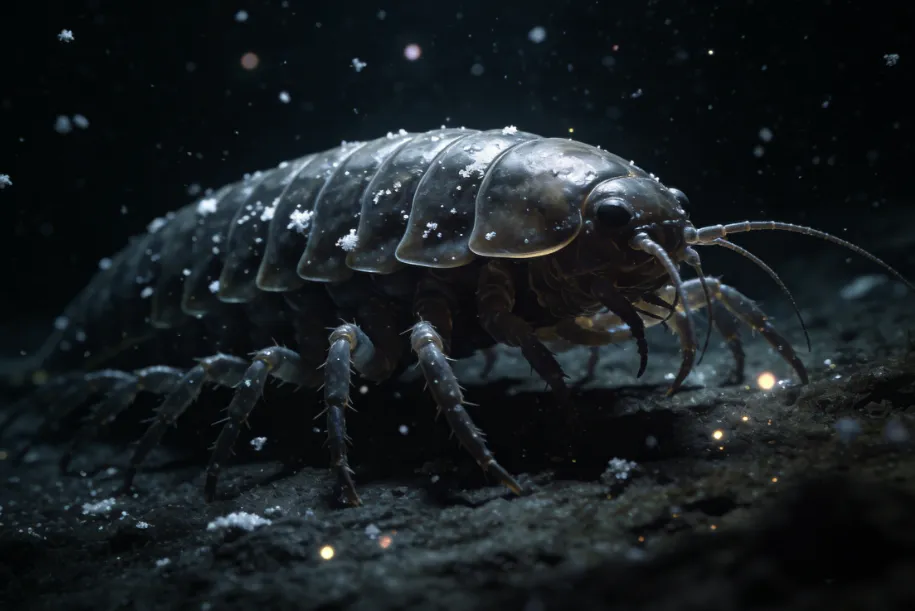
Step outside on a damp evening, and you’ve probably spotted a tiny, armored critter scurrying under a log or tucked into a flower pot: the common woodlouse, better known as a pill bug or roly-poly. These minuscule, segmented bugs are harmless, quirky, and easy to brush off—hardly the stuff of ocean legends. But drop thousands of feet below the waves, into the frigid, lightless abyss, and you’ll find their colossal, otherworldly cousin: the giant isopod. Calling it a “big woodlouse” is like calling a great white shark a “large goldfish.” This creature looks like it stepped straight off a sci-fi movie set, yet it’s very real, thriving in one of the harshest environments on Earth and guarding secrets that still stump marine biologists decades after its first discovery.
For anyone fascinated by the deep sea’s hidden wonders, the giant isopod is far more than a weird oddity—it’s a masterclass in survival. It’s a living paradox: menacing at first glance, but utterly gentle in nature; a slow, solitary recluse that can outlast starvation for years; a tiny crustacean blown to gargantuan sizes by the mysterious quirk of deep-sea gigantism. Most deep-sea creatures are translucent, microscopic, or rarely spotted, but the giant isopod is a fan favorite, drawing crowds at aquariums and lighting up internet curiosity feeds. This deep dive into its life, behaviors, and evolutionary quirks isn’t just a marine biology lesson—it’s a reminder that the ocean’s depths hold creatures we barely comprehend, and some of Earth’s most incredible life lives where the sun never reaches.
What Exactly Is a Giant Isopod? (Spoiler: It’s Not a Monster)
First, let’s cut through the mystery: the giant isopod (scientific name Bathynomus giganteus, the most studied species in the Bathynomus genus) is a marine crustacean, part of the same family as shrimp, crabs, lobsters, and yes, those tiny land woodlice in your backyard. Discovered in 1879 by French zoologist Alphonse Milne-Edwards during a Gulf of Mexico research expedition, this creature shattered every scientific assumption about deep-sea invertebrates. Back then, experts believed deep-sea life was small, fragile, and scarce—until they hauled a foot-long, armored behemoth from the dark depths.
Unlike its land-dwelling cousins that barely grow past an inch, the giant isopod can reach up to 16 inches (40 cm) in length, with some rare specimens tipping the scales at nearly two pounds. That’s roughly the size of a small house cat, but with a hard, calcified exoskeleton, 14 spindly legs, two sets of antennae, and large, compound eyes that glow faintly in the dark. Its body is segmented into a dome-shaped head, a sturdy torso, and a short, fan-like tail, giving it a prehistoric, armored look. It’s no wonder so many people mistake it for a deep-sea insect or even an alien creature—it looks like nothing else that roams the ocean’s abyssal zones.
But don’t let its fierce appearance fool you. Giant isopods are not aggressive predators, nor are they dangerous to humans—even if you could encounter one in the wild, which is nearly impossible for the average person. They’re slow, deliberate, and overwhelmingly docile, spending nearly their entire lives on the muddy, silty seafloor and moving only when absolutely necessary. Think of them as the ultimate oceanic couch potatoes: built for energy conservation, not speed—and in the unforgiving deep sea, that’s the secret to long-term survival.
Home Sweet Abyss: Where Giant Isopods Call Home
Giant isopods are no strangers to extreme living. They inhabit the bathyal and abyssal zones of the Atlantic, Pacific, and Indian Oceans, at depths ranging from 550 feet (170 meters) all the way down to a staggering 7,020 feet (2,140 meters) below the surface. That’s a world of perpetual darkness, near-freezing water temperatures (just 39 to 50°F / 4 to 10°C), and crushing water pressure—up to 200 times greater than the pressure at sea level. To put that in perspective, that’s like having the weight of two adult elephants pressing down on every square inch of your body.
These creatures prefer soft, muddy or clay-rich seafloors, where they can burrow slightly into the sediment for camouflage and protection. They’re solitary by nature, only gathering in small numbers on the rare occasion a large food source drifts down from above—something we’ll break down in detail next. You’ll find them in key deep-sea regions: the Gulf of Mexico, the western Atlantic Ocean, waters off Australia and Japan, and other abyssal hotspots where nutrient fallout from the sunlit upper ocean reaches the seafloor. Because they live in such remote, hard-to-reach depths, studying them in the wild is incredibly tough; most of what we know comes from trawled specimens, aquarium observations, and rare footage captured by remotely operated vehicles (ROVs).
The Art of Waiting: How Giant Isopods Eat (and Starve for Years)
Food is one of the rarest commodities in the deep sea. There’s no sunlight for photosynthesis, so no plants grow on the abyssal floor. Instead, nearly all deep-sea life relies on marine snow—a steady drizzle of dead plankton, fecal matter, algae, and small animal remains that drifts down from the sunlit upper ocean. For most deep-sea creatures, marine snow is a constant but sparse meal. But for giant isopods, the real feast comes from whale falls, fish kills, and other large carrion—the rare, massive pulses of food that sink to the seafloor when a large marine animal dies.
Giant isopods are obligate scavengers, meaning they’re built to feast on dead and decaying organic matter. They’re not built for chasing prey; their legs are made for crawling and gripping, not swimming, and their metabolism is painfully slow. When a whale fall or a large fish carcass sinks to their territory, giant isopods will swarm (as much as these solitary creatures can swarm) and gorge themselves, eating as much as possible in a short window. Their specialized mouthparts allow them to tear through flesh and crunch through bone, and they can eat enough in one sitting to last them for months—even years.
That’s not an exaggeration. One famous giant isopod kept in captivity at the Toba Aquarium in Japan made headlines worldwide when it refused to eat for five full years before finally taking a bite of food. This extreme fasting ability is a survival adaptation: in the deep sea, large food falls can be years apart, so giant isopods have evolved to slow their bodies to a near standstill when resources are scarce. They don’t waste energy moving, hunting, or even digesting food quickly—they simply wait, patiently, for the next meal to drift down from above. It’s a lifestyle that’s boring by human standards, but it’s made the giant isopod one of the most successful deep-sea species on the planet.
Deep-Sea Gigantism: Why Are These Isopods So Massive?
One of the biggest unanswered questions about giant isopods is also the most obvious: why are they so big? This phenomenon, known as deep-sea gigantism, affects a host of deep-sea creatures—from giant squid to colossal amphipods—but scientists still don’t have a single, definitive answer for why it happens. For giant isopods, researchers have a few leading theories that help explain their extraordinary size:
- Oxygen Efficiency: Cold, deep water holds more dissolved oxygen than warm surface water. Larger body size allows isopods to absorb and store more oxygen, giving them an edge in low-oxygen “dead zones” that dot the abyssal floor.
- Fewer Predators: The deep sea has far fewer large predators than shallow waters. Without the threat of being eaten, isopods can grow larger without risking their survival—plus, their hard, spiny exoskeleton makes them unappetizing to the few predators that do share their habitat.
- Slow Metabolism: A larger body retains heat and energy more efficiently, which is crucial for cold-water creatures that move slowly and eat infrequently. Giant isopods don’t need to grow quickly; they live long, slow lives, and their size helps them conserve every ounce of energy.
- Resource Competition: Being bigger means they can outcompete smaller scavengers for rare food falls, claiming the lion’s share of a meal before other creatures arrive.
No matter which theory holds the most truth, their massive size is what makes them so iconic. In a realm dominated by tiny, translucent deep-sea creatures, the giant isopod is a bold, unmissable presence—a living testament to how evolution shapes life to thrive in Earth’s most extreme corners.
Built for the Dark: The Giant Isopod’s Superpower Adaptations
Surviving in the deep sea isn’t just about being big and being patient—it’s about having the right tools for the job. Giant isopods are packed with unique adaptations that make them perfectly suited for life in the abyss:
Armor-Plated Exoskeleton
Their hard, calcified shell acts as a suit of armor, protecting them from predators, debris, and the crushing pressure of the deep. When threatened, they can even curl up into a tight ball—just like their land-dwelling woodlouse cousins—shielding their soft underbelly from harm.
Hyper-Sensitive Antennae
Giant isopods have two sets of antennae, some as long as half their body, that act as their primary sensory tool in the dark. These antennae can detect faint chemical signals in the water, leading them to distant food falls or helping them navigate the muddy seafloor without light.
Large, Light-Sensing Eyes
While their eyes aren’t built for sharp vision, they can detect even the faintest traces of bioluminescent light and movement in the pitch black, helping them avoid danger and locate food.
Hooked Legs
The tips of their 14 legs are equipped with tiny, sharp claws that grip the muddy seafloor, keeping them stable in slow ocean currents and preventing them from being swept away.
Energy-Saving Biology
Every part of their body is optimized for minimal energy use. They move slowly, breathe efficiently, and can shut down non-essential bodily functions during long fasts, making them the ultimate survivors in a world where every calorie counts.
Why Giant Isopods Matter (Beyond Being Cool)
It’s easy to love giant isopods for their weird, quirky appearance—they’re the internet’s favorite deep-sea oddity, after all. But these creatures play a vital role in the ocean’s ecosystem, one that’s often overlooked. As the deep sea’s primary scavengers, they act as the ocean’s cleanup crew, breaking down dead organic matter and recycling nutrients back into the food chain. Without giant isopods and other deep-sea scavengers, the seafloor would be littered with decaying carcasses, and vital nutrients would remain trapped, starving other deep-sea life.
They also serve as a valuable indicator species for the health of the deep ocean. Because they rely on consistent marine snow and food falls from the upper ocean, changes in their population or behavior can signal disruptions in the ocean’s food web—like overfishing, plastic pollution, or warming waters. Studying giant isopods helps scientists understand how human activity is affecting even the most remote parts of the planet, parts we rarely see or think about.
And let’s not forget their role in inspiring curiosity. For many people, the giant isopod is their first introduction to the deep sea’s wonders. It’s a gateway creature that sparks interest in marine biology, ocean conservation, and exploration. In a world where the deep sea remains 95% unexplored, the giant isopod is a reminder that there are still countless mysteries waiting to be uncovered beneath the waves.
Myths vs. Facts: Separating Truth from Internet Hype
Thanks to their viral fame, giant isopods have picked up their fair share of myths and misconceptions. Let’s set the record straight:
Myth: Giant isopods are aggressive and will attack humans.
Fact: They are completely harmless to humans. They’re slow, shy, and only eat dead or decaying matter—they have no interest in living prey, let alone humans.
Myth: Giant isopods are insects.
Fact: They’re crustaceans, closely related to crabs and shrimp, not insects.
Myth: They’re rare and endangered.
Fact: While they’re hard to find in the wild, giant isopods are not currently listed as endangered. However, deep-sea trawling and habitat destruction pose potential threats to their populations.
Myth: All giant isopods are the same size.
Fact: Size varies by species and depth—some Bathynomus species are much smaller than Bathynomus giganteus, and individuals living at greater depths tend to be larger.
Wrapping Up: The Unforgettable Giant of the Abyss
The giant isopod is more than just a bizarre deep-sea dweller—it’s a symbol of the ocean’s endless ability to surprise us. It defies every expectation, turning a tiny, ordinary land bug into a massive, resilient giant that flourishes where nearly no other life can survive. It’s a stark reminder that we still have so much to learn about the world beneath the waves, and that some of Earth’s most captivating creatures live in the dark, quiet corners we’ve barely started to explore.
Next time you scroll past a photo of a giant isopod, or catch a glimpse of one in an aquarium exhibit, take a moment to appreciate this remarkable creature. This is a species that has survived for millions of years, outwaiting starvation, crushing water pressure, and the test of time. It’s not a monster—it’s a survivor, a quirky natural wonder, and a beloved icon of the deep sea. As we keep pushing to explore the ocean’s darkest, most uncharted depths, the giant isopod will remain one of the most cherished and mysterious creatures we’ve ever uncovered.
Love deep-sea mysteries? Dive into our full archive of deep-sea creature profiles, exclusive ROV exploration footage, and actionable marine conservation guides to help protect these extraordinary abyssal species and their fragile habitat.
Leave a Reply