
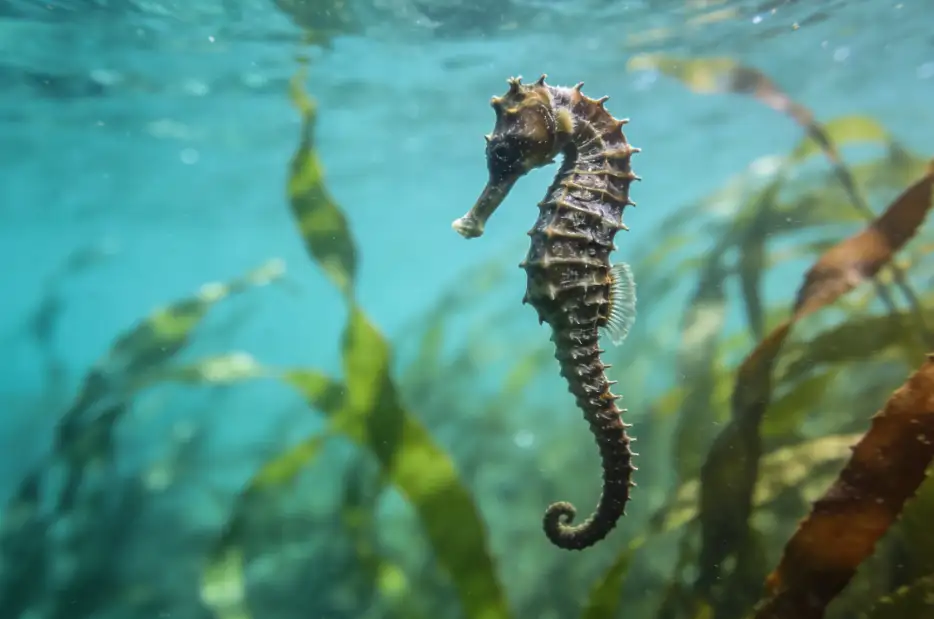
If you’ve ever seen a seahorse for the first time, chances are you had at least one of these thoughts:
- Is this a horse… underwater?
- Did evolution just get bored one afternoon?
- Am I hallucinating while snorkeling?
Relax. You’re not losing your mind.
Seahorses are very real, and they are among the most bizarre, charming, and scientifically fascinating animals in the ocean. From male pregnancy to terrible swimming skills, seahorses seem determined to break almost every biological stereotype we have.
This article will take you on a friendly, curiosity-driven dive into the world of seahorses—no lab coat required. We’ll explore what they are, how they live, why dads give birth, and why these tiny sea creatures desperately need our help.
So grab your imaginary snorkel. Let’s meet the ocean’s strangest little horse.
What Exactly Is a Seahorse?
Despite the name, a seahorse is not a horse. Shocking, I know.
Seahorses are fish—specifically bony fish—belonging to the genus Hippocampus. The name comes from Greek:
- Hippos = horse
- Kampos = sea monster
So yes, scientists officially named them “horse sea monsters.” No exaggeration.
There are currently over 45 known species of seahorses, found in shallow coastal waters across the world, especially in:
- The Pacific Ocean
- The Atlantic Ocean
- The Indian Ocean
They prefer calm environments such as:
- Seagrass beds
- Coral reefs
- Mangroves
- Coastal lagoons
In other words, seahorses often live right next to places humans love to vacation—quiet, warm, and full of life.
A Body Design That Defies Logic
Let’s talk about how seahorses look, because honestly… wow.
A seahorse has:
- A horse-like head 🐴
- A long, flexible neck
- A curled, prehensile tail
- Armor-like bony plates instead of scales
- Independently rotating eyes (yes, like a chameleon)
Perhaps the strangest part?
They swim upright.
Unlike most fish that glide horizontally, seahorses float vertically, bobbing through the water like confused balloons. And swimming is not their strong suit.
In fact, seahorses are officially considered one of the slowest-moving fish in the world. The fastest species clocks in at about 5 feet (1.5 meters) per hour.
To put that into perspective:
- A turtle could pass them.
- A snail might feel confident.
Instead of fighting the current, seahorses rely on their tails to anchor themselves to seagrass or coral, holding on and waiting for food to drift by. It’s less “Olympic swimmer” and more “zen monk.”
Male Pregnancy: Yes, Really
This is the part where biology flips the script.
In seahorses, males get pregnant.
No loopholes. No technicalities. Actual pregnancy.
Here’s how it works:
- A male and female seahorse perform a courtship dance
- The female deposits her eggs into the male’s brood pouch
- The male fertilizes the eggs internally
- The embryos develop inside his pouch for several weeks
- The male gives birth—sometimes to hundreds or even thousands of tiny seahorses
The birth process can take hours and looks surprisingly intense. Male seahorses contract their abdominal muscles to release fully formed miniature seahorses into the water.
Why did evolution choose this method?
Scientists believe male pregnancy:
- Allows females to produce eggs more frequently
- Gives males greater control over offspring survival
- Increases overall reproductive success
So if anyone ever says nature is “traditional,” feel free to introduce them to seahorses.
Surprisingly Romantic Fish
The ocean is a competitive place, and most fish don’t have time for romance. Seahorses, however, are different.
Many seahorse species are monogamous, meaning they form long-term pair bonds. Some even stay with the same partner for an entire breeding season—or longer.
They strengthen their bond through:
- Daily greeting rituals
- Color changes
- Synchronized swimming dances
Every morning, partners may meet, change colors together, and perform a short dance to confirm their connection. It’s essentially a daily relationship check-in.
If one partner disappears, the remaining seahorse often:
- Struggles to find a new mate
- Experiences lower reproductive success
For fish, this level of commitment is rare. For humans? Honestly, kind of impressive.
How Seahorses Eat (Constantly)
Seahorses don’t have stomachs.
This means they can’t store food, so whatever they eat passes through their system quickly. As a result, seahorses spend most of their day doing one thing:
Eating. A lot.
Their diet consists of:
- Tiny crustaceans
- Copepods
- Mysis shrimp
- Planktonic organisms
They hunt using stealth rather than speed. A seahorse will remain perfectly still, rotating its eyes independently, waiting for prey to drift close. Then—snap!—it sucks the prey in through its long snout like a biological vacuum cleaner.
Efficient? Yes. Athletic? Not exactly.
Masters of Disguise
Despite being slow and delicate, seahorses have a secret weapon: camouflage.
Many species can:
- Change color
- Grow skin filaments that resemble seaweed
- Blend seamlessly into coral or seagrass
This helps them avoid predators such as:
- Crabs
- Rays
- Larger fish
Unfortunately, camouflage only works when their habitat is healthy—which brings us to the less cheerful part.
The Harsh Reality: Seahorses Are in Trouble
As adorable as seahorses are, they face serious threats.
Major dangers include:
- Habitat destruction
- Coastal development
- Pollution
- Climate change
- Bycatch from fishing nets
- Harvesting for traditional medicine and souvenirs
It’s estimated that tens of millions of seahorses are captured every year, many unintentionally. Seagrass beds—critical seahorse habitats—are disappearing at alarming rates.
As a result, many species are now listed under:
- CITES (Convention on International Trade in Endangered Species)
- IUCN Red List of Threatened Species
They are quiet creatures, and their disappearance often goes unnoticed.
How You Can Help (Without Becoming a Marine Biologist)
Good news: small actions matter.
You can help protect seahorses by:
- Supporting sustainable seafood choices
- Reducing plastic use
- Avoiding souvenirs made from marine animals
- Supporting ocean conservation organizations
- Sharing accurate information
Awareness is often the first step toward conservation.
Small, Strange, and Extraordinary
Seahorses remind us that nature doesn’t follow our rules.
- Fathers can give birth
- Speed isn’t everything
- Romance exists underwater
- Survival sometimes means holding on, not racing ahead
They may be small, slow, and silent—but seahorses are living proof that evolution values creativity as much as strength.
The next time you see a seahorse—whether in the wild, an aquarium, or a documentary—remember:
this isn’t a cartoon creature or a myth.
It’s a miracle, drifting gently through the sea. 🌊🐴
Leave a Reply