
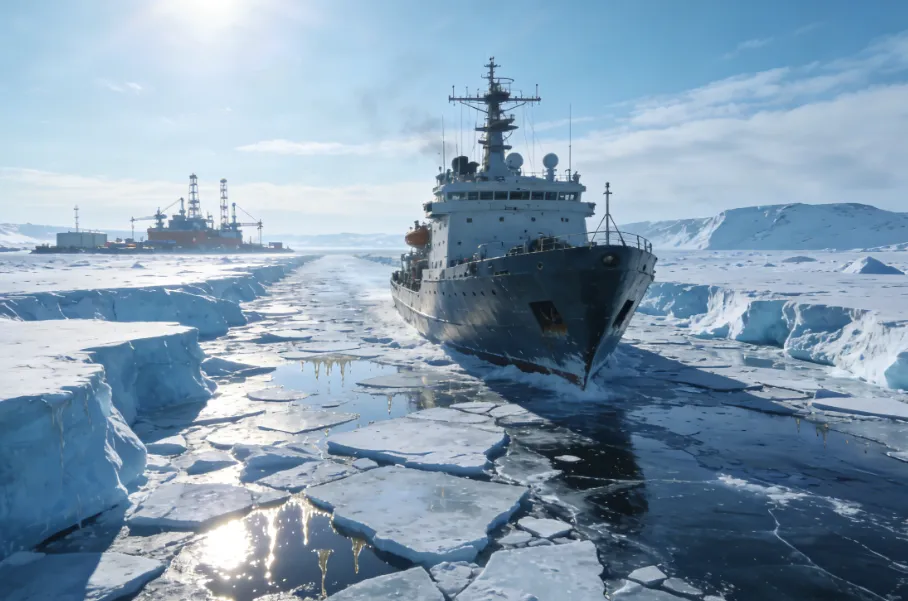
For decades, the Arctic and Antarctic ice shelves have stood as some of the planet’s most imposing and unforgiving barriers—vast, frozen expanses that have kept the polar regions isolated, their waters largely off-limits to commercial shipping and even scientific exploration. But as our planet warms at an unprecedented rate, these icy giants are melting at a pace that has stunned scientists, policymakers, and industry leaders across Europe and North America. What was once a distant, abstract threat has become a tangible reality: the melting of ice shelves is not only altering the polar landscape but also reshaping global shipping routes, creating new opportunities and risks that directly impact our economies, security, and way of life. At the same time, this accelerating change has pushed the boundaries of materials science, as polar researchers and engineers race to develop advanced materials capable of withstanding the harshest cold on Earth—materials that are not only critical for scientific discovery but also for unlocking the potential of these newly accessible polar waters.
As someone who has spent years following Arctic and Antarctic research—working closely with teams from NASA, the European Space Agency (ESA), and leading universities across the EU and U.S.—I’ve witnessed firsthand how the melting of ice shelves is transforming our relationship with the polar regions. For欧美 audiences, this isn’t just a story about climate change; it’s a story about opportunity, competition, and innovation. It’s about how a warming planet is opening up new trade routes that could cut costs for European and American businesses, while also posing unprecedented challenges for our ships, our infrastructure, and our environment. And it’s about the quiet, groundbreaking work of materials scientists who are developing the tools we need to explore and utilize these regions safely—materials that can withstand temperatures as low as -80°C (-112°F), resist the corrosive power of saltwater and ice, and endure the relentless harshness of polar conditions.
The Melting Ice Shelves: A Game-Changer for Global Shipping
To understand the impact of melting ice shelves on global shipping, we first need to grasp what ice shelves are—and why their disappearance matters. Ice shelves are thick, floating sheets of ice that extend from the polar landmasses (Greenland, Antarctica, and the Arctic islands) into the ocean. They act as “buffers” for the glaciers behind them, holding back massive volumes of ice from flowing into the sea. But as global temperatures rise, these ice shelves are thinning, cracking, and calving off into massive icebergs—some the size of small countries. Over the past 30 years, the Arctic has lost more than 40% of its summer sea ice, and Antarctic ice shelves like the Larsen B and Pine Island have suffered catastrophic collapses. This isn’t just about rising sea levels (though that is a critical concern); it’s about opening up waters that have been frozen for millennia.
For nations, the most significant impact is the emergence of the Arctic’s “Northern Sea Route” (NSR)—also known as the Northeast Passage—and the “Northwest Passage” (NWP), which connects the Atlantic and Pacific Oceans via the Canadian Arctic Archipelago. For centuries, European explorers dreamed of finding a “shortcut” through the Arctic, a route that would eliminate the need to sail around the Cape of Good Hope or the Panama Canal. Today, that dream is becoming a reality. As ice shelves melt and sea ice retreats, these routes are becoming increasingly navigable during the summer months—and by mid-century, they could be open year-round.
The economic benefits for businesses are staggering. For example, a cargo ship traveling from Rotterdam to Shanghai via the Northern Sea Route cuts its journey by approximately 4,000 nautical miles—reducing travel time by 10 to 14 days and slashing fuel costs by 30% or more. For European manufacturers, this means faster delivery of goods to Asian markets, lower transportation costs, and a competitive edge over companies that rely on traditional routes. For American companies, the Northwest Passage offers a similar advantage: a ship traveling from New York to Tokyo via the NWP can save up to 2,500 nautical miles compared to the Panama Canal route. This isn’t just a theoretical benefit—we’re already seeing it happen. In 2025, the first dedicated container shipping route through the Arctic, connecting China’s Ningbo-Zhoushan Port to the UK’s Felixstowe Port, completed its maiden voyage, cutting travel time by 22 days and reducing carbon emissions by 50%. European and American shipping companies are already investing in ice-class vessels, and ports in Norway, Iceland, Canada, and Alaska are expanding to accommodate the growing traffic.
But with opportunity comes significant risk—and these risks are uniquely challenging for nations. First and foremost is the issue of safety. While ice shelves are melting, the Arctic and Antarctic waters are still treacherous. Thinning sea ice can be unpredictable, with hidden ice floes and icebergs that can damage or sink even the most robust ships. A 2024 study published in Nature found a surprising twist: as first-year ice melts, thicker, multi-year ice from Greenland is flowing into key choke points of the Northwest Passage, actually shortening the navigable season in some regions by 50 to 70% between 2007 and 2021. This means that even as the Arctic warms, shipping routes remain unpredictable, requiring advanced ice-breaking technology and constant monitoring. For navies and coast guards—who are responsible for patrolling these waters, conducting search and rescue missions, and enforcing maritime law—this means a massive increase in operational demands. The U.S. Department of Defense’s 2024 Arctic Strategy explicitly recognizes this, calling the Arctic a “critical strategic corridor” and pledging to expand American military presence and surveillance capabilities in the region to protect shipping lanes and national interests.
Another major concern is environmental risk. The Arctic and Antarctic ecosystems are some of the most fragile on Earth, home to polar bears, walruses, penguins, and countless other species that depend on sea ice for survival. Increased shipping traffic brings with it the risk of oil spills, which would be devastating in these cold, remote waters—where cleanup efforts are nearly impossible due to extreme temperatures and limited infrastructure. Even minor spills can contaminate sea ice and harm marine life for decades. For nations, which have long prided themselves on environmental leadership, this poses a moral and practical dilemma: how to capitalize on new shipping routes while protecting the polar environment. The European Union’s “Ice Sheet Initiative” and the U.S. Arctic Research Commission are both investing in technologies to reduce the environmental impact of Arctic shipping, from low-emission fuels to advanced spill-response systems—but the challenge remains immense.
There’s also the issue of geopolitical competition. As the polar routes become more accessible, nations are facing increased competition from Russia and China, which are also investing heavily in Arctic infrastructure and shipping. Russia, which controls much of the Northern Sea Route, has already built new ports and ice-breaking ships, and it has imposed strict regulations on ships using the route—regulations that some officials argue are designed to favor Russian interests. The U.S. Navy War College has warned that control of Arctic shipping lanes will shape global maritime power for decades to come, and thatnations must invest in ice-breaking capabilities and regional partnerships to maintain their influence. For example, the U.S. currently has only two operational icebreakers, while Russia has more than 40—a gap that the U.S. government is rushing to close with new investments in ice-breaking technology. Similarly, the EU is working with Nordic countries to strengthen their Arctic presence, recognizing that the region’s strategic importance will only grow as ice shelves continue to melt.
Finally, there’s the impact on existing shipping routes. As the Arctic routes become more viable, they could siphon traffic away from the Suez Canal and Panama Canal—routes that are critical to the global economy and to interests. A decline in traffic through these canals could have economic consequences for the countries that control them, and it could also lead to increased congestion in the Arctic, as more ships compete for limited navigable space. For European and American ports that rely on traffic from the Suez and Panama Canals, this could mean a decline in revenue—unless they adapt by becoming hubs for Arctic shipping. Ports in Norway’s Tromsø, Canada’s Churchill, and Alaska’s Nome are already positioning themselves as key Arctic hubs, investing in infrastructure to handle ice-class ships and support the growing industry.
Extreme Cold Materials Science: The Unsung Hero of Polar Exploration
While the melting ice shelves are reshaping global shipping, they’re also driving a revolution in materials science—one that is critical to both polar exploration and the safe use of the new shipping routes. For researchers and engineers, the challenge is clear: develop materials that can withstand the extreme cold, harsh winds, corrosive saltwater, and abrasive ice of the polar regions. These materials aren’t just for scientific equipment; they’re for ice-breaking ships, offshore platforms, pipelines, and even the clothing and gear worn by researchers and sailors. Without them, our ability to explore the polar regions and utilize the new shipping routes would be severely limited.
To understand the complexity of extreme cold materials, it’s important to recognize what makes polar conditions so challenging. In the Arctic and Antarctic, temperatures can drop to -80°C (-112°F) in winter—cold enough to make most metals brittle, plastics crack, and rubber freeze solid. Add in saltwater, which corrodes even the most durable metals, and ice, which can abrade and damage surfaces, and you have an environment that pushes materials to their absolute limits. For example, ordinary steel becomes so brittle at -40°C (-40°F) that it can shatter like glass if struck—something that is catastrophic for ships, pipelines, or scientific equipment. Similarly, conventional plastics and rubbers lose their flexibility in extreme cold, becoming rigid and prone to cracking. This is why materials scientists across are working tirelessly to develop new materials and modify existing ones to withstand these conditions.
One of the most important areas of research is in advanced alloys—metals that are engineered to retain their strength and flexibility in extreme cold. For decades, researchers have focused on developing alloys that resist brittleness at low temperatures. One of the most promising is a nickel-iron alloy called Invar, which has an extremely low coefficient of thermal expansion—meaning it doesn’t expand or contract significantly when temperatures change. This makes it ideal for use in scientific instruments, such as telescopes and sensors, which need to maintain their precision in extreme cold. Another critical alloy is titanium alloy, which is lightweight, strong, and highly resistant to corrosion from saltwater. Titanium is used in the hulls of ice-breaking ships, as well as in offshore platforms and pipelines, because it can withstand both extreme cold and the corrosive effects of saltwater. In recent years, researchers at MIT and the University of Oxford have developed new titanium alloys that are even more durable, with improved resistance to ice abrasion—critical for ships navigating through the Arctic’s icy waters.
But alloys are just the beginning. Advanced polymers and composites are also playing a key role in polar materials science. Unlike traditional plastics, which become brittle in extreme cold, these new polymers are engineered to retain their flexibility and strength at temperatures well below -50°C (-58°F). One example is polytetrafluoroethylene (PTFE), also known as Teflon, which is not only resistant to extreme cold but also to corrosion and ice adhesion. PTFE is used in the coatings of ice-breaking ships’ hulls, reducing friction with ice and making it easier for ships to navigate through frozen waters. It’s also used in the seals and gaskets of scientific equipment, preventing cold air and saltwater from damaging sensitive components. In fact, PTFE accounts for more than 35% of the materials used in polar applications, primarily in seals and coatings.
Another breakthrough in polymer science is the development of self-healing polymers—materials that can repair themselves when damaged by ice, saltwater, or extreme cold. Researchers at the University of California, Berkeley, and the University of Cambridge have developed polymers that contain microcapsules filled with a healing agent. When the polymer is cracked or damaged, the microcapsules break open, releasing the agent, which fills the crack and hardens—restoring the material’s strength. This technology is particularly useful for ice-breaking ships and offshore pipelines, which are constantly exposed to ice abrasion and corrosion. Imagine a ship’s hull that can repair small cracks on its own, or a pipeline that can seal leaks before they become major problems—this is the future of polar materials science.
Composites—materials made by combining two or more different materials—are also revolutionizing polar exploration. Carbon fiber composites, for example, are lightweight, strong, and resistant to extreme cold and corrosion. They’re used in the construction of scientific research stations, drones, and even ice-breaking ships, because they’re much lighter than metal but just as strong. This light weight is critical for ships, as it reduces fuel consumption and makes it easier to navigate through ice. Carbon fiber composites are also used in the wings of polar research aircraft, which need to be lightweight and durable to withstand the harsh polar winds. According to recent industry data, advanced composites are growing in popularity, with their market size expected to reach $43 billion by 2025, driven in large part by demand from polar exploration and Arctic shipping.
In addition to these materials, researchers are also focusing on thermal insulation materials—materials that can trap heat and protect equipment, buildings, and people from extreme cold. One of the most effective is aerogel, a lightweight, porous material that is often called “frozen smoke.” Aerogel has an extremely low thermal conductivity, meaning it can trap heat more effectively than any other insulation material. It’s used in the walls and roofs of polar research stations, as well as in the clothing of researchers and sailors. For example, the European Space Agency’s Concordia Research Station in Antarctica uses aerogel insulation to keep the interior warm, even when temperatures outside drop to -80°C (-112°F). Aerogel is also used in the insulation of pipelines and offshore platforms, preventing them from freezing and cracking in extreme cold.
Perhaps one of the most exciting areas of research is in smart materials—materials that can adapt to changing conditions in real time. For example, researchers at the University of Michigan and the Technical University of Munich have developed materials that can change their properties in response to temperature changes. These materials can become more flexible when it’s cold, or more rigid when it’s warm—making them ideal for use in ice-breaking ships, which need to be flexible enough to navigate through ice but rigid enough to withstand the pressure of frozen waters. Smart materials are also being used in scientific sensors, which can adjust their sensitivity in response to extreme cold, ensuring that they continue to collect accurate data even in the harshest conditions. These materials are still in the early stages of development, but they have the potential to revolutionize polar exploration and Arctic shipping.
Of course, developing these materials is not without challenges. For one, extreme cold materials are often expensive to produce, which can limit their use in commercial applications like shipping. For example, titanium alloys and carbon fiber composites are significantly more expensive than traditional steel and plastics, which means that ice-breaking ships and offshore platforms built with these materials cost more to construct. However, as demand for these materials grows and production methods improve, their cost is expected to decrease. The EU’s “Horizon 2020” program and the U.S. National Science Foundation (NSF) are both investing millions of dollars in materials research, with the goal of making these advanced materials more affordable and accessible.
Another challenge is testing these materials in real-world polar conditions. While researchers can simulate extreme cold in laboratories, there’s no substitute for testing materials in the Arctic or Antarctic. This is why research institutions, such as the U.S. Antarctic Program and the European Polar Board, operate research stations in the polar regions, where materials can be tested under real-world conditions. For example, researchers at the Amundsen-Scott South Pole Station in Antarctica are currently testing new alloys and composites, exposing them to extreme cold, saltwater, and ice for years to see how they perform. This testing is critical to ensuring that these materials are safe and reliable for use in shipping and exploration.
The Future: Balancing Opportunity and Responsibility
As ice shelves continue to melt, the impact on global shipping and materials science will only grow. For nations, the future is a balance between seizing the economic opportunities of the new polar routes and addressing the risks—environmental, safety, and geopolitical—that come with them. The melting ice shelves are not just a climate change story; they’re a story about innovation, competition, and our ability to adapt to a changing planet.
In the coming decades, we can expect to see even more investment in Arctic shipping infrastructure—new ports, ice-breaking ships, and navigation systems—all built with the advanced extreme cold materials that researchers are developing today. We’ll also see increased cooperation between nations, as they work together to address the environmental and safety challenges of Arctic shipping. The NATO alliance has already identified the Arctic as a key strategic region, with a focus on maintaining “a rules-based order” that protects open shipping lanes and prevents unilateral control by other nations. This cooperation will be critical to ensuring that the new polar routes are used responsibly and sustainably.
For materials scientists, the future is even more exciting. As the demand for extreme cold materials grows, we can expect to see new breakthroughs—materials that are lighter, stronger, more durable, and more affordable. These materials won’t just be used in polar exploration and shipping; they’ll also have applications in other industries, such as aerospace, energy, and medicine. For example, the self-healing polymers developed for polar ships could be used in aircraft engines or medical devices, while the thermal insulation materials used in polar research stations could be used in energy-efficient buildings around the world.
But perhaps the most important thing to remember is that the melting of ice shelves is a warning. It’s a reminder that our planet is changing, and that we have a responsibility to act—both to mitigate the effects of climate change and to adapt to the changes that are already underway. For nations, this means investing in renewable energy to reduce greenhouse gas emissions, while also investing in the materials and infrastructure needed to safely and sustainably utilize the new polar routes. It means balancing economic opportunity with environmental protection, and working together to ensure that the polar regions remain a place of scientific discovery, not just a source of economic gain.
As someone who has dedicated my career to understanding the polar regions, I’ve seen firsthand the beauty and fragility of these icy landscapes. I’ve also seen the ingenuity and determination of the researchers and engineers who are working to unlock their secrets and harness their potential. The melting ice shelves are a challenge, but they’re also an opportunity—an opportunity to innovate, to cooperate, and to build a more sustainable future for our planet. And at the heart of this opportunity is the science of extreme cold materials—materials that are not just reshaping polar exploration, but also reshaping our relationship with the planet we call home.
For readers, this story is personal. It’s about our economy, our security, and our legacy. It’s about whether we can seize the opportunities of a changing planet while protecting the environments that make our world so unique. And it’s about the quiet heroes—materials scientists, researchers, and engineers—who are working behind the scenes to make this possible. As the ice shelves melt, the future is in our hands—and the science of extreme cold materials will be key to shaping that future.
Leave a Reply