
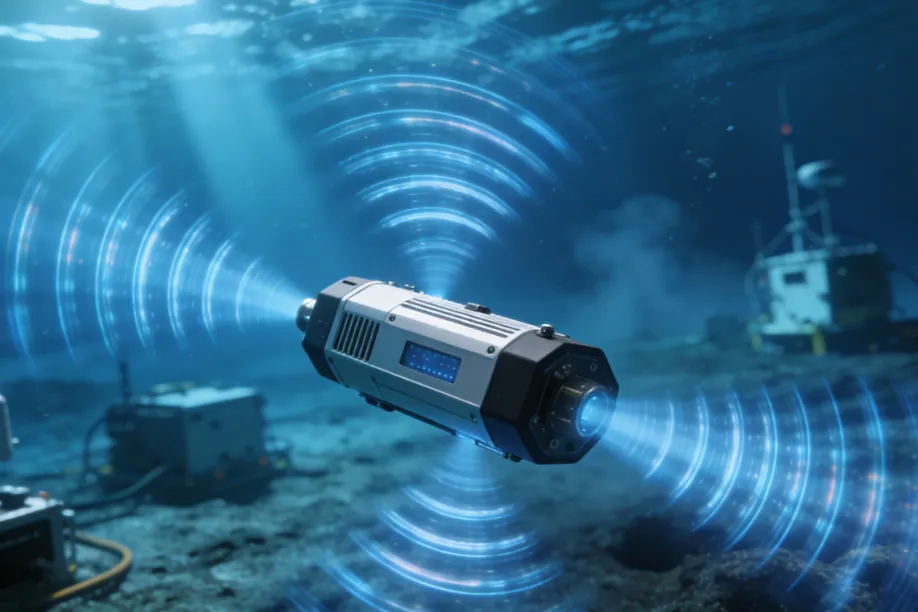
As a marine technologist who’s spent years working with underwater systems—from inspecting subsea energy infrastructure to guiding autonomous underwater vehicles (AUVs) through dark, unexplored ocean trenches—I’ve seen firsthand the critical role communication plays beneath the waves. For decades, the ocean’s depths have been a communication dead zone. Radio waves, which power our terrestrial Wi-Fi and cellular networks, fade to uselessness after just a few meters underwater. Light signals, too, struggle to penetrate far, limiting visual data transmission to short ranges.
But there’s one medium that has always cut through the water’s opacity: sound. For over a century, we’ve used sonar to map the seafloor, track marine life, and communicate with submarines. Today, that same acoustic technology is being reimagined as the backbone of deep-sea connectivity—what many in the industry are calling “underwater Wi-Fi.” At the heart of this revolution are acoustic modems: specialized devices that turn sound waves into high-speed, reliable digital data links, enabling real-time communication between underwater assets, surface vessels, and even remote research stations.
In this deep dive, we’ll unpack how sound travels through water, how depth and temperature shape its behavior, and how cutting-edge acoustic modems are making it possible to bring the connectivity of the open ocean to the ocean’s final frontier. Whether you’re an offshore engineer, marine researcher, AUV operator, or simply curious about the technology connecting our blue planet, this guide will demystify the science, real-world applications, and future of underwater acoustic communication.
The Science of Sound in Water: Why Acoustics Are the Only Game in Town
Before we dive into modems, let’s ground ourselves in why sound is the only practical way to transmit data underwater. To understand this, we need to compare acoustic communication to the alternatives—and the results are clear.
Why Radio and Light Fail Underwater
Terrestrial wireless communication relies on two primary signals: radio waves and light. But both are woefully inadequate for deep-sea use:
- Radio waves: These travel thousands of miles through air, but in water, they’re absorbed rapidly. At 100 meters depth, radio signals lose 99% of their strength; at 1,000 meters, they’re completely undetectable. This makes radio useless for any communication beyond the shallowest coastal waters.
- Light signals: Optical communication can work over short distances (tens of meters) in clear water, but it’s blocked by turbidity, algae, and marine life. Even in the best conditions, it can’t support high-bandwidth tasks like real-time video streaming or large data file transfers.
Sound, by contrast, is built for the ocean. Acoustic signals can travel hundreds—even thousands—of miles through water, making them the only viable medium for long-distance underwater communication. This is why sonar has been a cornerstone of marine science and defense for decades; now, we’re repurposing that technology to create the underwater equivalent of a broadband connection.
How Sound Travels Through Water: The Basics
Sound is a mechanical wave that propagates through a medium by vibrating particles. In water, these particles are much denser than in air, so sound travels faster and farther. The speed of sound in seawater isn’t fixed—it’s influenced by three key factors: temperature, depth (pressure), and salinity.
- Temperature: The single biggest driver of sound speed. In the ocean’s surface mixed layer (the top 100–200 meters), warmer water means faster sound. For every 1°C increase in temperature, sound speed rises by about 4 meters per second (m/s). In tropical waters, surface sound speed can reach 1,500 m/s; in polar regions, it drops to around 1,450 m/s.
- Depth (Pressure): As you dive deeper, pressure increases, which compresses water molecules and slightly boosts sound speed. For every 100 meters of depth, sound speed increases by about 1.7 m/s. In the deep ocean (below 1,000 meters), where temperature is stable, pressure becomes the dominant factor affecting sound speed.
- Salinity: Higher salinity (more dissolved salts) increases water density, which also raises sound speed. For every 1 psu (practical salinity unit) increase, sound speed rises by about 1.2 m/s. The open ocean has a salinity of around 35 psu, but coastal waters can vary widely—another variable that impacts acoustic propagation.
Together, these three factors create a sound speed profile that varies with depth and location. This profile isn’t just a scientific curiosity; it directly shapes how acoustic signals travel, bend, and attenuate—critical information for designing effective acoustic modems.
How Depth and Temperature Shape Acoustic Propagation
The ocean isn’t a uniform medium. Its temperature, pressure, and salinity change with depth, creating layers that affect sound waves in predictable (and sometimes surprising) ways. Understanding these effects is key to building modems that can communicate reliably in any deep-sea environment.
The Layers of the Ocean: Where Sound Travels (and Where It Doesn’t)
The ocean is divided into distinct vertical layers, each with unique characteristics that impact acoustic propagation:
- Surface Mixed Layer: The top 100–200 meters, where wind, waves, and sunlight mix water temperatures. In this layer, sound speed is relatively constant—making it ideal for short-to-medium range acoustic communication. But it’s also noisy: wave action, marine life (like shrimp and fish), and ship traffic create background noise that can interfere with signals.
- Thermocline: A layer where temperature drops rapidly with depth (often 1°C per meter). This creates a sound channel—a region where sound waves bend toward the layer of minimum sound speed (the “SOFAR channel,” short for Sound Fixing and Ranging). Signals in this channel can travel thousands of miles with minimal attenuation, making it perfect for long-distance communication.
- Deep Ocean Layer: Below the thermocline (typically 1,000 meters and deeper), temperature is nearly constant (around 1–4°C), and pressure is the main driver of sound speed. Here, sound speed increases gradually with depth. Acoustic signals in this layer travel in straight lines (or bend slightly upward) and can travel long distances, but they’re more susceptible to absorption at higher frequencies.
Attenuation: How Sound Fades Over Distance and Depth
No acoustic signal travels forever. Over distance and depth, sound energy is lost to attenuation—a combination of absorption, scattering, and spreading. For underwater communication, attenuation is a critical constraint: too much, and data can’t be transmitted reliably.
- Absorption: The biggest contributor to attenuation at mid-to-high frequencies. Seawater’s viscosity and ionic relaxation (breakdown of molecules like boric acid and magnesium sulfate) convert sound energy into heat. Absorption increases with frequency: high-frequency signals (above 10 kHz) are absorbed quickly, while low-frequency signals (below 1 kHz) travel much farther. For example, a 100 Hz signal can travel hundreds of miles, while a 100 kHz signal might fade after just a few kilometers.
- Scattering: Sound waves bounce off particles in the water (plankton, sediment, marine organisms) or the seafloor, losing energy in the process. Scattering is more common in shallow water (where the seafloor is close) and turbid coastal areas.
- Spreading: Sound waves expand outward in a spherical pattern, so their energy is distributed over a larger area. This is a natural effect, but it’s compounded by the ocean’s layered structure—signals that bend toward the SOFAR channel experience less spreading than those that travel through the surface mixed layer.
The Impact of Temperature and Depth on Bandwidth
Bandwidth—the amount of data that can be transmitted per second—is directly limited by attenuation. In shallow, warm waters (like the Caribbean), high-frequency signals are absorbed quickly, limiting bandwidth to a few hundred bits per second (bps). In the deep ocean, where temperature is stable and absorption is lower, bandwidth can reach a few kilobits per second (kbps)—a significant improvement, but still far slower than terrestrial Wi-Fi.
But it’s not just about distance. Temperature gradients (like those in the thermocline) can cause sound waves to bend, creating multipath propagation—signals that arrive at the receiver via multiple paths (direct, reflected, refracted). This leads to signal interference, which can reduce bandwidth and increase error rates. Similarly, depth changes can alter the sound speed profile, shifting the SOFAR channel and disrupting communication links.
For acoustic modems, this means that design must be adaptive. A modem that works well in the warm, shallow waters of the Gulf of Mexico will need different settings (frequency, modulation) than one that operates in the cold, deep waters of the Atlantic Ocean.
Acoustic Modems: The “Wi-Fi Routers” of the Deep Sea
Now that we understand how sound travels through water, let’s turn to the technology that makes deep-sea broadband possible: acoustic modems. These devices are the workhorses of underwater communication, converting digital data into acoustic signals that travel through water, then converting those signals back into digital data at the receiver.
What Is an Acoustic Modem?
At its core, an acoustic modem is a combination of a modulator and a demodulator (hence “modem”). Here’s how it works, step by step:
- Modulation: The modem takes digital data (text, images, video, sensor readings) and encodes it onto an acoustic carrier wave. This is done using modulation schemes—like frequency-shift keying (FSK) or orthogonal frequency-division multiplexing (OFDM)—that adjust the wave’s frequency, phase, or amplitude to represent 0s and 1s.
- Transmission: The modulated acoustic signal is sent into the water via a transducer (a device that converts electrical energy to acoustic energy).
- Propagation: The acoustic signal travels through water, affected by temperature, depth, salinity, and noise.
- Reception: A hydrophone (underwater microphone) picks up the signal, converting acoustic energy back to electrical energy.
- Demodulation: The modem processes the received signal, filters out noise, and decodes the digital data using the reverse of the modulation scheme.
This process is remarkably similar to how a terrestrial Wi-Fi router works—except instead of radio waves, it uses sound. And while the speeds are slower, acoustic modems are designed to overcome the unique challenges of the underwater channel, like multipath propagation, attenuation, and Doppler shift (a shift in frequency caused by relative motion between the transmitter and receiver).
Key Features of Modern Acoustic Modems
Not all acoustic modems are created equal. Today’s commercial and research-grade modems include a range of features to address the challenges of deep-sea communication:
- Adaptive Modulation: Adjusts the modulation scheme (e.g., FSK for low-bandwidth, OFDM for high-bandwidth) based on channel conditions. In warm, shallow waters, it might use low-frequency FSK for long range; in the deep ocean, it could switch to high-frequency OFDM for faster data transfer.
- Doppler Compensation: Corrects for frequency shifts caused by moving assets (like AUVs or surface vessels). This is critical for real-time control of moving underwater vehicles.
- Error Correction: Uses coding schemes like convolutional codes or Turbo codes to fix errors caused by noise or attenuation. These codes add redundant data to the transmission, allowing the receiver to reconstruct the original data even if some bits are lost.
- Long-Range Capability: Many modems are designed to communicate over distances of 10–100 kilometers (6–62 miles). For example, NATO’s JANUS protocol (a standard for underwater acoustic communication) supports transmission up to 28 kilometers using frequencies from 900 Hz to 60 kHz.
- Deep-Depth Rating: Commercial modems like Sonardyne’s Modem 6 are rated to 5,000 meters (16,400 feet), making them suitable for most deep-sea applications.
- Low Power Consumption: Many underwater assets (like AUVs and sensor nodes) run on batteries. Modern modems are optimized for low power, extending operational time and reducing maintenance needs.
Leading Acoustic Modem Solutions
The acoustic modem market is growing rapidly, with solutions for every use case—from research to industrial applications. Here are a few leading options:
- Teledyne Marine Benthos Modems: A market leader for subsea applications. Their BlueStreamX2 upgrade doubles data rates to 4,800 bps while maintaining range, making them ideal for offshore energy and marine research.
- Sonardyne Modem 6: Designed for simple point-to-point data transfer from sensors (like ADCPs and CTDs) to the surface. It supports data rates up to 9,000 bps and is rated to 5,000 meters, with battery life up to 1,390 days for long-term deployments.
- Florida Atlantic University Software-Defined Modem: A research-grade option that’s reconfigurable on the fly. It can switch between modulation schemes (FSK, Fast Frequency Hopping FSK) and support bandwidths up to 75 kHz, making it perfect for experimental applications.
- JANUS-Compliant Modems: Any modem that follows the NATO JANUS standard (STANAG 4748) is interoperable across different systems, making it easy to connect assets from different manufacturers. This standardization is critical for large-scale underwater networks.
Real-World Applications: Where Acoustic Modems Are Making an Impact
Acoustic modems aren’t just lab technology—they’re being used today to solve some of the ocean’s biggest challenges. From offshore energy to marine conservation, here are the most impactful applications:
Offshore Energy: Connecting Subsea Infrastructure
The offshore oil, gas, and wind energy industries rely on subsea infrastructure—pipes, turbines, wellheads, and sensors—that’s often located hundreds of meters below the surface. Traditionally, this infrastructure was connected via wired cables, which are expensive to install, prone to damage, and difficult to maintain.
Acoustic modems are changing that. They enable wireless communication between subsea assets and surface vessels, reducing costs and risks. For example:
- Real-Time Monitoring: Operators on ships can receive sensor data (pressure, temperature, flow rates) from subsea equipment in real time, allowing them to detect issues before they become critical.
- Remote Control: Acoustic modems let operators send commands to subsea valves, pumps, and lights—no need for divers or ROVs (Remotely Operated Vehicles) to be on-site.
- Wind Farm Maintenance: Offshore wind turbines use acoustic modems to communicate with subsea sensors, monitoring turbine health and ensuring safe operation in harsh marine conditions.
Marine Research: Unlocking the Ocean’s Secrets
Marine researchers are using acoustic modems to collect data from remote, hard-to-reach areas of the ocean—data that was previously impossible to gather. Here are a few examples:
- AUV and Glider Networking: Acoustic modems connect AUVs and underwater gliders to surface stations, allowing researchers to control these vehicles in real time and download large datasets (like high-resolution seafloor maps or video footage) instantly.
- Ocean Sensor Networks: Thousands of underwater sensors are deployed to monitor temperature, salinity, currents, and marine life. Acoustic modems transmit this data to buoys or satellites, creating a real-time picture of ocean health.
- Deep-Sea Exploration: When exploring hydrothermal vents or shipwrecks, researchers use acoustic modems to send live video feeds from ROVs to surface control rooms—letting them observe and document these rare environments in real time.
Defense and Security: Secure Underwater Communication
For navies and defense organizations, secure underwater communication is critical for missions like submarine operations, mine countermeasures, and port security. Acoustic modems provide a secure, hard-to-detect communication channel:
- Submarine Networking: Submarines use acoustic modems to communicate with each other and with surface vessels without revealing their position (radio signals would be detected by enemy sonar).
- Mine Disposal: Acoustic modems trigger mine disposal systems from a safe distance, reducing risk to personnel.
- Port Security: Sensors deployed in harbors use acoustic modems to detect unauthorized vessels or divers, alerting authorities in real time.
Marine Conservation: Protecting Ocean Ecosystems
Acoustic modems are also playing a role in marine conservation, helping scientists monitor and protect vulnerable ecosystems:
- Marine Life Tracking: Researchers attach acoustic tags to whales, dolphins, and fish. These tags transmit data (location, behavior, health) to underwater receivers, which send the data to the surface via acoustic modems. This helps track endangered species and understand their migration patterns.
- Coral Reef Monitoring: Sensors on coral reefs use acoustic modems to transmit data on water temperature, acidity, and fish populations. This data helps scientists detect coral bleaching and take action to protect reefs.
- Aquaculture Management: Fish farms use acoustic modems to monitor water quality and control feeding systems, improving sustainability and reducing waste.
Leave a Reply