
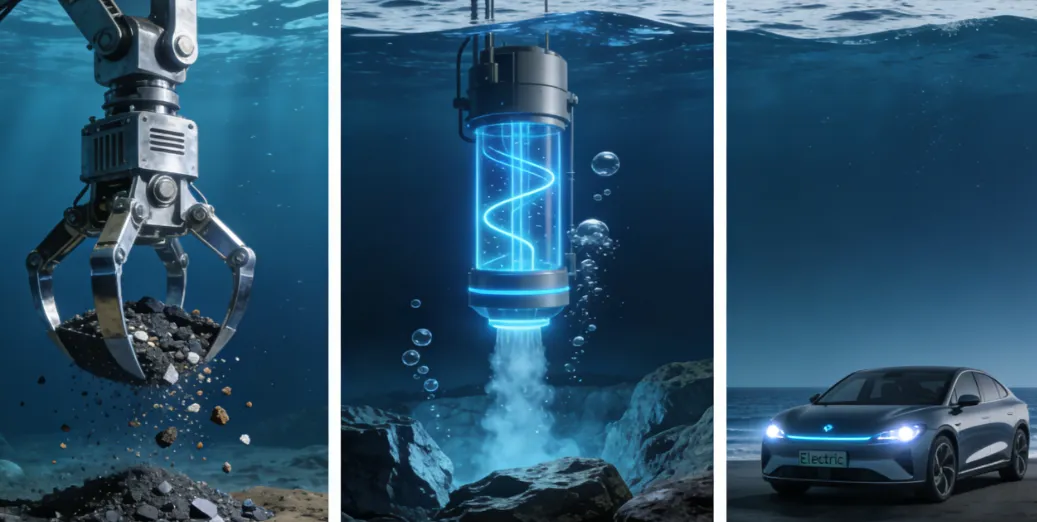
If you’re like most of us in the U.S. and Europe, you’ve probably hopped into an electric vehicle (EV) at some point—whether it’s a Tesla, a Volkswagen ID.4, or a Ford F-150 Lightning—and felt that quiet pride in doing your part for the planet. We’re told EVs are the future of transportation, the key to slashing our carbon footprints and fighting climate change. But what if I told you the “green” revolution under the hood of your EV is deeply connected to the darkest, most mysterious part of our planet: the deep sea? And what if that same deep sea could hold the solution to one of our biggest climate headaches—capturing the carbon we’re still pumping into the atmosphere?
Today, we’re diving into two critical topics that are reshaping our energy future, our economy, and our relationship with the ocean: deep-sea mining (DSM) for the minerals that power EV batteries, and deep-sea carbon capture (DSCC) as a tool to reverse climate change. As someone who’s followed energy and environmental trends for years—talking to experts, visiting EV factories, and even joining a research expedition to the continental shelf—I’m here to break down why these two issues matter to you: the everyday driver, the concerned citizen, and anyone who cares about building a sustainable future that doesn’t leave our planet behind.
Let’s start with the basics: Why does the deep sea matter for your EV? Spoiler: Without it, our transition to electric vehicles could stall. Then, we’ll explore how the same ocean that’s supplying our battery minerals could also help us clean up the carbon mess we’ve made. Along the way, we’ll tackle the big questions: Is deep-sea mining worth the environmental risk? Can carbon capture really make a difference? And what do these technologies mean for jobs, energy independence, and our planet’s most fragile ecosystems?
Part 1: Deep-Sea Mining—The Unsung Hero of the EV Revolution (Whether We Like It or Not)
First, let’s get real about EV batteries. You’ve probably heard terms like “lithium-ion” thrown around, but the truth is, EV batteries rely on a cocktail of critical minerals—many of which are in short supply on land. Cobalt, manganese, nickel, and copper are the workhorses here: cobalt keeps batteries stable and safe (no more fiery explosions), manganese boosts energy density (so you can drive farther on a single charge), and nickel and copper help conduct electricity efficiently. Without these minerals, your EV’s battery would be heavy, short-lived, and impractical.
Here’s the problem: On land, these minerals are hard to come by—and when we do find them, extracting them comes with a host of problems. In the Democratic Republic of the Congo (DRC), which supplies 70% of the world’s cobalt, mining is often done by hand in artisanal mines, with child labor, unsafe working conditions, and devastating environmental damage. In Australia, lithium mining uses massive amounts of water, drying up local aquifers and harming Indigenous communities. In Europe, most of our critical minerals are imported—from China, Russia, and other countries with questionable human rights records and geopolitical tensions that threaten our supply chains.
Enter the deep sea. Beneath the waves—400 meters to 6.5 kilometers below the surface—lie vast deposits of minerals that could solve our EV battery crisis. These aren’t your average rocks: they’re polymetallic nodules (round, potato-sized lumps scattered across the seabed), cobalt-rich crusts (hard layers on seamounts), and polymetallic sulfides (formed by hydrothermal vents). These deposits are packed with cobalt, manganese, nickel, and copper—often in higher concentrations than land-based mines—and they’re found in abundance across the world’s oceans, from the Clarion-Clipperton Zone (CCZ) in the Pacific to the waters off Norway and the U.S. East Coast¹.
For Americans and Europeans, this isn’t just a “nice-to-have”—it’s a matter of energy independence. Right now, we’re at the mercy of global supply chains for the minerals that power our EVs. If China cuts off our access to cobalt or nickel (as it’s threatened to do), our EV factories could grind to a halt, our auto workers could lose their jobs, and our goal of net-zero emissions by 2050 could be derailed. Deep-sea mining offers a way to secure a domestic (or at least Western-controlled) supply of these critical minerals. In the U.S., companies like The Metals Company (TMC) and Impossible Metals are already pushing to mine in U.S. waters, with TMC planning to apply for a mining license in 2025 to supply EV batteries for American carmakers³. In Europe, while the European Parliament has vowed to ban deep-sea mining until environmental risks are fully understood, countries like Norway have flirted with allowing exploration—highlighting the tension between our green goals and the need for mineral security⁴.
Let’s talk numbers, because they don’t lie. The International Energy Agency (IEA) estimates that by 2040, global demand for cobalt will increase by 21 times, nickel by 19 times, and manganese by 17 times—all driven by the EV revolution. Land-based mines simply can’t keep up. The CCZ alone, a 4.5-million-square-kilometer area in the Pacific, contains an estimated 21 billion tons of polymetallic nodules—enough cobalt to power 3 billion EV batteries, enough manganese to meet global demand for 300 years, and enough nickel to supply the world for 40 years¹. That’s not just a drop in the bucket—it’s a game-changer.
But here’s the catch: Deep-sea mining isn’t without its risks. The deep sea is one of the least explored places on Earth—we know more about the surface of the moon than we do about the seabed 10,000 feet below. It’s home to unique ecosystems: bioluminescent creatures, slow-growing corals that take thousands of years to form, and microbial communities that play a critical role in regulating our planet’s climate. Mining these areas could destroy habitats, disrupt marine life, and release sediment plumes that poison water and harm fish populations¹. In the CCZ alone, scientists have discovered over 5,000 animal groups, with an estimated 6,000 to 8,000 total species—many of which haven’t been named yet². Disturbing these ecosystems could lead to irreversible biodiversity loss, and we’re only just beginning to understand the long-term impacts.
As someone who cares about both the environment and the EV revolution, this is the crux of the issue: Do we sacrifice one for the other? Or can we mine responsibly? The good news is that technology is evolving. Modern deep-sea mining ships use remotely operated vehicles (ROVs) and autonomous underwater vehicles (AUVs) to minimize disturbance, and companies are developing “low-impact” mining techniques that avoid scraping the entire seabed³. Some experts argue that deep-sea mining is actually less harmful than land mining—no deforestation, no displacement of communities, no toxic runoff into rivers. But critics say the deep sea is too fragile to risk, and that we should focus on recycling EV batteries (which is growing but still in its early stages) and developing battery technologies that use fewer critical minerals.
For consumers, this debate hits close to home. Every time you buy an EV, you’re casting a vote for the future of mining. Do you want your battery to come from a land mine in the DRC, or from a deep-sea mine that’s regulated by Western environmental standards? It’s not a perfect choice, but it’s one we need to confront—because the EV revolution isn’t slowing down, and neither is our need for these minerals.
Part 2: Deep-Sea Carbon Capture—The Ocean’s Hidden Superpower in the Fight Against Climate Change
Now, let’s shift gears to another deep-sea technology that’s gaining traction: deep-sea carbon capture (DSCC). If deep-sea mining is about extracting resources to power our green future, deep-sea carbon capture is about storing the carbon we’re still emitting—keeping it out of the atmosphere and slowing global warming.
We all know the problem: Even as we transition to EVs and renewable energy, we’re still burning coal, oil, and gas to power our homes, factories, and transportation. Carbon dioxide (CO2) levels in the atmosphere are at an all-time high, driving rising temperatures, extreme weather, and sea-level rise. We need to not only cut emissions (the “mitigation” part) but also remove the CO2 that’s already in the air (the “removal” part). That’s where carbon capture comes in—and the deep sea could be our biggest ally.
Here’s how deep-sea carbon capture works: CO2 is captured from industrial sources (like power plants, steel mills, or cement factories) before it’s released into the atmosphere. It’s then compressed into a liquid or supercritical fluid (a state where it’s neither liquid nor gas) and transported to the deep sea—usually 1,000 meters or more below the surface—where it’s injected into geological formations (like depleted oil and gas reservoirs, saline aquifers, or even deep-sea sediments) that trap it permanently². The deep sea is ideal for this because it’s cold, high-pressure, and has vast storage capacity—estimates suggest the ocean’s geological formations can store trillions of tons of CO2, enough to absorb decades of global emissions².
For Americans and Europeans, this is a game-changer for our climate goals. The U.S. has set a target of net-zero emissions by 2050, and the EU has pledged to be carbon-neutral by 2050 as well. But even with aggressive EV adoption and renewable energy growth, we’ll still need to remove billions of tons of CO2 from the atmosphere to hit those targets. Deep-sea carbon capture can fill that gap. In fact, the International Panel on Climate Change (IPCC) says that carbon capture and storage (CCS)—including deep-sea storage—will be essential to limiting global warming to 1.5°C (the threshold to avoid the worst climate impacts).
Let’s look at real-world examples. In Europe, Norway has been a pioneer in offshore carbon capture. The Sleipner field in the North Sea has been storing CO2 in a saline aquifer 1,000 meters below the seabed since 1996—capturing over 20 million tons of CO2 to date. In the U.S., the Department of Energy (DOE) is investing billions of dollars in carbon capture projects, including deep-sea storage off the Gulf Coast. Even China has joined the fray, with its Enping 15-1 oilfield project capturing and storing over 100 million cubic meters of CO2—proving that deep-sea carbon capture is a global solution².
But like deep-sea mining, deep-sea carbon capture has its critics. Some environmentalists worry that injecting CO2 into the deep sea could harm marine life—lowering the pH of seawater (making it more acidic) or creating toxic plumes that kill fish and other organisms. Others fear that CO2 could leak from storage sites, re-entering the atmosphere and undoing our efforts. However, studies show that when done properly, deep-sea carbon capture is safe. The CO2 is stored in geological formations that are sealed by rock layers, preventing leakage, and the deep sea’s cold temperatures and high pressure help keep the CO2 stable². In the Sleipner field, for example, no significant leaks have been detected in over 25 years.
Another benefit? Deep-sea carbon capture can create jobs—something that’s top of mind for both Americans and Europeans. Building carbon capture facilities, transporting CO2, and maintaining storage sites requires skilled workers: engineers, technicians, sailors, and scientists. In the U.S., the DOE estimates that carbon capture could create over 100,000 jobs by 2030, many in communities that have been hit hard by the decline of the coal and oil industries. In Europe, the EU’s Green Deal includes funding for carbon capture projects, which will create jobs in countries like Norway, the UK, and Germany.
Part 3: What This Means for You—The Future of Energy, Jobs, and Our Planet
So, why should you care about deep-sea mining and deep-sea carbon capture? Let’s break it down into three key areas that affect every American and European:
1. Energy Independence and National Security
Right now, we’re dependent on foreign countries for the minerals that power our EVs and the energy that heats our homes. Deep-sea mining gives us a way to secure a domestic supply of cobalt, manganese, and nickel—reducing our reliance on China, Russia, and other geopolitical rivals. Deep-sea carbon capture allows us to reduce our dependence on fossil fuels by cleaning up the emissions from the ones we still use. Together, these technologies make us more energy independent, which is critical for our national security and economic stability.
2. Jobs and Economic Growth
The transition to EVs and renewable energy is already creating jobs—but deep-sea mining and carbon capture will take it to the next level. In the U.S., deep-sea mining could create jobs in coastal communities (like Louisiana, Texas, and California) that have been struggling with the decline of the oil and gas industry. Carbon capture projects will create jobs in manufacturing, construction, and research. In Europe, countries like Norway and the UK are already seeing job growth in offshore carbon capture, and deep-sea mining could bring similar opportunities to coastal regions. These are good, high-paying jobs that don’t require a college degree—perfect for communities that need economic revitalization.
3. The Environment and Our Legacy
At the end of the day, both technologies are about building a more sustainable future. EVs are critical for cutting emissions, but we need the minerals to make them—and deep-sea mining is a more ethical and environmentally friendly alternative to land mining (when done responsibly). Deep-sea carbon capture is essential for removing the CO2 we’ve already emitted, slowing climate change, and protecting our planet for future generations. Yes, there are risks—but doing nothing is riskier. If we don’t secure our mineral supply, the EV revolution will stall. If we don’t capture carbon, we’ll face more extreme weather, rising sea levels, and the loss of countless species.
The Bottom Line: We Can’t Have One Without the Other
Deep-sea mining and deep-sea carbon capture are two sides of the same coin. One provides the minerals we need to power our green future; the other cleans up the mess we’re still making. As Americans and Europeans, we have a choice: we can reject these technologies out of fear of the unknown, or we can embrace them—with strict regulations, robust oversight, and a commitment to protecting our oceans.
The key is balance. We need to ensure that deep-sea mining is done responsibly—with strict environmental standards, ongoing monitoring, and a commitment to restoring damaged ecosystems. We need to invest in research to make deep-sea carbon capture safer and more affordable. And we need to hold companies and governments accountable—because the ocean is a shared resource, and we all have a stake in its health.
As a blogger who’s passionate about sustainability and energy, I believe that these technologies are our best shot at building a future where we can drive EVs, power our homes with renewable energy, and protect our planet. It won’t be easy—there will be debates, setbacks, and hard choices—but it’s worth it. After all, the deep sea isn’t just a mystery to be explored; it’s a resource to be protected and used wisely.
So, the next time you plug in your EV, take a moment to think about the deep sea—about the minerals that power your battery and the carbon that’s being stored beneath the waves. It’s a reminder that our actions are connected to every part of our planet, and that we have the power to build a better future—one deep-sea technology at a time.
What do you think? Are you in favor of deep-sea mining for EV minerals? Do you think deep-sea carbon capture is the solution to our climate crisis? Let me know in the comments below—I’d love to hear your thoughts. And if you found this article helpful, share it with your friends and family—let’s start a conversation about the future of our ocean and our planet.
Leave a Reply