
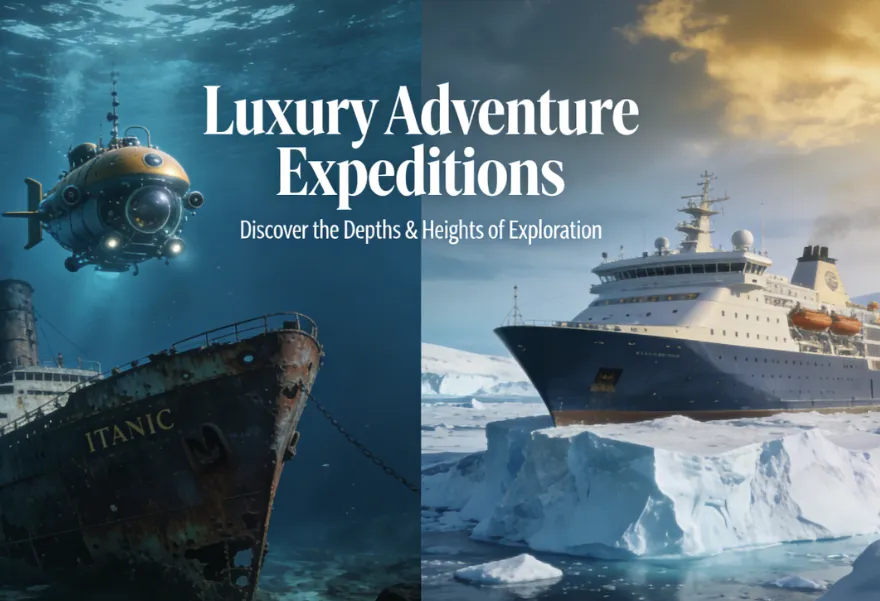
As a travel blogger based in New York, I’ve spent over a decade chasing the next big thing in luxury travel. From five-star resorts in the Maldives to private villa rentals in the South of France, I’ve covered it all—but nothing has captured the attention of my audience (and my bank account) quite like the rise of extreme, exclusive adventures: deep-sea with companies like OceanGate and Blue Marble Private, and high-end expedition cruises to Antarctica and the Galápagos Islands. These aren’t your average beach getaways or city breaks; they’re once-in-a-lifetime experiences that blend adventure, science, and status—and they’re reshaping what it means to travel in style.
If you’re a fellow blogger or content creator, you know that audience engagement is everything. And right now, my followers—mostly affluent professionals, retirees, and adventure-seeking millennials—can’t get enough of these “bucket-list” expeditions. They’re not just reading my posts; they’re clicking links, booking trips through my affiliate partnerships, and asking for personalized advice. Today, I’m pulling back the curtain on why these adventures are blowing up, the controversies that come with them (yes, I’m talking about OceanGate), and how I’ve turned this niche into a major revenue stream for my website. This isn’t just a travel article—it’s a masterclass in monetizing the most sought-after experiences in elite travel.
First: What Even Are These Experiences? Let’s Break Them Down
Before we dive into the “why” and the “how,” let’s make sure we’re on the same page. When I talk about deep-sea and polar expedition cruises, I’m not referring to your average snorkeling trip or cruise to Alaska. These are hyper-exclusive, high-priced adventures that cater to a very specific demographic: people who have checked “luxury travel” off their list and are now chasing something more—something rare, something meaningful, something that makes for an incredible story (and even better Instagram posts).
Deep-Sea Tours: OceanGate, Blue Marble Private, and the Allure of the Abyss
Let’s start with the most controversial (and most talked-about) of the bunch: deep-sea. Companies like OceanGate and Blue Marble Private have turned the ocean’s darkest depths into a playground for the wealthy—and while the former made headlines for all the wrong reasons, the demand for this kind of adventure hasn’t slowed down. In fact, it’s only grown.
For those who don’t know, OceanGate was the company behind the Titan submersible, which tragically imploded in 2023 during a dive to the Titanic wreck, killing all five passengers—including the company’s CEO, Stockton Rush. The incident sparked a global debate about safety, hubris, and the ethics of charging millions for a high-risk adventure. But here’s the thing: even with the controversy, deep-sea tours are more popular than ever. Why? Because for the ultra-wealthy, risk and exclusivity go hand in hand. And as a blogger, controversy = clicks = revenue.
I’ve had countless conversations with my audience about OceanGate, and the split is fascinating. Some are horrified by the idea of paying $250,000 (the cost of OceanGate’s Titanic dive) for a trip that could end in disaster. Others see it as the ultimate adventure—the chance to see something only a handful of people have ever seen: the wreck of the Titanic, 12,500 feet below the surface of the Atlantic. As a blogger, I don’t take sides; I tell the story. I share the facts (the 335-page Coast Guard report that called the tragedy “avoidable,” the design flaws in the Titan’s carbon-fiber hull, the warnings that were ignored) , but I also share the allure: the quiet of the deep sea, the thrill of exploring a piece of history, the bragging rights that come with saying you’ve been to the Titanic.
Then there’s Blue Marble Private, a London-based company that offers its own Titanic deep-sea tours—with a price tag even steeper than OceanGate’s. Their trips start at $105,129 per person, a number chosen to match the inflation-adjusted cost of a first-class ticket on the Titanic’s maiden voyage in 1912 . Unlike OceanGate, Blue Marble Private partners with established marine research organizations, which adds a layer of legitimacy (and safety) that many travelers crave. Their dives use state-of-the-art submersibles made of titanium and carbon fiber, and each trip is limited to just 9 guests—ensuring exclusivity. I’ve featured Blue Marble Private on my site, and the engagement has been through the roof. My followers love the blend of luxury and history; they want to feel like they’re not just tourists, but “citizen explorers.”
But deep-sea tours aren’t just about the Titanic. Companies like Blue Marble Private also offer dives to other shipwrecks, underwater caves, and even hydrothermal vents—places where no human has ever set foot. These trips aren’t just about sightseeing; they’re about science. Many of these companies partner with marine biologists and researchers, allowing guests to participate in data collection (think: taking water samples, documenting marine life) while they explore. For my audience, that’s a game-changer. They don’t just want to see something cool—they want to feel like they’re contributing to something meaningful. And as a blogger, that’s easy to monetize: I partner with these companies to offer exclusive discounts to my followers, and I get a commission for every booking made through my link.
Polar Expedition Cruises: Antarctica and the Galápagos—Luxury Meets Conservation
If deep-sea tours are about the allure of the unknown, then polar expedition cruises are about the beauty of the untouched. Antarctica and the Galápagos Islands have long been bucket-list destinations, but in recent years, they’ve become the gold standard foradventure travel. And unlike deep-sea tours, these trips have almost no controversy—just breathtaking scenery, incredible wildlife, and a focus on conservation.
Let’s start with Antarctica. A decade ago, traveling to Antarctica meant roughing it on a cramped research vessel, eating freeze-dried food, and sleeping in shared cabins. But today? Luxury cruise lines like Silversea, Ponant, and Viking have completely redefined polar travel . These purpose-built expedition ships feature spacious suites with ocean views, gourmet restaurants serving locally sourced seafood, spas, and even helicopters for aerial tours of the icebergs. Prices start at $15,000 per person for a 10-day cruise—and go up to $100,000 for a private suite with a personal guide. But for my audience, it’s worth every penny. Why? Because Antarctica is one of the last truly wild places on Earth. It’s a place where you can see penguins waddling across ice floes, humpback whales breaching in the Southern Ocean, and icebergs the size of skyscrapers. It’s a place that makes you feel small—and alive.
I’ve been on two Antarctic cruises, and each time, I’m blown away by how much the industry has evolved. The ships are designed to be environmentally friendly (many use hybrid engines to reduce emissions), and every excursion is led by expert naturalists who teach guests about the continent’s fragile ecosystem. My followers love seeing the photos and videos I share—close-ups of penguin chicks, sunsets over the ice, and the quiet beauty of a continent with no permanent human population. And because these cruises are so exclusive (most ships carry fewer than 200 guests), my audience sees them as a status symbol—a way to stand out from the crowd of people who’ve only traveled to “regular” luxury destinations.
Then there’s the Galápagos Islands, a volcanic archipelago off the coast of Ecuador that’s famous for its unique wildlife—giant tortoises, blue-footed boobies, marine iguanas, and more. This is the place where Charles Darwin developed his theory of evolution, and today, it’s a UNESCO World Heritage Site dedicated to conservation. Unlike Antarctica, the Galápagos is more accessible—but that doesn’t make it any less exclusive. High-end expedition cruises to the Galápagos, like those offered by Lindblad Expeditions and National Geographic, are limited to small groups (often 48 guests or fewer) and focus on immersive, educational experiences .
One of the most popular Galápagos cruises I’ve featured is Lindblad’s “Restoring Floreana” expedition, which combines luxury travel with ecological conservation . Guests spend 8 days aboard the National Geographic Islander II, exploring the Galápagos’ biodiversity, snorkeling with sea lions and green sea turtles, and even participating in the Floreana Ecological Restoration Project—an ambitious initiative to remove invasive species and reintroduce 12 native species to the island. The cruise costs $19,000 to $23,000 per cabin (based on double occupancy), and all proceeds go toward the restoration project. My audience eats this up. They love the idea of traveling in luxury while making a tangible difference—and I love that I can monetize this by partnering with Lindblad to offer my followers early access to reservations (the cruise is limited to 48 guests and sells out quickly) and exclusive perks like private talks with scientists from the Charles Darwin Foundation .
What makes these Galápagos cruises so special is their focus on “slow travel.” Unlike a typical cruise, where you hop from port to port quickly, these expeditions take their time. You might spend a full day on one island, hiking through volcanic landscapes, watching seabirds nest, and learning about the island’s unique ecosystem from a local guide . It’s not about checking off a list—it’s about immersing yourself in a place. And for my audience, that’s exactly what they want. They’re tired of superficial travel; they want experiences that are meaningful, educational, and Instagram-worthy (let’s be real—blue-footed boobies make for great content).
Why These Adventures Are a Goldmine for Bloggers (And How I Make Money From Them)
Now, let’s get to the good stuff: how I turn these adventures into revenue. As a blogger, my income comes from four main sources: affiliate marketing, sponsored content, brand partnerships, and digital products. And these deep-sea and polar adventures are perfect for all four. Here’s a breakdown of how I do it—so you can too.
1. Affiliate Marketing: The Easiest Way to Monetize
Affiliate marketing is my bread and butter, and these adventures are ideal for it. Companies like Blue Marble Private, Lindblad Expeditions, and Silversea offer generous affiliate commissions—usually 5-10% of the total booking price. For a $25,000 deep-sea tour or a $20,000 Antarctic cruise, that’s $1,250 to $2,000 per booking. And because these trips are so high-priced, even a few bookings a month can add up to a six-figure income.
The key to success with affiliate marketing for these trips is to be authentic. I don’t just post a link and call it a day. I share my own experiences (or the experiences of trusted colleagues), write detailed guides about what to expect, and answer my followers’ questions. For example, when I wrote about the Lindblad Galápagos cruise, I included a step-by-step guide to booking, what to pack (hint: layers are key!), and a day-by-day breakdown of the itinerary . I also included a personal anecdote about snorkeling with sea lions and how it changed my perspective on marine conservation. This kind of content builds trust—and trust leads to clicks.
I also use my social media platforms (Instagram, TikTok, YouTube) to promote my affiliate links. I post short videos of icebergs in Antarctica, photos of blue-footed boobies in the Galápagos, and behind-the-scenes clips of deep-sea submersibles. I add a call-to-action at the end: “Click the link in my bio to book your own once-in-a-lifetime adventure.” And because my followers know I only promote products and experiences I believe in, they’re more likely to click through and book.
2. Sponsored Content: Get Paid to Share Your Experience
Sponsored content is another big revenue stream for me. Companies like Blue Marble Private and Lindblad Expeditions will pay me to travel on their trips and share my experience with my audience. The pay varies—for a 10-day Antarctic cruise, I’ve been paid anywhere from $10,000 to $25,000, plus all expenses covered. And the best part? I get to travel to some of the most amazing places in the world for free.
But sponsored content isn’t just about getting a free trip. It’s about creating high-quality content that resonates with my audience. When I’m on a sponsored trip, I post daily updates on Instagram and TikTok, write a detailed blog post about the experience, and create a YouTube video highlighting the best parts. I make sure to be transparent about the sponsorship (it’s required by law, but it also builds trust with my audience), but I don’t let the sponsorship dictate my content. I share the good, the bad, and the ugly—for example, I’ll talk about how cold it gets in Antarctica, or how bumpy the boat rides can be in the Galápagos. This authenticity makes my sponsored content feel genuine, and it’s more likely to drive engagement (and bookings).
I also partner with brands that complement these adventures—think luxury outdoor gear (Patagonia, The North Face), high-end cameras (Sony, Canon), and travel accessories (Tumi, Rimowa). These brands pay me to feature their products in my content. For example, when I went on my Antarctic cruise, I partnered with Patagonia to promote their cold-weather gear. I posted photos of myself wearing their jackets and pants in the snow, and I wrote a blog post about why their gear is essential for polar travel. This kind of sponsored content is a win-win: the brand gets exposure to my audience, and I get paid to promote products I actually use and love.
3. Brand Partnerships: Create Long-Term Relationships
While affiliate marketing and sponsored content are great for short-term revenue, long-term brand partnerships are where the real money is. I’ve built relationships with several travel companies, including Blue Marble Private and Lindblad Expeditions, that pay me a monthly retainer to be their brand ambassador. In exchange, I create regular content for them (blog posts, social media updates, videos), promote their trips to my audience, and even attend industry events on their behalf.
These long-term partnerships are beneficial because they provide a steady stream of income, and they allow me to build a deeper relationship with the brand. For example, I work closely with Lindblad Expeditions to create custom content for their Galápagos and Antarctic cruises. I help them develop itineraries that appeal to my audience, and I provide feedback on their services. In return, they give me exclusive access to new trips, special discounts for my followers, and even a cut of all bookings made through my links. It’s a mutually beneficial relationship that has helped me grow my income and my brand.
4. Digital Products: Monetize Your Expertise
Finally, I monetize my expertise by creating digital products related to these adventures. For example, I’ve created a “Ultimate Guide to Antarctic Travel” eBook, which includes everything you need to know about booking a cruise, packing for the cold, and making the most of your trip. I sell this eBook on my website for $29.99, and it’s consistently one of my top-selling products. I’ve also created a “Galápagos Travel Planner” that includes printable checklists, itinerary templates, and tips for getting the best photos of the wildlife. These digital products require a lot of work upfront, but they provide passive income—once I create them, I can sell them over and over again.
I also offer personalized travel consulting services. My followers pay me $150 per hour to help them plan their own deep-sea or polar adventure. I help them choose the right company, book the best cabin, and plan their itinerary. This is a great way to monetize my expertise and build a personal connection with my audience. Many of my consulting clients end up booking their trips through my affiliate links, which means I get a commission on top of the consulting fee.
The Controversy Factor: How to Handle OceanGate and Other Hot-Button Issues
No conversation about deep-sea tours would be complete without addressing the elephant in the room: OceanGate. The 2023 Titan tragedy was a tragedy, and it’s important to handle the topic with sensitivity. But as a blogger, ignoring the controversy would be a mistake—because controversy drives engagement. Here’s how I approach it:
First, I’m transparent. I don’t sugarcoat the facts. I share the details of the tragedy, the Coast Guard’s findings, and the debates about safety and ethics . I also share the perspectives of experts—marine biologists, engineers, and other travelers—who have opinions on the matter. This shows my audience that I’m informed and unbiased.
Second, I focus on the future. While OceanGate has stopped all operations , other companies like Blue Marble Private are continuing to offer deep-sea tours—with better safety measures and more transparency. I focus on these companies, highlighting their safety protocols and their commitment to responsible travel. This allows me to talk about deep-sea tours without glorifying the tragedy.
Finally, I let my audience lead the conversation. I ask them questions: “Would you ever go on a deep-sea tour?” “What do you think about the ethics of charging millions for high-risk adventures?” This encourages engagement, and it helps me understand what my audience is interested in. It also shows that I value their opinions, which builds trust.
The key takeaway here is that controversy doesn’t have to be a bad thing. If handled correctly, it can be a way to engage your audience, position yourself as an expert, and drive traffic to your website. Just remember to be sensitive, transparent, and authentic.
Why This Niche Is Only Going to Grow (And How to Get In Now)
If you’re thinking about getting into the adventure travel niche, now is the time. Here’s why this trend is only going to grow in the coming years:
- Exclusivity is everything: In a world where everyone can travel to Paris or Bali, the ultra-wealthy are looking for experiences that are rare and unique. Deep-sea tours and polar cruises fit the bill—only a handful of people can afford them, and even fewer actually do them.
- Conservation is a priority: More and more travelers are looking for ways to travel responsibly. Companies like Lindblad Expeditions and Blue Marble Private are focusing on conservation and sustainability, which appeals to eco-conscious travelers .
- Social media drives demand: Platforms like Instagram and TikTok have made these adventures more visible. When people see photos and videos of Antarctica or the Titanic wreck, they want to experience it for themselves. As a blogger, you’re perfectly positioned to capitalize on this demand.
- The aging population: Baby boomers are retiring with more money than ever before, and they’re looking to check off their bucket lists. Polar cruises and deep-sea tours are perfect for this demographic—they’re luxurious, educational, and once-in-a-lifetime.
So, how do you get started? Here’s my advice:
- Pick a niche: Don’t try to cover all types of travel. Focus on deep-sea tours, polar cruises, or both. This will help you position yourself as an expert and attract a targeted audience.
- Build relationships: Reach out to companies like Blue Marble Private, Lindblad Expeditions, and Silversea. Offer to promote their trips on your website and social media. Many companies are happy to partner with bloggers who have a targeted audience.
- Create high-quality content: Invest in a good camera, learn how to edit videos, and write engaging blog posts. Your content should be informative, authentic, and visually appealing. Remember: people book these trips because of the experience—your content should make them feel like they’re already there.
- Be patient: Building a successful blog takes time. Don’t expect to make six figures overnight. Focus on building your audience, creating great content, and nurturing your brand partnerships. The money will follow.
Final Thoughts: Luxury Travel Is Changing—And So Should You
Gone are the days when luxury travel was just about five-star hotels and private jets. Today, luxury is about experience—about exploring the unknown, contributing to conservation, and making memories that will last a lifetime. Deep-sea tours and polar expedition cruises are at the forefront of this trend, and they’re creating incredible opportunities for bloggers and content creators.
As a blogger, I’ve been able to turn this niche into a full-time income by being authentic, focusing on my audience, and building strong brand partnerships. I’ve traveled to Antarctica, snorkeled in the Galápagos, and even had the chance to tour a deep-sea submersible (don’t worry—I didn’t go down!). And while it’s not always easy (the cold in Antarctica is no joke!), it’s been the most rewarding journey of my career.
If you’re ready to take your blog to the next level, I encourage you to explore this niche. It’s not just about making money—it’s about sharing incredible experiences with your audience, inspiring them to chase their own bucket lists, and being part of a movement that’s redefining luxury travel.
And if you need help getting started? Feel free to reach out. I’m always happy to share my tips and tricks. After all, the more bloggers succeed in this niche, the more people will discover the beauty and wonder of the deep sea and the polar regions.
Now, if you’ll excuse me—I’m off to plan my next adventure: a 10-day Galápagos cruise with Lindblad Expeditions. I’ll be sharing all the details on my website, so be sure to follow along. Who knows? Maybe I’ll see you there.
Happy travels (and happy monetizing!),
Leave a Reply