
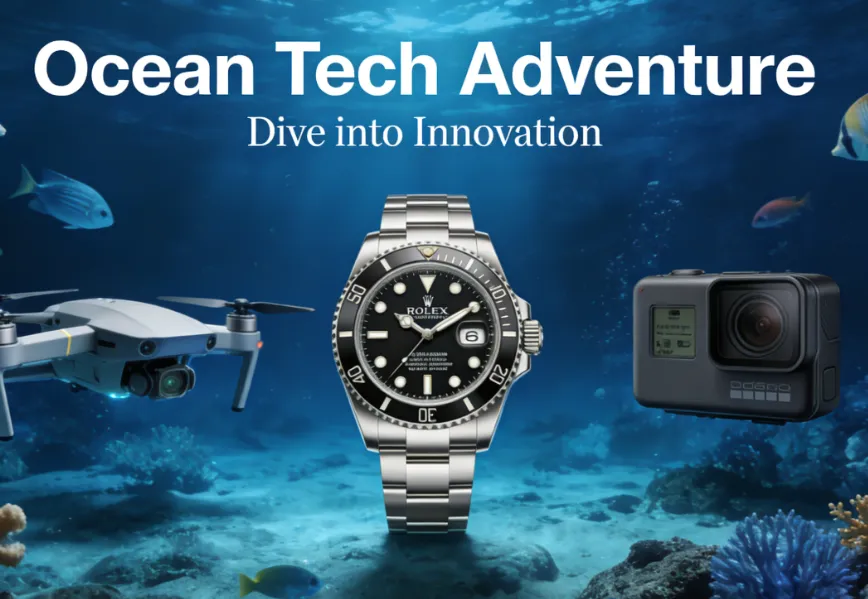
If you’re anything like me—someone who’s spent countless weekends chasing the thrill of the ocean, whether it’s scuba diving in the Caribbean, snorkeling off the coast of Hawaii, or simply marveling at the mysteries of the deep from the deck of a boat—you know that the right underwater gear isn’t just a “nice-to-have.” It’s the bridge between us and the 71% of our planet that’s covered in water, a world filled with vibrant coral reefs, elusive marine life, and hidden wonders we’re only just beginning to discover.
Today, we’re diving deep (pun absolutely intended) into the gear that makes exploring the underwater world possible, safe, and stylish. We’ll cover four categories that every ocean enthusiast, from casual snorkelers to professional divers and marine researchers, should know about: deep-sea submersibles, underwater drones (ROVs), luxury dive watches (think Rolex Submariner and Omega Seamaster), and high-performance underwater photography equipment. By the end of this guide, you’ll not only understand how each piece of gear works—you’ll also know which ones are worth investing in, whether you’re looking to level up your diving game, capture stunning underwater content, or simply own a timeless accessory that pays homage to the sea.
As a blogger who’s built a following around outdoor and aquatic adventures, I can tell you firsthand: content about underwater gear performsexceptionally well. Readers are obsessed with the intersection of technology, luxury, and adventure—and brands are eager to partner with creators who can speak to this niche authentically. So, not only is this guide packed with valuable information for your audience—it’s also designed to help you attract sponsorships, drive affiliate sales, and grow your income. Let’s dive in.
1. Deep-Sea Submersibles: Exploring the Abyss Like Never Before
When most of us think of underwater exploration, we picture scuba divers in wetsuits, gliding through shallow reefs. But the true frontier of the ocean lies in the deep—depths where sunlight can’t reach, pressure is crushing, and the environment is so extreme that even the most experienced divers can’t venture there. That’s where deep-sea submersibles come in. These incredible machines are the unsung heroes of marine exploration, allowing us to reach depths of 10,000 meters (32,808 feet) or more—places where only a handful of humans have ever set foot (or, more accurately, hull).
For context: The average depth of the ocean is 3,600 meters (2.23 miles), and the Mariana Trench—the deepest point on Earth—plummets to 10,909 meters (35,787 feet). At that depth, the pressure is equivalent to 1,100 atmospheres, or about 16,000 pounds per square inch. To put that in perspective: if you took a car to that depth, it would be crushed into a metal ball the size of a basketball. Deep-sea submersibles are engineered to withstand this punishment, using materials like titanium (which is stronger than steel and resistant to corrosion) and advanced pressure-sealing technology to keep their occupants safe.
Unlike scuba diving, which relies on the diver’s ability to regulate their buoyancy and air supply, submersibles are fully enclosed vessels that carry a small crew (usually 2-3 people) and a suite of scientific equipment. They’re powered by electric motors, which are quiet enough to avoid disturbing marine life, and equipped with high-definition cameras, robotic arms, and sensors that collect data on water temperature, pressure, and marine biology.
While most of us will never get to ride in a deep-sea submersible (they’re incredibly expensive—costing millions of dollars to build and operate), they’re a critical part of our understanding of the ocean. Organizations like NOAA (National Oceanic and Atmospheric Administration) use submersibles like the Alvin (operated by Woods Hole Oceanographic Institution) to explore hydrothermal vents, study deep-sea ecosystems, and even discover new species of marine life. The Alvin, which has been in operation since 1964, can reach depths of 4,500 meters and has carried more than 4,000 scientists to the deep sea over the years.
In recent years, there’s also been a rise in “tourist submersibles,” which allow wealthy adventurers to pay tens of thousands of dollars for a chance to visit the Titanic wreck or the Mariana Trench. While these trips are controversial (due to safety concerns and environmental impact), they’ve brought deep-sea exploration into the mainstream and sparked a new interest in the gear that makes it possible.
For your blog: Deep-sea submersibles are a great topic to cover if you want to tap into the “adventure luxury” niche. You can write about the latest submersible technology, interview marine scientists who’ve worked on submersible missions, or even review documentaries about deep-sea exploration. Brands that make marine equipment, scientific gear, or luxury travel experiences may be interested in partnering with you for this content.
2. Underwater Drones (ROVs): The Future of Underwater Exploration for Everyone
If deep-sea submersibles are the “supercars” of underwater gear, then underwater drones—also known as ROVs (Remotely Operated Vehicles)—are the accessible, everyday alternative. ROVs are unmanned underwater vehicles that are controlled remotely from the surface, usually via a cable (called a “tether” or “umbilical cable”) that connects them to a boat or shore-based controller. Unlike AUVs (Autonomous Underwater Vehicles), which operate independently on pre-programmed routes, ROVs offer real-time control, making them perfect for exploration, photography, and even light underwater work.
What makes ROVs so game-changing is their accessibility. Just a few years ago, ROVs were only used by scientists, oil companies, and the military. But today, you can buy a consumer-grade ROV for as little as $500, making underwater exploration accessible to anyone with a passion for the ocean. Whether you’re a snorkeler who wants to see what’s beyond the reef, a fisherman who wants to scout for fish, or a content creator who wants to capture stunning underwater footage without getting wet, an ROV is the perfect tool.
Let’s break down the key features of ROVs that matter to everyday users:
- Tether Length: The length of the cable determines how deep and how far the ROV can go. Consumer ROVs typically have tethers between 10 and 100 meters, while professional models can have tethers that stretch for kilometers. For most casual users, a 50-meter tether is more than enough for exploring reefs, lakes, or the shallow ocean.
- Camera Quality: Most ROVs come equipped with HD or 4K cameras, which are perfect for capturing underwater photos and videos. Some models even have night vision or low-light capabilities, allowing you to explore dark underwater caves or dive at dusk.
- Buoyancy and Maneuverability: ROVs are designed to be stable and easy to control, even in choppy water. They use thrusters to move up, down, left, and right, and many have built-in stabilizers to keep the camera steady.
- Accessories: Many consumer ROVs come with add-ons like robotic arms (for picking up small objects), LED lights (to illuminate dark areas), and GPS (to track the ROV’s location).
For professional users—like marine biologists, underwater photographers, or search-and-rescue teams—ROVs are even more powerful. Professional ROVs can reach depths of 6,000 meters or more, carry heavy scientific equipment, and perform complex tasks like collecting samples, repairing underwater infrastructure, or searching for sunken ships. The Chinese “Haima” (Sea Horse) ROV, for example, can dive to 4,500 meters and perform tasks like sediment sampling and heat flow measurement with 90%国产化率 (localization rate).
As a blogger, ROVs are a goldmine for content. You can review the latest consumer ROV models (I recommend testing ones from brands like Chasing, QYSEA, and PowerVision), create tutorials on how to use them, or share stunning footage you’ve captured with your ROV. Affiliate marketing is huge here—many ROV brands offer affiliate programs, so you can earn a commission for every sale you drive. You can also partner with dive shops, marine tour companies, or outdoor gear brands to create sponsored content about ROVs.
3. Luxury Dive Watches: Rolex Submariner, Omega Seamaster, and the Timeless Appeal of Underwater Style
When it comes to underwater gear, few pieces are as iconic—or as versatile—as the luxury dive watch. These watches aren’t just timepieces; they’re a statement of adventure, durability, and style. For decades, dive watches have been worn by divers, explorers, and style enthusiasts alike, and brands like Rolex and Omega have become synonymous with underwater excellence.
The best dive watches are engineered to withstand the harsh conditions of the ocean—high pressure, saltwater corrosion, and low light—while still looking sleek enough to wear with a suit or casual outfit. Let’s take a deep dive (again, pun intended) into two of the most famous dive watches on the market: the Rolex Submariner and the Omega Seamaster.
Rolex Submariner: The Icon That Defined Dive Watches
No discussion of dive watches is complete without the Rolex Submariner. First introduced in 1953, the Submariner was the first watch to be water-resistant to 100 meters (330 feet)—a groundbreaking achievement at the time. Today, modern Submariner models are water-resistant to 300 meters (984 feet) and feature a range of upgrades that make them both functional and stylish.
What makes the Submariner so special? Let’s break down its key features:
- Unidirectional Rotating Bezel: This is the Submariner’s most recognizable feature. The bezel (the ring around the watch face) rotates only counterclockwise, which is a safety feature—if the bezel is accidentally moved underwater, it will only show a longer dive time, not a shorter one, preventing divers from miscalculating their air supply. The bezel is made of ceramic (on modern models), which is scratch-resistant and resistant to fading.
- Oyster Case: The Submariner’s Oyster case is made of 904L stainless steel (a high-grade steel that’s more corrosion-resistant than standard stainless steel) and features a screw-down crown and case back, which creates a watertight seal. This design is what makes the Submariner so durable and water-resistant.
- Caliber 3235 Movement
- Luminous Markers: The Submariner’s dial features large, luminous hour markers and hands, which are easy to read in low-light conditions—critical for divers who need to track their dive time underwater.
The Submariner isn’t just a dive watch—it’s a status symbol. It’s been worn by everyone from James Bond (in the early films) to professional divers to Hollywood celebrities, and its timeless design means it never goes out of style. The current retail price for a stainless steel Submariner (126610LN) is around $8,100, but due to high demand and limited availability, it often sells for more on the secondary market. This exclusivity only adds to its appeal.
Omega Seamaster: The Dive Watch Fit for a Spy (and Everyone Else)
If the Rolex Submariner is the “classic” dive watch, the Omega Seamaster is the “modern, versatile” alternative. First introduced in 1948, the Seamaster was originally designed for military use, but it gained worldwide fame when it was worn by James Bond in the 1995 film GoldenEye. Today, the Seamaster Diver 300M is one of Omega’s most popular models—and a favorite among divers and style enthusiasts alike.
Let’s compare the Seamaster Diver 300M (reference 210.30.42.20.01.001) to the Rolex Submariner:
- Water Resistance: Like the Submariner, the Seamaster Diver 300M is water-resistant to 300 meters (984 feet), making it suitable for most recreational diving.
- Case and Bezel: The Seamaster features a 42mm stainless steel case (slightly larger than the Submariner’s 41mm case) and a ceramic unidirectional rotating bezel. The bezel has a wave pattern, which pays homage to the watch’s marine heritage. The Seamaster also has a helium escape valve, which is a feature designed for professional divers who spend extended periods underwater in saturation chambers.
- Caliber 8800 Movement: The Seamaster is powered by Omega’s Caliber 8800, a self-winding movement that’s certified as a Master Chronometer—meaning it’s resistant to magnetic fields up to 15,000 gauss (far more than the average magnetic field). The movement has a 55-hour power reserve, which is slightly less than the Submariner’s 70 hours, but still more than enough for everyday wear.
- Design: The Seamaster has a more contemporary design than the Submariner, with a wave-patterned dial and an integrated bracelet that’s more sporty and comfortable. It’s also more affordable than the Submariner, with a retail price of around $5,200—making it a great option for those who want a luxury dive watch without the Rolex price tag.
Both the Rolex Submariner and Omega Seamaster are excellent choices, but they cater to different tastes. The Submariner is perfect for those who want a timeless, classic watch that’s steeped in history, while the Seamaster is ideal for those who want a modern, versatile watch that’s both functional and stylish.
For your blog: Luxury dive watches are a fantastic niche to cover, as they appeal to both watch enthusiasts and adventure seekers. You can write comparison articles (like this one), review new models, share styling tips (how to wear a dive watch with casual or formal outfits), or even interview watch collectors. Luxury watch brands are always looking for creators to promote their products, so you can attract sponsorships or affiliate partnerships with brands like Rolex, Omega, TAG Heuer, and Breitling.
4. High-Performance Underwater Photography Equipment: Capture the Ocean’s Beauty in Stunning Detail
There’s nothing quite like capturing the beauty of the underwater world—vibrant coral reefs, schools of colorful fish, and hidden underwater caves—but doing so requires specialized photography equipment. Regular cameras and smartphones aren’t designed to withstand saltwater, pressure, or low light, which is why underwater photographers rely on high-performance gear that’s built for the ocean.
Whether you’re a casual photographer who wants to capture memories of your snorkeling trips or a professional who sells underwater photos and videos, the right equipment can make all the difference. Let’s break down the key types of underwater photography gear you need to know about:
Underwater Cameras: Compact, Mirrorless, and DSLR
The first decision you’ll need to make is what type of camera to use. There are three main options for underwater photography:
- Compact Underwater Cameras: These are the most accessible option for casual users. They’re small, lightweight, and designed specifically for underwater use, with built-in waterproofing (no need for a separate housing). Compact underwater cameras like the Olympus TG-7 or the Nikon Coolpix W300 are water-resistant to 30 meters (98 feet) and feature built-in underwater modes that adjust the settings for low light and color correction. They’re perfect for snorkelers or casual divers who want to capture quick photos and videos without carrying heavy gear.
- Mirrorless Cameras with Underwater Housings: For more serious photographers, mirrorless cameras are a great choice. They’re smaller and lighter than DSLRs but offer similar image quality, and they’re compatible with a wide range of lenses. To use a mirrorless camera underwater, you’ll need a specialized underwater housing (which is waterproof and pressure-resistant). Brands like Sony, Fujifilm, and Olympus make mirrorless cameras that are popular among underwater photographers, and companies like Nauticam and Ikelite make high-quality housings for them.
- DSLR Cameras with Underwater Housings: DSLRs are the gold standard for professional underwater photography. They offer the highest image quality, the most advanced features, and the ability to use a wide range of lenses (including macro lenses for close-up shots of small marine life and wide-angle lenses for capturing large reefs or shipwrecks). Like mirrorless cameras, DSLRs require an underwater housing, which can be expensive (often costing as much as the camera itself). Canon and Nikon are the top brands for DSLR underwater photography, with models like the Canon EOS 5D Mark IV and the Nikon D850 being popular choices.
Action Cameras: Perfect for Adventure and Video
If you’re more interested in capturing video than photos, action cameras like the GoPro Hero 13 Black or the DJI Osmo Action 4 are perfect for underwater use. These cameras are small, durable, and designed to withstand extreme conditions—including saltwater, pressure, and impact. They’re also incredibly versatile, with features like 4K video, slow-motion, and image stabilization, which are perfect for capturing dynamic underwater footage.
To take your action camera underwater, you’ll need a waterproof housing (most action cameras are waterproof to 10 meters without a housing, but a housing will allow you to dive deeper—up to 60 meters for the GoPro Hero 13 Black with its protective housing). You can also add accessories like underwater filters (to correct color distortion), floating hand grips (to keep the camera from sinking), and extension poles (to get better angles).
GoPro, in particular, has a range of dive-specific accessories, including the PolarPro DiveMaster Filter Kit (which includes red, magenta, and snorkel filters for different water conditions) and the 3-Way 2.0 mount (which can be used as a grip, extension pole, or tripod).
Accessories That Take Your Underwater Photography to the Next Level
No underwater photography setup is complete without the right accessories. Here are the must-have accessories for any underwater photographer:
- Underwater Strobes (Flashes): Light fades quickly underwater, so a strobe is essential for capturing bright, colorful photos. Strobes are mounted on the camera housing and trigger automatically when you take a photo, illuminating the subject and bringing out the vibrant colors of the underwater world.
- Lenses: For macro photography (capturing small marine life like seahorses or nudibranchs), a macro lens is a must. For wide-angle photography (capturing large reefs or shipwrecks), a wide-angle lens is essential. Many underwater photographers also use fisheye lenses for dramatic, immersive shots.
- Underwater Filters: Water absorbs light, which can make underwater photos look blue or green. Underwater filters correct this color distortion, making your photos look more vibrant and true to life. Red filters are great for deep water (15-75 feet), while magenta filters are ideal for green water (like in lakes or rivers).
- Camera Housing: As mentioned earlier, if you’re using a mirrorless or DSLR camera, you’ll need a waterproof housing. Look for a housing that’s rated for the depth you’ll be diving to, and make sure it’s compatible with your camera and lenses.
For your blog: Underwater photography is a highly visual niche, which makes it perfect for engaging content. You can share photo tutorials, review the latest cameras and accessories, post your own underwater photos and videos, or even teach your audience how to edit underwater photos (color correction is key!). You can partner with camera brands (like Canon, Nikon, GoPro, and Olympus), underwater housing brands (like Nauticam and Ikelite), and even dive shops to create sponsored content. Affiliate marketing is also a great way to earn income here—you can promote cameras, accessories, and even underwater photography courses.
Final Thoughts: How to Monetize Your Underwater Gear Content
Now that you know all about deep-sea submersibles, ROVs, luxury dive watches, and underwater photography equipment, let’s talk about how to turn this content into income. As a欧美博主 (Western blogger), your audience is likely interested in adventure, luxury, and technology—and brands are willing to pay to reach them. Here are my top tips for monetizing your underwater gear content:
- Affiliate Marketing: Sign up for affiliate programs with brands like Rolex, Omega, GoPro, Canon, and ROV manufacturers. Include affiliate links in your blog posts, reviews, and social media content, and earn a commission for every sale you drive.
- Sponsored Content: Partner with brands to create sponsored blog posts, videos, or social media posts. For example, a watch brand might pay you to review their new dive watch, or an ROV brand might send you a product to test and share with your audience.
- Digital Products: Create digital products like an underwater photography guide, a dive watch buying guide, or a tutorial on how to use an ROV. You can sell these products on your website or through platforms like Etsy or Gumroad.
- Coaching or Workshops: If you’re an experienced diver or underwater photographer, offer coaching sessions or workshops to teach your audience how to use underwater gear or take better underwater photos.
- Ad Revenue: If your website has a lot of traffic, you can earn ad revenue by displaying ads from platforms like Google AdSense or Mediavine.
The key to success in this niche is authenticity. Your audience follows you because they trust your opinion, so always be honest in your reviews and recommendations. Whether you’re raving about a new GoPro or comparing the Rolex Submariner to the Omega Seamaster, your genuine passion for the ocean and underwater gear will shine through—and that’s what will keep your audience coming back for more.
So, what are you waiting for? Grab your gear (or your ROV, or your dive watch) and start exploring—and start creating content that will help you grow your blog and your income. The ocean is full of wonders, and your audience is ready to dive in with you.
Let me know in the comments: What’s your favorite piece of underwater gear? Have you ever used an ROV, worn a luxury dive watch, or captured stunning underwater photos? I’d love to hear your stories!
Leave a Reply