
Beneath the sunlit surface of our oceans lies a world so alien, so unforgiving, that it often feels more like outer space than a part of Earth. We’re talking about the **abyssal zone**—a pitch-black realm where pressure crushes like a thousand elephants, temperatures hover near freezing, and food is so scarce that every meal is a matter of life or death. For millions of years, one creature has ruled this dark frontier not with brute strength, but with evolutionary trickery so wild it sounds like science fiction: the deep-sea anglerfish.
You’ve probably seen glimpses of these oddballs in documentaries, memes, or even animated films—those nightmarish little fish with a glowing “fishing rod” sprouting from their heads and jaws full of needle-sharp teeth. But the anglerfish is far more than a viral deep-sea oddity. It’s a masterclass in adaptation, a living puzzle that has stunned marine biologists for decades, and a perfect example of how life finds a way to thrive in the harshest corners of the planet. For Western audiences fascinated by weird wildlife, unsolved natural mysteries, and the thrill of deep-sea exploration, the anglerfish isn’t just a creature—it’s a story that keeps getting more incredible the deeper we dive.
What Even Is a Deep-Sea Anglerfish? (Beyond the Scary Memes)
First, let’s get the basics straight: anglerfish belong to the order **Lophiiformes**, a diverse group of fish with more than 300 known species spread across the world’s oceans. While some anglerfish live in shallow, coastal waters, the ones that capture our collective imagination are the **deep-sea species**—those that dwell 1,000 to 4,000 meters below the surface, in the complete darkness of the bathypelagic and abyssal zones.
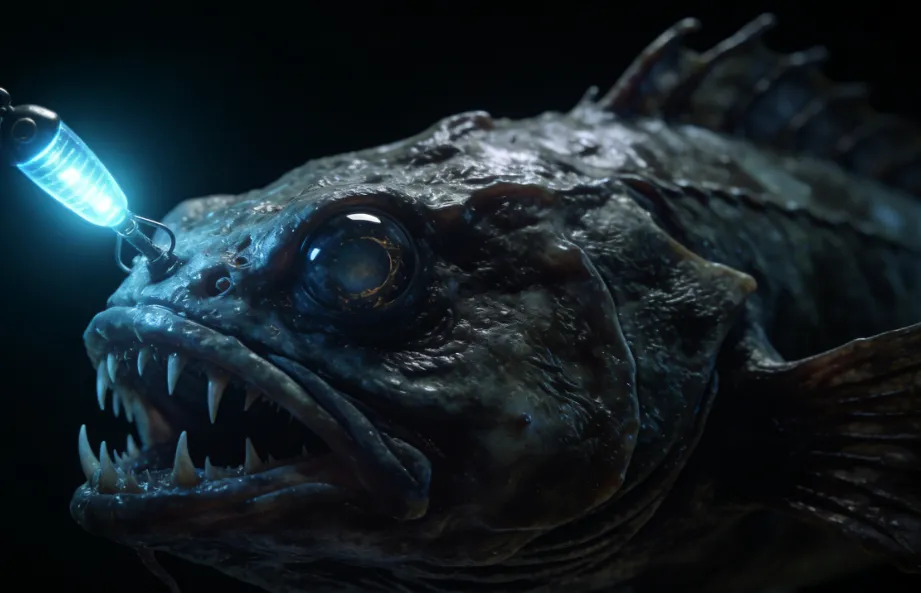
At first glance, these fish look like they were cobbled together from spare parts. Most deep-sea anglerfish females (we’ll get to why we specify “females” in a minute) have a flattened, blob-like body, a massive head that makes up nearly half their length, and a gaping mouth lined with translucent, fang-like teeth that curve inward—perfect for trapping prey so it can’t escape. Their skin is typically a dull, dark brown or black, camouflaging them perfectly in the inky dark, and they lack scales, giving them a slimy, almost alien texture.
But the anglerfish’s most iconic feature is its **esca**—the bioluminescent “lure” that dangles from a modified spine called an illicium, sticking right out above its mouth. This isn’t just a random decoration; it’s the fish’s namesake and its most vital tool. Think of it as a tiny, glowing fishing pole built into its body, designed to lure unsuspecting prey close enough to strike.
The Glow: How Anglerfish Light Up the Abyss (And Why It Matters)
Bioluminescence is one of the ocean’s most magical superpowers, and anglerfish have perfected it. Unlike some deep-sea creatures that produce their own light through chemical reactions, most deep-sea anglerfish don’t make light on their own—they team up with tiny, glowing bacteria that live inside their esca. This symbiotic relationship is a win-win: the bacteria get a safe, nutrient-rich home, and the anglerfish gets a built-in flashlight to hunt in the dark.
The glow itself is usually a soft blue or green, the only wavelengths of light that travel far in deep water. To an unsuspecting fish or shrimp wandering the abyss, that tiny flicker looks like a bioluminescent plankton or a wounded prey item—easy pickings. But when they dart in for a snack, they’re greeted by the anglerfish’s lightning-fast strike: its jaws can expand to swallow prey twice its size, and its stretchy stomach lets it gorge on meals that will sustain it for weeks, even months, in a world where food is few and far between.
This hunting strategy is genius for the abyssal zone. In a place where swimming long distances burns precious energy, the anglerfish doesn’t chase prey—it waits. It’s a sit-and-wait predator that conserves every calorie, a survival hack honed over millions of years of evolution. For scientists and curious readers alike, this adaptation isn’t just cool; it’s a window into how life evolves to handle extreme scarcity.
The Wildest Part: Anglerfish Mating (Yes, It’s As Crazy As You’ve Heard)
If the anglerfish’s hunting tactics aren’t mind-blowing enough, its mating ritual is easily one of the most bizarre reproductive strategies in the animal kingdom—one that has become a viral talking point in Western science circles and nature media. Let’s break it down, because it’s not just weird; it’s a radical adaptation to life in the deep sea.
First, the size difference is staggering: female anglerfish can be up to **60 times larger** than their male counterparts. Males are tiny, underdeveloped, and born with one mission: find a female fast. In the vast, dark abyss, finding a mate is nearly impossible—so males have evolved a superpower of their own: an elite sense of smell. They can detect tiny traces of female pheromones in the water, following the scent trail until they lock onto their target.
Once a male finds a female, he doesn’t court her or swim alongside her—he bites onto her body, and then something extraordinary happens: his body **fuses with hers**. His mouth, fins, and internal organs merge with the female’s bloodstream, becoming a permanent, parasitic appendage. Over time, the male loses his eyes, his digestive system, and even his brain—all that remains are his testes, ready to fertilize the female’s eggs the moment she’s ready to spawn.
This extreme sexual parasitism sounds like a horror story, but it’s pure survival logic. In the deep sea, males can’t afford to waste energy growing large or hunting for food; by fusing to a female, he guarantees he’ll never lose his mate, and the female always has a ready source of sperm when it’s time to reproduce. Some females even carry multiple males on their bodies at once, ensuring maximum reproductive success. For Western readers who love underdog stories and evolutionary oddities, this mating ritual is endlessly fascinating—it challenges everything we think we know about animal behavior and love.
Why Anglerfish Matter (Beyond Being a Cool Deep-Sea Meme)
It’s easy to love the anglerfish for its weird looks and wild habits, but this creature is far more than a social media sensation. It plays a critical role in the deep-sea ecosystem, acting as a mid-tier predator that keeps small fish and invertebrate populations in check. And for scientists, anglerfish are a goldmine of research opportunities:
- Symbiosis Research: Studying the relationship between anglerfish and their glowing bacteria teaches us about how species work together to survive, with applications for microbiology and medicine.
- Extreme Adaptation: Anglerfish can survive crushing pressure, near-freezing temperatures, and extreme starvation—unlocking their genetic secrets could help us understand how life adapts to extreme environments, even beyond Earth.
- Deep-Sea Conservation: The abyss was once thought to be untouched by human activity, but overfishing, deep-sea mining, and plastic pollution are now threatening anglerfish habitats. By sharing the anglerfish’s story, we raise awareness about protecting the least explored part of our planet.
For Western audiences, the anglerfish also taps into a timeless fascination with the unknown. For centuries, sailors told tales of sea monsters lurking in the deep—creatures that were half-myth, half-reality. The anglerfish is that myth made real: a monster that’s not evil, just a survivor, perfectly built for its dark home. It’s a reminder that our planet still holds secrets waiting to be discovered, and that the most incredible life forms are often the ones we can barely see.
Exploring the Anglerfish’s World: How We Finally Saw These Creatures in the Wild
For decades, all we knew about deep-sea anglerfish came from dead specimens pulled up in fishing nets—mangled, discolored, and barely recognizable. It wasn’t until the 21st century that advances in deep-sea technology, like remotely operated vehicles (ROVs) and high-resolution submersibles, let us film these creatures in their natural habitat.
Footage of live anglerfish went viral in the Western world when researchers from the Monterey Bay Aquarium Research Institute (MBARI) and NOAA captured rare clips of females dangling their glowing lures, swimming calmly through the abyss. These videos shattered old myths: anglerfish aren’t the slow, clumsy monsters we once thought—they’re graceful, deliberate swimmers, perfectly at home in the dark. Every new sighting adds a piece to the puzzle, making the anglerfish a symbol of modern deep-sea exploration.
For casual readers and nature enthusiasts, this real-life exploration is just as exciting as the creature itself. It’s a reminder that science isn’t just about textbooks—it’s about adventure, discovery, and venturing into places no human has ever been. The anglerfish isn’t just a subject of study; it’s a gateway to falling in love with the deep ocean.
Wrapping Up: Why the Anglerfish Is the Ultimate Deep-Sea Icon
In a world full of cute pandas, majestic lions, and playful dolphins, the anglerfish stands out as something different: it’s weird, it’s a little scary, and it lives in a world most of us will never visit. But that’s exactly why Western audiences can’t get enough of it. It’s a creature that defies expectations, that proves evolution doesn’t care about being “pretty”—it cares about surviving.
The deep-sea anglerfish is more than just an animal; it’s a story about resilience, ingenuity, and the beauty of the unknown. It reminds us that our planet is full of wonders, even in the darkest, most isolated places. The next time you see a meme or a documentary clip of this bizarre little fish, take a moment to appreciate it: it’s not just a monster of the deep—it’s one of nature’s greatest success stories.
And who knows? As we keep exploring the abyss, we might discover even more wild secrets about the anglerfish. For now, we’ll keep marveling at this tiny, glowing, toothy survivor that rules the darkest corners of our blue planet.
Leave a Reply