
Beneath the sunlit surface of our oceans lies a world so alien, so unforgiving, that it might as well be another planet. The deep sea—stretching from 200 meters below the waves all the way to the darkest ocean trenches at 11,000 meters—is a realm of perpetual darkness, bone-crushing pressure, near-freezing temperatures, and precious little food to sustain life. For millions of years, creatures here have adapted to this extreme habitat in ways that defy logic and stretch the bounds of imagination, and no species encapsulates the weird, wonderful grit of deep-sea survival quite like the anglerfish. Known to many as the “monster of the deep” or the “black sea devil,” this iconic fish is far more than a spooky Hollywood trope. It’s a survival expert honed by millennia of evolution, and a living window into the hidden wonders of Earth’s least explored frontier.
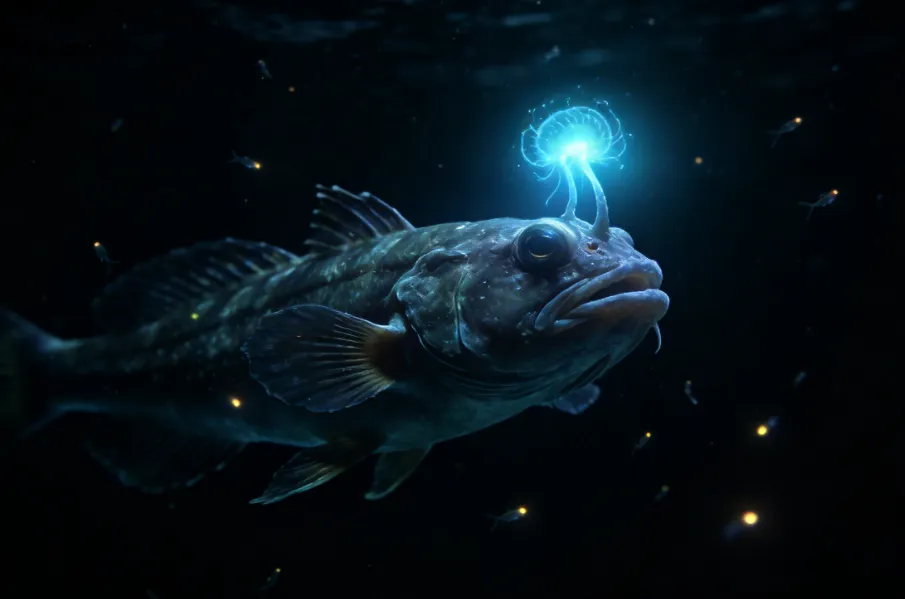
If you’ve ever caught a glimpse of an anglerfish in a nature documentary or sci-fi flick, you know it’s a creature you can’t unsee. A massive, gaping mouth lined with needle-sharp, translucent teeth, a lumpy, flattened body, and a glowing, wiggling lure perched right above its jaws—it looks like it crawled straight out of a creature feature. But every bizarre physical quirk is no accident; each detail is a finely tuned adaptation that lets this fish thrive where nearly all other life would perish. For Western readers drawn to extreme wildlife, unsolved natural mysteries, and the thrill of unearthing the unknown, the anglerfish isn’t just another deep-sea animal. It’s a story that keeps us guessing, a living testament to nature’s wild creativity, and a stark reminder that our planet still holds countless secrets waiting to be uncovered.
What Exactly Is a Deep-Sea Anglerfish?
First, let’s set the record straight: not all anglerfish live in the deep sea. There are more than 200 known species of anglerfish (order Lophiiformes), ranging from shallow, tropical bottom-dwellers to the true abyss dwellers that capture our collective curiosity. The deep-sea anglerfish—often referred to as ceratioid anglerfish—are the ones that inhabit the mesopelagic and bathypelagic zones, typically between 300 and 4,000 meters below the surface. These are the species that have evolved the most extreme adaptations, making them the stars of deep-sea exploration lore.
Unlike many fish that are sleek and built for speed, deep-sea anglerfish are slow, sedentary predators. Most are dark gray or black, perfect camouflage in the pitch-black abyss, and their bodies are soft and flabby—they don’t need strong muscles for chasing prey, because they’ve evolved a far smarter hunting strategy. Females (the larger, more recognizable gender) range from a few inches to over 3 feet long, while males are tiny, often less than an inch in length—a size difference that’s one of the most extreme in the entire animal kingdom. This stark sexual dimorphism isn’t just a random quirk; it’s a critical survival hack in a world where finding a mate is nearly as hard as tracking down a meal.
For decades, scientists were utterly baffled by anglerfish specimens pulled up by deep-sea trawls. Early researchers misidentified the tiny males clamped onto females as parasites, not mates, and even mistook the glowing forehead lure for a separate living organism. It wasn’t until the mid-20th century that marine biologists finally began to unravel the anglerfish’s true biology, and even today, new discoveries about their behavior, habitat, and unique adaptations roll in every year—all thanks to leaps in deep-sea submersibles, remotely operated vehicles (ROVs), and high-resolution underwater imaging tech.
The Anglerfish’s Greatest Weapon: The Glowing Lure That Hunts for Prey
The anglerfish’s most iconic feature—and the reason behind its name—is its esca: a bioluminescent lure that dangles from a modified dorsal fin spine (called an illicium) just above its gaping mouth. Think of it as a built-in fishing rod and live bait, engineered to do all the hard work for a predator that can’t afford to waste a single calorie in the food-scarce deep sea.
This otherworldly glow isn’t magic—it’s a perfect symbiotic partnership. The lure is home to millions of bioluminescent bacteria that produce a faint, blue-green light via a chemical reaction called bioluminescence. The anglerfish gives the bacteria a safe, nutrient-rich home to thrive, and in return, the tiny organisms’ glow acts as a beacon for unsuspecting prey. In the total darkness of the abyss, even the tiniest glimmer of light is impossible to resist for small fish, shrimp, squid, and other crustaceans that wander too close.
Here’s where the anglerfish’s evolutionary genius truly shines: it stays perfectly still, blending into the dark seabed or floating motionless in the water column, wiggling its lure to mimic a weak, injured small creature. When a curious fish swims in for a closer look, the anglerfish strikes with lightning speed, yawning its enormous mouth open to create a powerful vacuum that sucks prey inside in milliseconds. Its jaws are hyper-flexible, and its stomach can stretch to an incredible size—allowing it to swallow prey twice its own body size. This is non-negotiable in the deep sea, where less than 1% of organic matter from the surface ever reaches the seafloor; wasting a meal is simply not an option.
What makes this lure even more fascinating?Only females have it. Males lack the illicium and esca completely, as they lose the ability to hunt for food once they reach adulthood. This is just the first of many mind-bending differences between male and female anglerfish, a reproductive strategy that’s as bizarre as it is brutally effective.
Love in the Abyss: The Extreme Mating Strategy of the Anglerfish
Imagine wandering through a vast, pitch-black desert with no landmarks, no sounds, and barely any other living creatures in sight—all while racing against starvation to find a mate. That’s the daily reality for male deep-sea anglerfish. In the endless, empty expanse of the abyss, encountering a female is a near-impossible feat, which is why males have evolved intoobligate parasites: a one-of-a-kind mating strategy found only in ceratioid anglerfish.
When a male anglerfish hatches, it’s born with hyper-sensitive sensory organs, specially tuned to detect pheromones—chemical signals released by females into the water. Unlike females, adult males have no functional digestive system; they can’t feed themselves, and their sole purpose in life is to find a female before they run out of energy and die. When a male finally locks onto a female’s scent and tracks her down, he bites onto her body with his tiny, sharp teeth, and an extraordinary biological process kicks off: permanent fusion.
Over time, the male’s body physically merges with the female’s, connecting directly to her bloodstream and skin. He loses his eyes, fins, and most internal organs—only his testes remain fully functional. He becomes nothing more than a permanent sperm donor, entirely dependent on the female for all nutrients. A single female can carry six or more tiny males attached to her body at once, guaranteeing she always has access to sperm when she’s ready to spawn. This extreme adaptation solves the single biggest challenge of deep-sea life: finding a mate in a vast, dark, and desolate world.
For Western readers, this mating ritual is endlessly captivating—it’s a tale of survival, sacrifice, and evolutionary oddity that reads more like science fiction than real life. It challenges our core ideas of love, partnership, and what it means to be an independent organism, turning the anglerfish from a scary “deep-sea monster” into a deeply fascinating, relatable survivor.
Living in the Extreme: How Anglerfish Survive the Deep Sea’s Brutal Conditions
The deep sea isn’t just dark—it’s hostile in every conceivable way. At 1,000 meters below the surface, water pressure is over 100 times greater than at the ocean’s surface, strong enough to crush an unprotected human submarine. Temperatures hover just above freezing (3-4°C/37-39°F), oxygen levels are dangerously low, and food is so scarce that going weeks without a meal is the norm. Most animals would perish here in minutes, but anglerfish thrive, thanks to a suite of incredible, fine-tuned adaptations.
- Crushing Pressure Resistance: Anglerfish have no swim bladders—the gas-filled organs that help most fish control buoyancy—because these would collapse instantly under extreme pressure. Instead, their bodies are made of water-rich, gelatinous tissue that’s incompressible, letting them withstand the deepest depths with zero effort.
- Hyper-Energy Efficiency: They move almost never, conserving every last calorie. Their ultra-slow metabolism allows them to go weeks or even months without eating, a make-or-break trait in a habitat where prey is few and far between.
- Stealth Camouflage: Their dark, matte skin doesn’t reflect any light, rendering them nearly invisible to both prey and predators. Some species even have specialized light-absorbing cells that wipe out any stray bioluminescence, keeping them hidden in the inky blackness.
- Supercharged Senses: While their eyes are small (there’s no sunlight to utilize anyway), they have incredibly sensitive hearing and chemical receptors, letting them detect prey and mates from far distances in the dark, still water.
These aren’t just random cool science facts—they’re a masterclass in evolutionary ingenuity. The anglerfish didn’t just “get by” in the deep sea; it dominated this harsh landscape, carving out a unique niche in one of the most extreme ecosystems on Earth. For audiences who love tales of resilience and underdog survival, the anglerfish is the perfect mascot for the mysterious world below the waves.
Why Anglerfish Matter to Us (And Why We Need to Protect Them)
You might be asking yourself: why does a fish that lives miles below the ocean surface matter to humans? The answer lies in what anglerfish can teach us about evolution, marine ecosystems, and the overall health of our planet.
First and foremost, anglerfish are a keystone species in the deep-sea food web. As top predators in their habitat, they keep populations of smaller deep-sea creatures in check, maintaining the delicate balance of the entire ecosystem. Without them, the fragile deep-sea food chain could collapse, sending ripples upward that impact the surface oceans—which regulate our global climate and produce roughly half the oxygen we breathe.
Second, anglerfish are a scientific goldmine. Their bioluminescent symbiosis is being studied for groundbreaking medical and technological applications, from developing advanced imaging tools for minimally invasive surgery to creating sustainable, eco-friendly lighting solutions. Their unique immune system, which allows male-female fusion without tissue rejection, is also helping researchers unlock clues about autoimmune diseases and organ transplant rejection—breakthroughs that could transform human healthcare.
But even in the remote deep sea, anglerfish are under threat. Industrial deep-sea trawling, plastic pollution that drifts to the ocean floor, and rising water temperatures from climate change are destroying their habitat and disrupting the fragile food webs they rely on. Because they live in such extreme depths and reproduce at a glacial pace, anglerfish populations are extremely vulnerable to disturbance—they can’t bounce back quickly from overfishing or habitat destruction.
For Western audiences, this adds a meaningful layer of purpose to learning about anglerfish: they’re not just a fascinating creature to marvel at—they’re a symbol of the ocean’s fragility. Exploring the anglerfish’s world isn’t just about satisfying curiosity; it’s about inspiring conservation action, rallying support for deep-sea research, and reminding us that every corner of the planet, no matter how remote, deserves protection.
The Thrill of Discovery: Why We’re Still Learning About Anglerfish
Despite being one of the most famous deep-sea animals, anglerfish are still shrouded in mystery. The vast majority of what we know about them comes from dead, damaged specimens trawled from the deep; we’ve barely seen them alive and thriving in their natural habitat. It wasn’t until 2014 that scientists captured the first-ever clear footage of a live female anglerfish with a fused male, and new anglerfish species are still being discovered every few years as deep-sea exploration tech improves.
This lingering sense of mystery is exactly what makes anglerfish so irresistible to readers. In a world where we often think we’ve mapped and explored every corner of the planet, the deep sea remains Earth’s final frontier, and the anglerfish is its most enigmatic resident. Every new ROV dive, every newly studied specimen, every fresh research paper unlocks another piece of the puzzle, keeping audiences hooked and eager to learn more.
For website creators targeting Western audiences, the anglerfish is pure engagement gold. It taps into universal human fascinations: the allure of the unknown, a obsession with the bizarre and unusual, admiration for unbreakable resilience, and that childlike wonder at nature’s most awe-inspiring creations. It resonates with casual readers scrolling for a captivating read, die-hard nature enthusiasts, science buffs craving factual depth, and even sci-fi or horror fans drawn to its otherworldly vibe. This cross-niche appeal is what makes it timeless content that keeps visitors clicking, reading, and coming back for more.
Final Thoughts: The Anglerfish as a Gateway to the Deep Sea
The deep-sea anglerfish is so much more than just a weird fish with a glowing lure. It’s a living testament to the power of evolution, a tenacious survivor in the harshest environment on Earth, an unsolved mystery waiting to be fully uncovered, and a gentle reminder that our planet is brimming with wonders we’ve barely begun to understand. For Western readers, it’s a story that captivates, educates, and inspires—exactly the kind of authentic, engaging content that builds loyal website audiences.
The next time you find yourself thinking about the deep sea, don’t just picture endless darkness and empty void. Picture the anglerfish, glowing softly in the inky blackness, a small but fierce predator holding its own in a world that would destroy most living things. And hold onto this thought: there are millions more stories just like this lurking beneath the waves, completely undiscovered. The ocean’s abyss isn’t a place to fear—it’s a realm of endless beauty, curiosity, and discovery, and the anglerfish is its most unforgettable ambassador.
Leave a Reply