
The Silent Frontier
Four miles beneath the surface of the Pacific Ocean, in a realm of perpetual darkness and bone-crushing pressure, lies a field of stones that could decide the future of human civilization. These are polymetallic nodules—small, dark, potato-shaped accretions that have taken millions of years to form. They are rich in manganese, nickel, cobalt, and copper: the “four pillars” of the green energy revolution.
In 2026, the deep sea is no longer a remote scientific curiosity; it is the center of a global geopolitical and environmental firestorm. As the United States and Europe scramble to de-risk their supply chains from terrestrial monopolies, the Clarion-Clipperton Zone (CCZ)—a 4.5 million square kilometer fracture zone between Hawaii and Mexico—has become the most valuable real estate on Earth.
But this “Silent Gold Rush” presents a harrowing paradox. To save the atmosphere from carbon saturation, must we sacrifice the last undisturbed wilderness on our planet?
I. The Science of the “Potato”
To the untrained eye, a polymetallic nodule is just a rock. To a geochemist, it is a miracle of slow-motion physics. These nodules grow at a rate of roughly 1 to 10 millimeters every million years, precipitating minerals from the surrounding seawater around a tiny core, such as a fossilized shark tooth or a fragment of shell.
The concentration of metals within these stones is staggering. Terrestrial mines are suffering from “grade decline”—we are forced to dig deeper and move more earth to find the same amount of copper or nickel. In the CCZ, however, the ore is “high-grade” and sits directly on the seafloor, ready to be harvested.
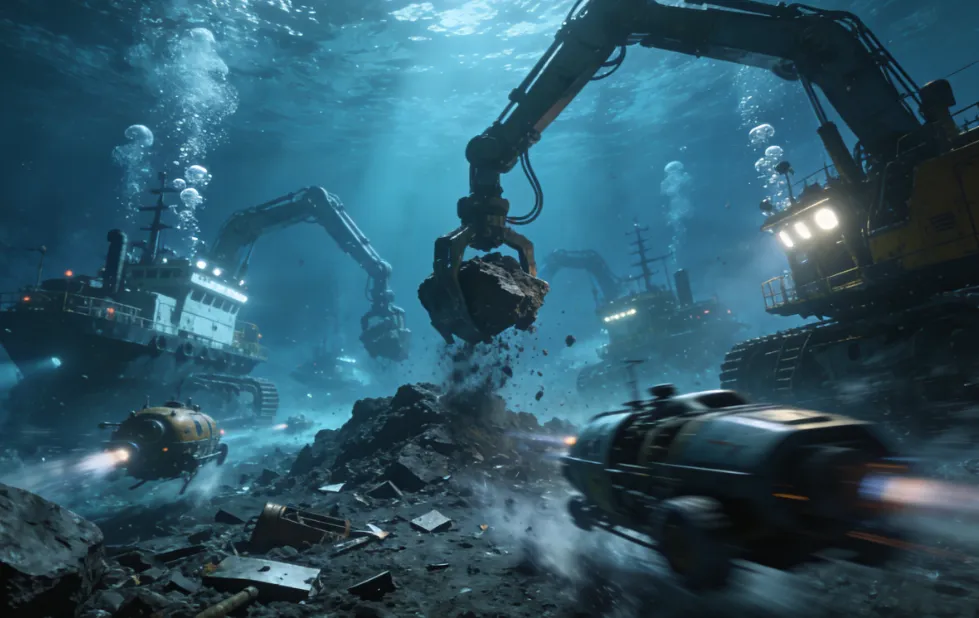
In 2026, the technology to reach them has transitioned from science fiction to industrial reality. Companies are deploying Automated Collector Vehicles (ACVs)—monstrous, house-sized robotic tractors. These machines utilize advanced AI and computer vision to navigate the abyssal mud, identifying and plucking nodules while attempting to avoid large biological structures. They are connected to a surface vessel by a four-mile-long “riser” pipe, a feat of engineering comparable to dangling a soda straw from the top of the Empire State Building to pick up pebbles on the sidewalk below.
II. The Biological Twilight
For decades, we viewed the abyssal plains as a biological desert—a vast, empty expanse of mud. We were wrong.
Recent expeditions have revealed that the CCZ is a reservoir of extraordinary biodiversity. Because food is scarce and temperatures hover just above freezing, life in the deep moves in slow motion. Here, you find the “Ghost Octopus” (Graneledone), a translucent cephalopod that broods its eggs for years. You find giant glass sponges that may be over 5,000 years old, having survived since the dawn of human recorded history.
The primary concern for marine biologists is that these species are “nodule-dependent.” Many deep-sea organisms require the hard surface of a nodule to attach themselves to; without them, the ecosystem collapses. Furthermore, the mining process creates sediment plumes. As the ACVs crawl across the seafloor, they kick up clouds of fine silt. In the still waters of the deep, this silt does not settle quickly. It can drift for hundreds of miles, “choking” filter-feeders and interfering with the bioluminescent signals that deep-sea creatures use to hunt and find mates.
III. The Geopolitical Chessboard
The governance of this frontier falls to the International Seabed Authority (ISA), a UN-mandated body based in Kingston, Jamaica. The ISA is currently paralyzed by a legal “cliff-edge.”
In 2021, the tiny island nation of Nauru triggered a legal “two-year rule,” demanding that the ISA finalize mining regulations. By 2026, the world is split into two camps:
- The Pro-Mining Coalition: Countries like Norway, China, and several Pacific Island nations argue that deep-sea mining is a sovereign right and an environmental necessity. Norway, in particular, has made headlines by opening its continental shelf to exploration, citing the need for “mineral security.”
- The Precautionary Bloc: Led by France, Germany, and Canada, more than 30 nations have called for a moratorium or “precautionary pause.” They argue that the “Blue Economy” cannot be built on the destruction of the deep.
The United States occupies a precarious middle ground. While not a signatory to the UN Convention on the Law of the Sea (UNCLOS), Washington is warily watching China’s dominance in the sector. If China secures the lion’s share of deep-sea contracts, the West could find itself trading one resource dependency for another.
IV. The Battery Revolution: Is Mining Obsolete?
The strongest argument against disturbing the abyss may not come from environmentalists, but from chemists. The “need” for deep-sea minerals is based on the assumption that we will always need cobalt and nickel for batteries.
However, 2026 has seen a massive market shift toward Lithium Iron Phosphate (LFP) and Sodium-ion batteries. These chemistries use abundant materials like iron and salt, entirely bypassing the need for cobalt and nickel. If the “cobalt-free” movement continues to gain momentum among EV giants like Tesla and BYD, the trillion-dollar business case for deep-sea mining could evaporate before the first commercial haul is ever brought to the surface.
Furthermore, the concept of Urban Mining—the hyper-efficient recycling of existing electronics—is gaining traction in Europe. Projections show that by 2040, recycled materials could satisfy up to 40% of the demand for critical minerals. Why dig a hole four miles deep when we are sitting on a mountain of discarded smartphones?
V. The Ethical Crossroads
As consumers, the deep-sea dilemma forces us to look in the mirror. We demand smartphones that never die and EVs that travel 500 miles on a single charge. We want to stop the melting of the Arctic ice and the burning of the Amazon.
But if the “Green Transition” requires us to strip-mine the cradle of life on Earth, is it truly green?
In 2026, the scientific community is calling for a “Science First” approach. We need at least another decade of research to understand the carbon-sequestration role of the deep sea. The abyss is the world’s largest carbon sink; if we disturb the seafloor, do we risk releasing gigatons of stored CO2 back into the ocean, accelerating the very climate change we are trying to stop?
A Legacy in the Dark
The decisions made at the ISA headquarters this year will resonate for a thousand years. Unlike a forest, which can be replanted, or a river, which can be cleaned, the deep sea does not “recover” on a human timescale. A track left by a mining vehicle in the abyssal mud will still be visible centuries after the company that made it has ceased to exist.
We are the first generation with the technology to exploit the deep ocean, and we are the last generation with the opportunity to protect it. As we stand at the edge of the abyss, the question is not whether we can mine the deep sea, but whether we have the wisdom not to.
Leave a Reply