
For decades, humanity has looked to the stars with a sense of wonder, spending billions to map distant planets. Yet, beneath the rolling waves of our own blue planet lies a world more alien than Mars and more pressurized than the surface of Venus. Deep-sea exploration is no longer just a scientific curiosity; it is a critical race for resources, climate data, and the secrets of life’s origins.
1. Defining the Abyss: The Zones of the Ocean
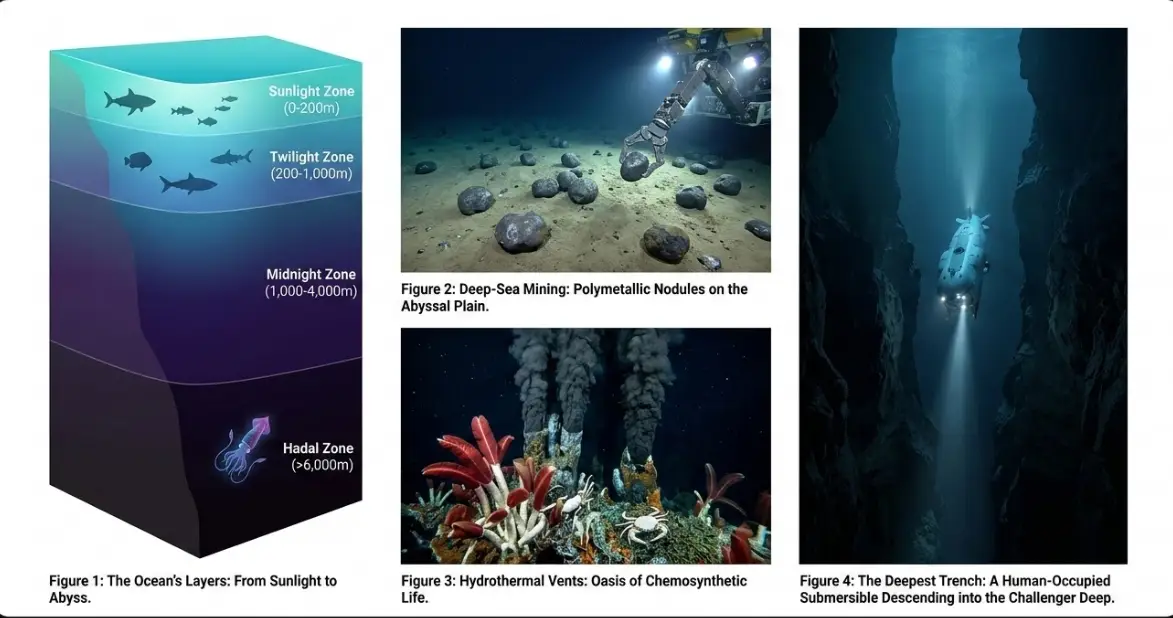
To understand deep-sea exploration, one must first grasp the sheer scale of the vertical wilderness. Marine biologists divide the ocean into distinct layers, each presenting unique challenges for technology.
- The Sunlight Zone (Epipelagic): Surface to 200 meters. This is where most familiar marine life resides.
- The Twilight Zone (Mesopelagic): 200 to 1,000 meters. Light fades, and pressure begins to mount.
- The Midnight Zone (Bathypelagic): 1,000 to 4,000 meters. Total darkness. This is the primary frontier for modern ROVs (Remotely Operated Vehicles).
- The Hadal Zone: 6,000 meters and below. Named after Hades, this includes the deepest trenches on Earth.
2. The Technological Evolution: How We Reach the Bottom
Exploring an environment where the pressure can exceed 1,000 atmospheres (equivalent to an elephant standing on your thumb) requires extraordinary engineering.
AUVs and ROVs: The Robotic Explorers
Most modern exploration is conducted by robots. Remotely Operated Vehicles (ROVs) are tethered to a surface ship, allowing pilots to see through high-definition cameras in real-time. Conversely, Autonomous Underwater Vehicles (AUVs) are untethered, pre-programmed to map the seafloor using advanced sonar technology.
The Role of Artificial Intelligence
AI is now being integrated into underwater drones to identify rare species or detect mineral deposits without human intervention. This shift is drastically reducing the cost of deep-sea missions, making high-resolution ocean mapping more accessible.
3. Deep-Sea Mining: The Billion-Dollar Conflict
One of the most controversial aspects of deep-sea exploration is the hunt for Polymetallic Nodules. These potato-sized rocks, found on the abyssal plains, are rich in:
- Cobalt
- Nickel
- Copper
- Manganese
These minerals are essential for the production of Electric Vehicle (EV) batteries and renewable energy storage. While corporations eye the trillions of dollars in untapped wealth, environmentalists warn that mining could cause irreversible damage to fragile ecosystems that have remained undisturbed for millions of years.
4. Bizarre Biology: Life in Extreme Environments
Perhaps the most captivating part of the deep sea is the life that thrives there. In the 1970s, scientists discovered Hydrothermal Vents—underwater geysers that spew superheated, mineral-rich water.
Chemosynthesis: Life Without the Sun
Unlike surface life, which relies on photosynthesis, deep-sea organisms use chemosynthesis. Bacteria convert chemicals like hydrogen sulfide into energy, supporting a food chain of giant tubeworms, ghost-white crabs, and “headless chicken” sea cucumbers.
Scientific Note: Many researchers believe that these hydrothermal vents may have been the “cradle of life” where the first prehistoric cells emerged.
Shutterstock
5. Why Deep-Sea Exploration Matters for the Future
Beyond gold and weird fish, the deep sea plays a vital role in Climate Change regulation. The ocean acts as a massive carbon sink, absorbing nearly 25% of human-generated $CO_2$. Understanding the deep-ocean currents is crucial for predicting global temperature shifts and sea-level rise.
6. Frequently Asked Questions (FAQ)
Q: How much of the ocean floor has been mapped?
A: As of 2026, only about 25-30% of the seafloor has been mapped with high-resolution sonar. We have better maps of the Moon than our own seabed.
Q: What is the deepest a human has ever gone?
A: The record is held by the Challenger Deep in the Mariana Trench, reaching approximately 10,935 meters (35,876 feet).
Q: Are there monsters in the deep sea?
A: While “monsters” are myths, the Giant Squid and the Colossal Squid are very real, reaching lengths of up to 14 meters.
Conclusion
The deep sea is the Earth’s final frontier. As technology continues to bridge the gap between the surface and the abyss, we face a dual responsibility: to harness the resources necessary for a green energy transition while protecting the most mysterious and untouched habitat on our planet.
Leave a Reply