
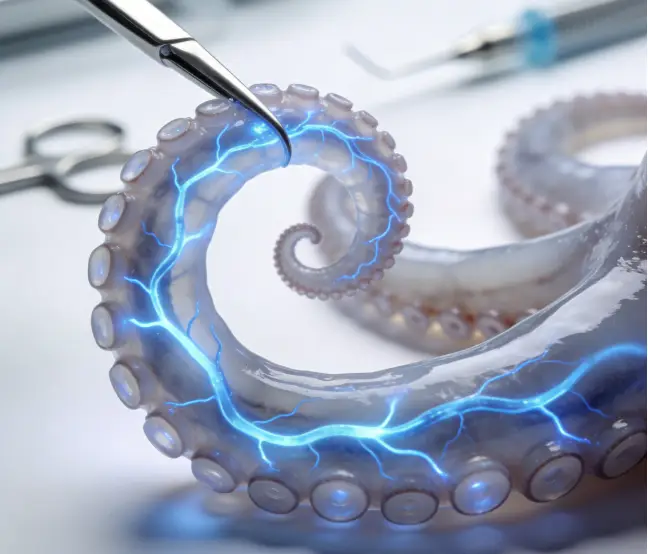
The Billion-Year R&D Department
For the last century, human engineering has been defined by “The Age of Hard Materials.” We built planes from aluminum, engines from steel, and computers from silicon. But as we move toward the mid-21st century, these rigid materials are hitting a wall. They are heavy, energy-inefficient, and often fragile.
Meanwhile, in the crushing pressures and absolute darkness of the Hadal zone (6,000+ meters deep), nature has already solved our most complex engineering problems. From the “distributed intelligence” of cephalopods to the drag-reducing microscopic architecture of shark skin, the ocean is the world’s most advanced R&D lab.
Today, a new multidisciplinary field—Marine Biomimetics—is translating these biological blueprints into a multi-billion dollar industry. Here is a deep dive into the three marine-inspired technologies currently disrupting the global market.
I. The Octopus and the “Soft Robotics” Revolution
Traditional robots, like those on Tesla’s assembly lines, are precise but “dumb” and dangerous. If a steel robotic arm hits a human, it causes injury. If it tries to grab an egg, it crushes it.
The Biological Secret: The octopus is the ultimate “soft” machine. It possesses no internal skeleton, allowing it to squeeze through any opening larger than its beak. More importantly, it utilizes Embodied Intelligence. Two-thirds of an octopus’s neurons are located in its arms. Each arm can taste, touch, and move independently without waiting for instructions from the brain.
The Tech Translation: Fluidic Logic and Elastomers Engineers at the Wyss Institute at Harvard have developed the “Octobot.” Instead of wires and circuit boards, it uses a microfluidic logic circuit. It “thinks” through the flow of liquid and gas within its soft body.
- Surgical Precision: In London, scientists are testing a “snake-like” robotic endoscope inspired by octopus tentacles. It can stiffen or soften segments of its body on demand, allowing surgeons to navigate the complex curves of the human digestive tract without damaging delicate tissue.
- Commercial Impact: The surgical robotics market is expected to grow at a CAGR of 15%, reaching nearly $40 billion by 2030. Companies like Intuitive Surgical are heavily scouting these bio-inspired patents.
II. Shark Skin and the Billion-Dollar “Drag” Problem
In global logistics, “drag” (fluid resistance) is a silent profit killer. Whether it’s a Maersk cargo ship or a Boeing 787, moving through fluid (water or air) consumes massive amounts of energy.
The Biological Secret: If you rub a shark’s skin from head to tail, it feels smooth. Rub it the other way, and it feels like sandpaper. This is due to dermal denticles—microscopic, tooth-like scales. These structures create tiny vortices that actually pull the fluid closer to the body, preventing the “turbulence” that slows an object down.
The Tech Translation: Riblet Film Technology Lufthansa Technik and BASF recently developed “AeroShark,” a surface film that mimics this texture.
- The Data: By applying this film to the belly of a Boeing 777, Lufthansa reduced fuel consumption by 1.1%. While that sounds small, for a global airline, it translates to thousands of tons of fuel and millions of dollars saved annually per aircraft.
- The Maritime Shift: In the shipping industry, bio-inspired coatings are replacing toxic anti-fouling paints. This not only makes ships faster but prevents invasive species from hitchhiking across oceans, solving a major ecological crisis.
III. The “Invisibility Cloak”: Cephalopod Optics
The military-industrial complex has long dreamed of “adaptive camouflage”—armor that changes color to match its surroundings in real-time.
The Biological Secret: The Cuttlefish (the “chameleon of the sea”) uses a three-layer optical system.
- Chromatophores: Tiny balloons of pigment controlled by muscles.
- Iridophores: Structural colors that reflect light like a prism.
- Leucophores: White reflectors that match the ambient light.
The Tech Translation: Hyper-Spectral E-Skin Researchers at the University of California, Irvine, have successfully created “squid-inspired” infrared-reflecting thin films. These materials can hide a soldier’s heat signature from thermal cameras.
- Consumer Application: This isn’t just for war. “Smart fabrics” are being developed for athletes that can change their thermal properties. In the summer, the fabric “opens” its microscopic pores to release heat; in the winter, it closes them to trap it, mimicking the way marine mammals regulate temperature.
- Energy Efficient Buildings: Architects are proposing “Cephalopod Facades”—glass windows containing fluidic channels of pigment. These windows can darken automatically to block UV rays, potentially reducing air conditioning costs in skyscrapers by 30-40%.
IV. Ethical Considerations: Extraction vs. Inspiration
As we “mine” the ocean for its genetic and structural secrets, a new debate is rising in the West: Digital Bioprospecting. Who owns the “patent” to a shark’s skin? Should a tech giant like Google or Tesla pay a “royalty” into an ocean conservation fund when they mimic a deep-sea creature’s design?欧美受众(尤其是 Z 世代)非常看重企业的社会责任。科技公司如果能在研发仿生技术的同时,注资保护该物种的栖息地,将会获得极高的品牌声誉和公众支持。
The Bio-Digital Convergence
We are entering an era where the line between “grown” and “built” is blurring. The next generation of engineers won’t just be proficient in Python or C++; they will be students of Marine Biology.
The “blue economy” is no longer just about fishing and oil. It is about information. In the deep, silent corners of our oceans, the solutions to our energy, medical, and manufacturing crises have already been written. We just need to learn how to read them.
Leave a Reply