
The First Time a Starfish Changed the Way I See the Ocean
I still remember the first time I held a living starfish in my hands.
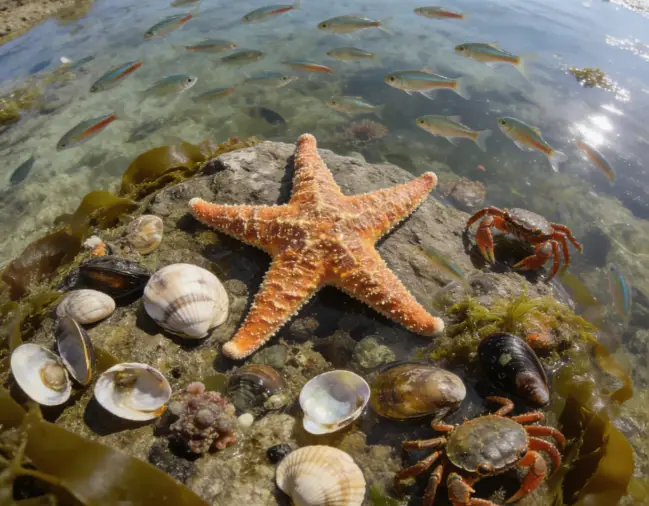
I was a teenager, standing knee-deep in the cold tidal pools along the Pacific coast. The air smelled of salt and kelp, waves crashed somewhere beyond the rocks, and there it was—an orange sea star clinging stubbornly to the stone beneath the water.
At first glance, it looked simple. Almost primitive. Just a star-shaped creature doing nothing in particular.
I couldn’t have been more wrong.
That moment marked the beginning of a lifelong fascination—one that eventually led me to study marine biology and spend countless hours diving, researching, and writing about one of the ocean’s most misunderstood animals: the starfish, or as scientists prefer to call them, sea stars ⭐.
In this article, I want to take you on a journey beneath the waves—to explore the biology, behavior, and surprising intelligence of sea stars, and to explain why they matter far more than most people realize.
🌍 What Exactly Is a Starfish?
Despite the name, starfish are not fish at all.
They belong to a group of marine animals called echinoderms, which also includes sea urchins, sand dollars, and sea cucumbers. The word echinoderm comes from Greek and means “spiny skin”—a fitting description if you’ve ever touched one.
Key Characteristics of Sea Stars
- No backbone (they are invertebrates)
- Radial symmetry (usually five arms, but sometimes more!)
- A unique water vascular system
- Tube feet instead of fins or legs
- Remarkable regenerative abilities 🧬
From a Western scientific perspective, sea stars are evolutionary marvels—organisms that challenge our assumptions about how bodies, movement, and even survival work.
⭐ Why Do Most Starfish Have Five Arms?
Five arms may be the most iconic feature of sea stars, but nature is rarely rigid.
Some species have:
- Six arms
- Ten arms
- Up to 40 arms (yes, really!)
The five-arm design likely evolved because it offers a balance between stability, mobility, and regeneration. With radial symmetry, a sea star doesn’t need a “front” or “back.” It can move, hunt, and react to threats from any direction—an enormous advantage in the unpredictable ocean environment.
As someone trained in Western evolutionary biology, I find this design both elegant and brutally efficient.
🌊 How Do Starfish Move Without Muscles?
This is where things get fascinating.
Sea stars move using a hydraulic system called the water vascular system—a network of fluid-filled canals connected to hundreds of tiny tube feet.
How It Works:
- Seawater enters through a porous plate called the madreporite
- Water pressure inflates tube feet
- Each tube foot extends, grips the surface, and pulls
- The starfish glides forward—slowly, but steadily
No brain.
No blood.
No muscles like ours.
And yet, it works beautifully.
From a Western engineering perspective, it’s like a living hydraulic robot 🤖—designed by millions of years of natural selection.
🧠 Do Starfish Have a Brain?
Short answer: No.
Long answer: They don’t need one.
Sea stars have:
- A nerve ring around their mouth
- Radial nerves extending into each arm
- Sensory cells that detect light, chemicals, and touch
Each arm can operate semi-independently. If one arm finds food, it can coordinate with the others—without central command.
This decentralized intelligence challenges the Western idea that cognition must be centralized. In many ways, sea stars are living proof that complex behavior doesn’t require a brain like ours.
🍽️ The Most Disturbing (and Amazing) Way to Eat
Let’s talk about feeding—because this is the part that always shocks my readers.
Many sea stars eat by pushing their stomachs out of their bodies.
Yes. You read that correctly 😮.
How Starfish Eat:
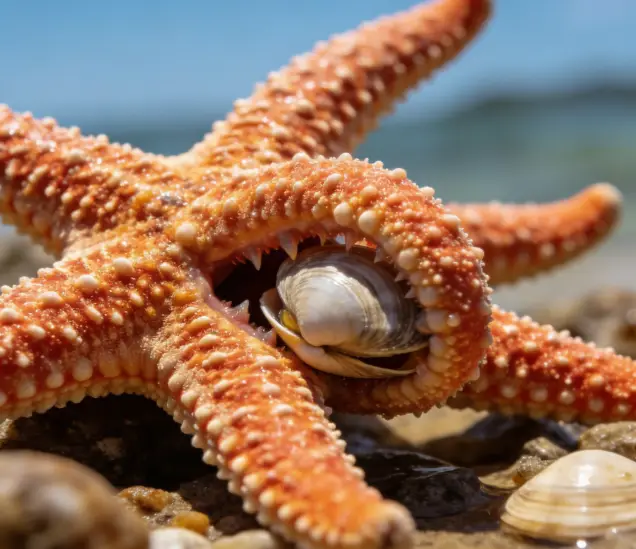
- They pry open prey (often clams or mussels)
- They evert their stomach through their mouth
- Digest the prey outside their body
- Pull the stomach back in—meal complete
As a Western scientist, I can tell you this method is both horrifying and ingenious. It allows sea stars to eat prey larger than their mouths and extract nutrients with minimal effort.
Nature doesn’t care about elegance. It cares about efficiency.
🧬 Regeneration: The Superpower That Made Starfish Famous
If you’ve ever heard that a starfish can regrow its arms, that’s true.
But the reality is even more impressive.
Some species can:
- Regrow an arm in months
- Regenerate internal organs
- Form an entire new individual from a single arm 😲
This ability has made sea stars a major focus of Western medical research, especially in:
- Regenerative medicine
- Stem cell studies
- Tissue repair mechanisms
Studying sea stars might one day help humans heal spinal injuries or regrow damaged tissues. That’s not science fiction—it’s active research.
🌍 The Ecological Importance of Starfish
One species in particular changed how Western ecologists view the ocean:
The Keystone Predator
The ochre sea star controls mussel populations along the Pacific coast. Without it, mussels would dominate, reducing biodiversity dramatically.
When sea star populations collapse—as they did during the Sea Star Wasting Disease outbreak—entire ecosystems unravel.
This is a classic Western ecological lesson:
Remove one species, and the whole system can fall apart.
⚠️ Threats Facing Starfish Today
Despite their resilience, sea stars face serious threats:
- Climate change 🌡️
- Ocean acidification
- Pollution and microplastics
- Disease outbreaks
- Habitat destruction
As someone raised in a culture that values conservation and scientific responsibility, I believe protecting sea stars means protecting the health of our oceans as a whole.
🌱 How You Can Help (Yes, You!)
Even if you live far from the coast, you can make a difference:
- Reduce plastic use
- Support marine conservation organizations
- Choose sustainable seafood
- Share knowledge about ocean life
- Never remove sea stars from the wild 🐚
Small actions add up—especially when millions of people take them.
⭐ Why Starfish Matter More Than You Think
To many people, starfish are just pretty souvenirs or beach decorations.
To me—and to many Western scientists—they are:
- Evolutionary masterpieces
- Ecological guardians
- Medical inspirations
- Symbols of ocean resilience 🌊
The next time you see a starfish, I hope you’ll see more than a simple shape.
I hope you’ll see a survivor, a teacher, and a reminder that the ocean still holds more wisdom than we can imagine.
Leave a Reply