
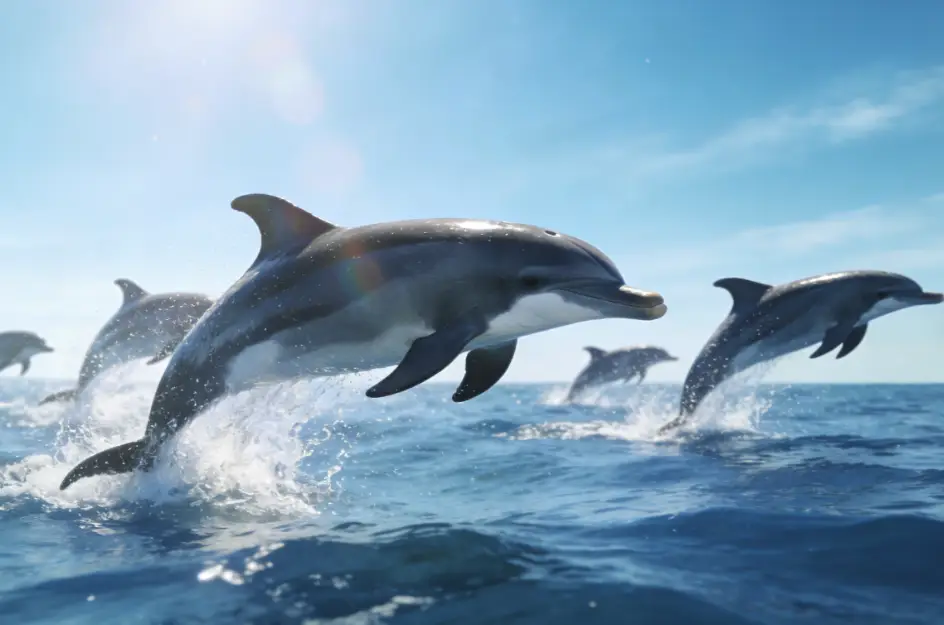
Why I Never Get Tired of Talking About Dolphins 🌊
I still remember the first time I saw a dolphin in the wild. I was standing on the deck of a small research vessel off the coast of California, coffee in hand, when a pod suddenly appeared beside us—sleek gray bodies slicing through the water with effortless grace. That moment changed the way I looked at the ocean forever.
As someone raised in a Western coastal culture, dolphins have always been part of our collective imagination. They appear in children’s books, marine parks, documentaries, and even ancient myths. But beyond their friendly reputation lies a story that is far more fascinating—and far more important—than most people realize.
This article is my attempt to share what science has taught us about dolphins: who they really are, how they think, how they live, and why their future is so closely tied to ours.
🧬 What Exactly Is a Dolphin?
Let’s start with the basics.
Despite living in the ocean, dolphins are not fish. They are marine mammals, which means:
- They breathe air through lungs
- They are warm-blooded
- They give birth to live young
- Mothers nurse their calves with milk
Scientifically speaking, dolphins belong to the family Delphinidae, which includes over 40 different species, ranging from the familiar bottlenose dolphin to lesser-known species like the Irrawaddy dolphin.
🧠 Fun fact: Dolphins are more closely related to cows and hippos than to sharks or tuna.
🐬 Anatomy Built for Intelligence and Speed
One of the reasons dolphins captivate us is their perfectly balanced design.
Key Physical Features
- Streamlined bodies for efficient swimming
- Powerful tails (flukes) that move up and down, unlike fish
- Dorsal fins for stability
- Highly flexible necks (unlike many whales)
But the real marvel lies inside their heads.
Dolphin Brains 🧠
Dolphins have:
- A large brain-to-body ratio
- Highly developed neocortex regions
- Complex neural folding, similar to humans
Many neuroscientists believe dolphins rank second only to humans in terms of cognitive complexity.
🗣️ Communication: A Language Beneath the Waves
Dolphins don’t just make random noises. They communicate using an advanced system of:
- Clicks
- Whistles
- Burst-pulse sounds
Signature Whistles 🎵
Each dolphin develops a unique signature whistle, essentially a name. Other dolphins can mimic that whistle to “call” a specific individual.
Imagine living in a society where everyone knows your name—and can call it underwater.
This level of vocal identity is extremely rare in the animal kingdom.
🔍 Echolocation: Seeing With Sound
One of the most astonishing dolphin abilities is echolocation.
Dolphins emit high-frequency clicks that bounce off objects and return as echoes. Their brains translate these echoes into detailed mental images.
With echolocation, dolphins can:
- Detect prey buried under sand
- Distinguish between materials (metal vs. plastic)
- Estimate size, shape, and distance
Some studies even suggest dolphins can sense a pregnant human fetus through echolocation—an idea that feels almost like science fiction.
👨👩👧 Dolphin Society: Complex, Emotional, and Cooperative
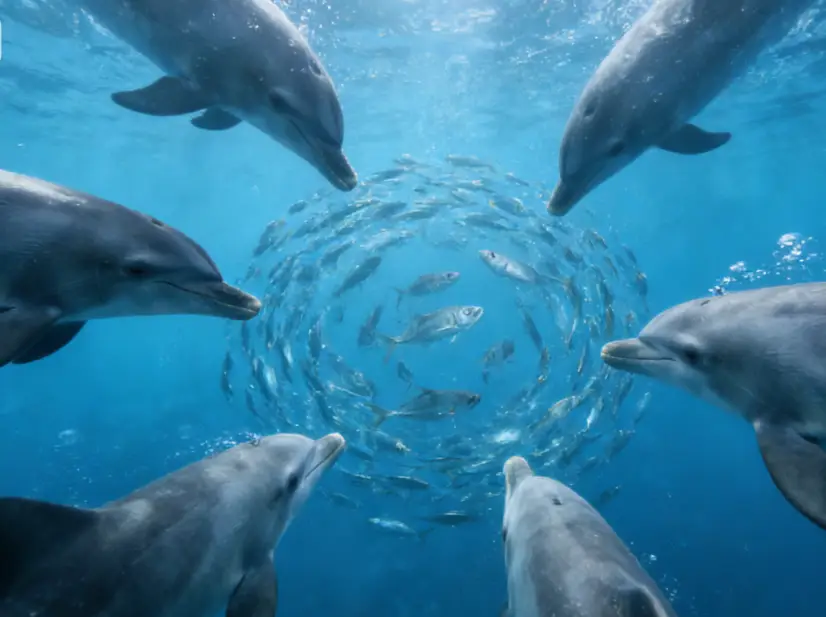
Dolphins live in highly social groups, often called pods. These groups can range from a few individuals to hundreds, depending on species and environment.
Social Behaviors Include:
- Cooperative hunting
- Babysitting each other’s calves
- Teaching survival skills
- Mourning dead pod members 😔
Yes—mourning. Dolphins have been observed staying with deceased companions for hours or even days.
🧠 Culture and Learning in Dolphins
One of the most exciting discoveries in modern marine biology is that dolphins have culture.
Culture, in scientific terms, means behaviors that are:
- Learned socially
- Passed down through generations
- Not genetically hardwired
Famous Example: Sponge Tool Use 🧽
In Shark Bay, Australia, certain dolphins place sea sponges on their snouts to protect themselves while foraging on the seafloor. This behavior is taught from mother to calf, not instinctively inherited.
That’s culture. Plain and simple.
🐟 What Do Dolphins Eat?
Dolphins are skilled predators, but they are also strategic thinkers.
Their diet typically includes:
- Fish
- Squid
- Crustaceans
Some species use team-based hunting techniques, such as:
- Herding fish into tight balls
- Creating mud rings to trap prey
- Taking turns feeding to maximize efficiency
Watching dolphins hunt feels less like observing animals—and more like watching a coordinated sports team.
🧍♂️ Dolphins and Humans: A Long, Complicated Relationship
Humans have admired dolphins for thousands of years. Ancient Greek sailors believed dolphins were messengers of the gods. Modern cultures often see them as symbols of intelligence, freedom, and kindness.
But admiration hasn’t always meant protection.
The Dark Side 🌍
Human activities threaten dolphins through:
- Overfishing
- Plastic pollution
- Noise pollution from ships and sonar
- Climate change
🛑 Noise pollution is especially dangerous. Dolphins rely on sound the way we rely on sight.
♻️ Conservation: Why Dolphin Protection Matters
Protecting dolphins isn’t just about saving a single species—it’s about protecting ocean ecosystems as a whole.
Healthy dolphin populations indicate:
- Balanced marine food chains
- Clean, productive oceans
What Can We Do?
- Reduce plastic use
- Support sustainable seafood 🐟
- Choose responsible eco-tourism
- Advocate for marine protected areas
Even small lifestyle changes can ripple outward—much like sound waves in the sea.
🧭 What Dolphins Teach Us About Ourselves
When I think about dolphins, I don’t just think about biology or science. I think about empathy, intelligence, and connection.
Dolphins remind us that:
- We are not the only intelligent beings on this planet
- Complex societies can exist without cities or technology
- The ocean is not empty—it’s alive with minds
If we listen carefully, the ocean is telling us a story. Dolphins are one of its clearest voices.
Let’s make sure they’re heard—for generations to come. 💙🐬
Leave a Reply